Can a German Owner Bring Back The Daily Telegraph’s Proud Traditions?
The Daily Telegraph needs to shed its practice of telling lies about Europe, if it is to fulfill the vision of becoming Europe’s major center-right newspaper.
March 10, 2026
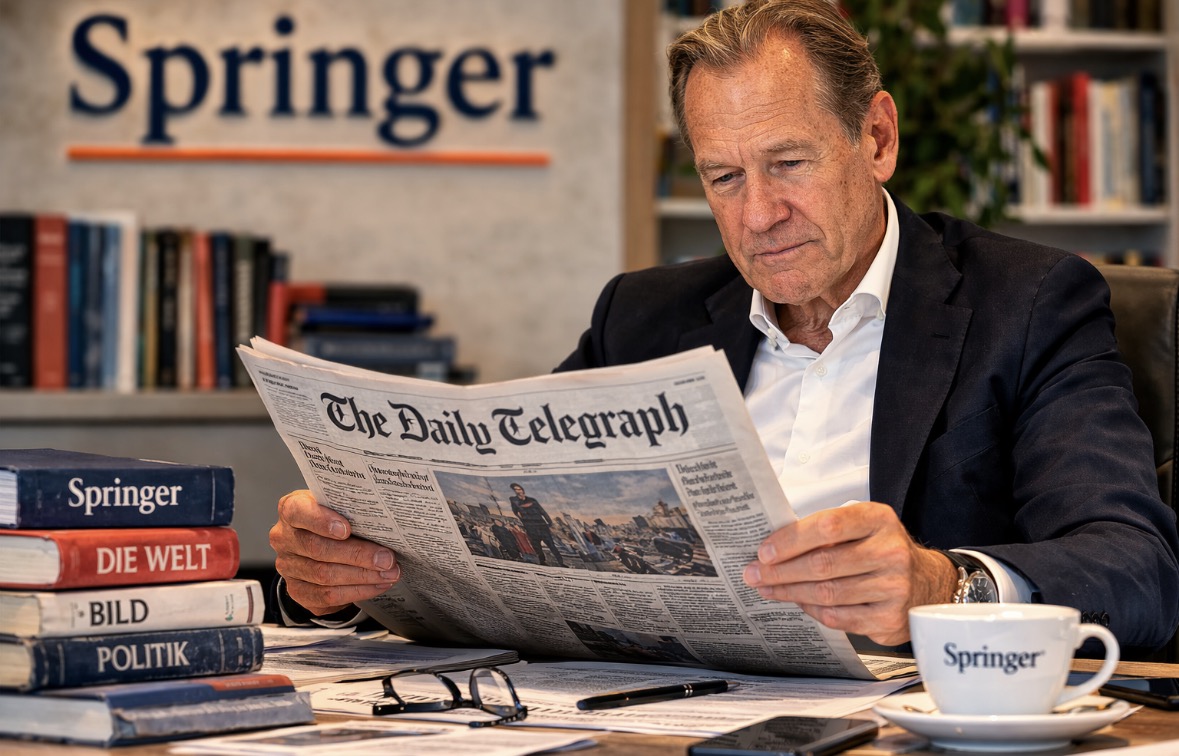

The takeover of the Daily Telegraph by the German media giant Axel Springer is the most important foreign engagement altering the ownership structure of the British press since Rupert Murdoch bought the Sun (and in due course the Sunday Times), turning both papers into cheerleaders for a Thatcherite world view.
The Daily Telegraph’s acquisition was driven forward by Mathias Döpfner, the CEO and majority owner of Springer SE. Fluent in English, Döpfner was a close friend of the late George Weidenfeld, the Austrian emigré publisher who promoted cooperation and contacts between London, Paris and Berlin.
Strong editorial principles
Springer publishes both a Sun-type tabloid, Bild, and a national daily, Die Welt. It has also bought some media entities in the United States.
The publisher has a list of principles – support for the transatlantic alliance, for the state of Israel, for a united Europe and for the social market economy (in which trade unions are seen as partners, not enemies) as well as opposition to political extremism.
At the same time, Springer has vowed no editorial interference in running The Daily Telegraph Media Group. It also said it wants to focus its DT-related efforts on turning it into Europe’s major center-right media voice.
Something has got to give
There is a clear majority in all polls showing the British people now think their 2016 populist plebiscite vote was an error. But no one in government or in the Tory-Reform political opposition dare admit this truth.
So, the obvious question is: Will the new owners of the Daily Telegraph allow it to continue as it is, specifically running continuous comment and news stories that represent open propaganda for Brexit isolationism?
Or will the paper start reporting accurate news about the damage the Brexit experiment had done to Britain and the need for Britain to once again be a leading nation in Europe in line with the decades-long principles of its new owners and publishers?
After all, since Brexit, Britain has slipped to 15th rank among European nations in terms of GDP per capita. Despite that deplorable fact, the Labour government walks in fear of pointing out how Brexit is impoverishing Britain and diminishing its influence in European and global affairs.
Britain’s brand of media-driven political extremism
Meanwhile, Daily Telegraph editors, for their part, are unhappy if there is not a story every day sneering at Europe or mocking the very timid proposals by Sir Keir Starmer to improve relations, especially trade and economic links.
They are completely unperturbed by the fact that a clear majority in all polls shows the British people now think their 2016 populist plebiscite vote was an error. But no one in government or in the Tory-Reform political opposition dare admit this truth.
There is a deplorable tradition in modern British media being a key force of political extremism. It has been driven forward this century by the Daily Telegraph, the Murdoch papers, the Daily Mail and the Europhobe Tories who all promoted Britain leaving the EU.
The BoJo factor
It is worth recalling that, already under the editorship of Sir Max Hastings in the 1990s, The Daily Telegraph handed editorial comment on Europe over to Boris Johnson, a fluent writer but one, to put it charitably, who was indifferent to the truth.
To advance his own notoriety and political career, he portrayed the European Union as a monstrous federal super-state whose prime purpose was to crush Britain.
After having become the country’s Prime Minister, Johnson told the Sunday Telegraph in the run-up to the Brexit plebiscite that, while the EU was using “different methods” than the Nazis, they shared a common goal of uniting Europe under a single, centralized authority.
Recalling a proud tradition
Even so, The Daily Telegraph is not just any old UK national broadsheet. For more than a century, it was the daily bible of the Conservative voting half which often accounted for more than half of the adult British population.
Under different owners and editors, the paper had a rough and ready rule of professional, well-researched news reporting that met the traditional obligations of quality journalism such as exemplified by the New York Times, Le Monde or Neue Zürcher Zeitung.
Meaning it was based on factual accuracy, giving both or more sides in a story and avoiding the lurid sensationalism, one-sidedness and outright contempt for truth of tabloids like the Daily Mail or the Sun.
Indeed, when I worked as a journalist in the 1970s for the BBC Radio 4 news bulletins or the BBC World Service, the Daily Telegraph was the paper that most BBC journalists turned to first – not for its opinions – but because its news reporting could be trusted.
The men who abandoned the proud tradition
However, once the Citizen Kane figure of the Canadian newspaper proprietor, Conrad Black, bought the Daily Telegraph in 1985, his strongly held rightwing views in support of Margaret Thatcher and Ronald Reagan started to permeate The Telegraph.
Subsequently, the Barclay brothers, living in tax exile in the Channel Islands, bought the paper in 2004. They had made their fortune in financial speculation.
Their big concern was to object to the timid efforts by the European Union to bring transparency and some sense of responsibility to the post-national capitalism that had been unleashed in the 1980s.
The Telegraph’s new owners at the time shared the new rightwing politics of the United States as well as the profound dislike of the European Union as a supra-national regulatory body embraced by the emerging rulers of post-Communist Russia.
Conclusion: Back to the proud tradition?
One can only hope that Mathias Döpfner will somehow manage to get The Daily Telegraph to rediscover its solid journalism, non-propagandist roots.
He clearly can’t stick by both of his “guns” – a pro-European editorial stance and editorial non-interference. Something will have to give.
Takeaways
Springer has vowed no editorial interference in running The Daily Telegraph Media Group. It also said it wants to focus its DT-related efforts on turning it into Europe’s major center-right media voice.
The publisher has a list of principles – support for the transatlantic alliance, for the state of Israel, for a united Europe and for the social market economy.
Will the new owners of the Daily Telegraph allow it to continue as it is, specifically running continuous comment and news stories that represent open propaganda for Brexit isolationism?
Or will the paper start reporting accurate news about the damage the Brexit experiment had done to Britain and the need for Britain to once again be a leading nation in Europe in line with the decades-long principles of its new owners and publishers?
Until some decades ago, The Daily Telegraph the paper had a well-earned reputation for professional, well-researched news reporting that met the traditional standards of quality Journalist as exemplified by the New York Times, Le Monde or Neue Zürcher Zeitung.