Crimea Under Putin: Another Late-Soviet Provincial Outpost
Vladimir Putin, now over a quarter century in power, is the creator of the biggest tragedy in 21st century European history so far.
June 11, 2026
For a president who has made such a big deal talking about geopolitical catastrophes manifesting themselves on Russian soil (which for him was the 1991 collapse of the late unlamented Soviet Union), hardly anyone would have expected that Vladimir Putin would add greatly to that record of catastrophes befalling Russia.
And yet, the indisputable evidence is now in.
Back to improvisation as an economic system
Crimea, Putin told the world back in 2014, had finally come home. Now, though, a dozen years later, the problem is that his newly forcibly acquired “home” increasingly looks like a late-Soviet provincial outpost.
There are not only strained supply lines, but also manifest shortages and rationing, including of oil, which usually flows amply in Russia. Crimea’s new reality in year five of Putin’s war on Ukraine isn’t just about the return of the black market, but the quiet reintroduction of improvisation as an economic system.
Putin’s crown jewel, which was meant to symbolize Russia’s resurgence as the great imperial power redrawing at will post-World War II European borders, is now flirting with a distinctly familiar problem: not enough of the basics, and too many excuses from the hapless authorities.
The message Putin still has to learn
Ukrainian strikes on infrastructure have exposed what should have been obvious from the start—that annexing a territory is easier than sustaining it, especially when your logistics depend on a handful of vulnerable routes and a great deal of wishful thinking.
Crimea’s geography always rebelled against Russia’s control. Remember that the inability to supply water to the bone-dry peninsula from the Russian Federation was the reason why in 1954 Nikita Khrushchev “gifted” the Crimea peninsula to the Ukrainian Soviet Socialist Republic in the first place — in exchange for a bunch of Ukrainian mainland territories which went to Russia.
Showered with subsidies – and yet
Since 2014, Putin provided Crimea with more subsidies than any other Russian region – even more than Chechnya. Yet, now reports of fuel and food rationing give the lie to the Kremlin’s messaging about prosperity and integration. The cognitive dissonance would be amusing if it were not so predictable.
In the Soviet Union, shortages were a feature, not a bug—evidence not of failure, but of a system permanently at war with reality. Crimea reacquaints the Russian people with that tradition.
The irony is hard to miss
The Crimea “reacquisition” project, framed by Putin as a correction of presumable historical injustices, is beginning to reproduce the very economic conditions that defined the Soviet system Putin claims to have transcended.
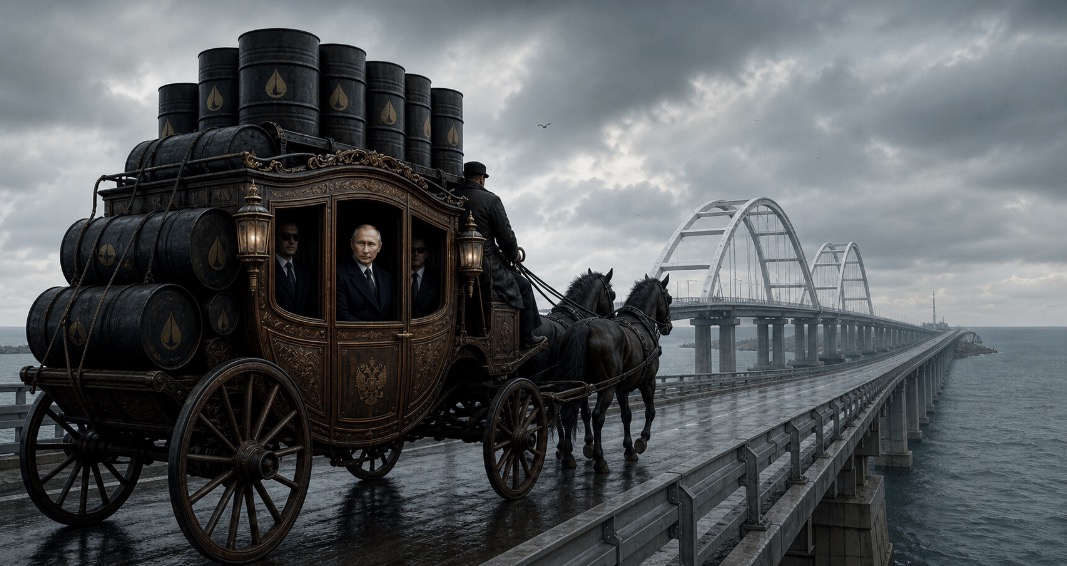
When officials and residents half-jokingly float the idea of reverting to horse-drawn transport, it does not read as gallows humor so much as institutional memory kicking in.
The broader pattern is unmistakable
Naturally, none of this alters the official narrative. It casts today’s Crimea as a success story. Any inconvenience is temporary, externally imposed and, bizarrely, cast as proof of resilience. Marxist-era dialectics are at work when store shelves that are much emptier and fuel scarcer, are seen as a sign of strength. At best, it is a desperate sign of narrative discipline.
The Soviet economy excelled at converting political ambition into logistical fragility, and logistical fragility into everyday scarcity. Crimea now offers a smaller, more contemporary demonstration of the same principle.
Ukraine won’t stop at paralyzing Crimea
What should be even more alarming for ordinary Russians as well as their rulers in the Kremlin is that the Ukrainians’ “medicine” for Crimea may be about to spread.
Ukrainians are systematically striking Russian oil pipelines and refineries over the European part of the country all the way up to the Urals. Gasoline shortages are starting to hit other parts, including the hyper-coddled regions as Moscow and St. Petersburg.
Conclusion
If the war continues – and Putin seems to have no intention of putting an end to it, it is only a matter of time until Soviet-style shortages will once again become a daily reality in Russia.
History may not repeat itself exactly, but in Putin’s and modern Russia’s case, it appears to once again come down to exhausted or torn supply chains.