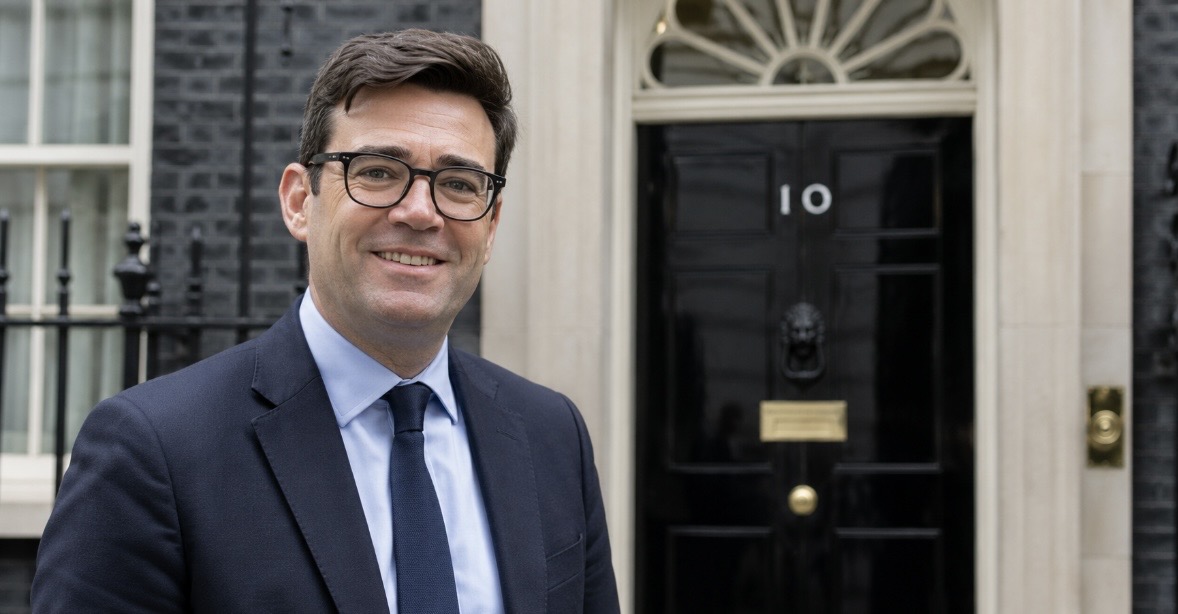
Who is Andy Burnham?
For Andy Burnham, politics is about helping those without money to find their way to an income, to found a family and to live in their own home.
July 20, 2026

Note to journalists: You may quote from this text, provided you mention the name of the author and reference it as a new Strategic Assessment Memo (SAM) published by the Global Ideas Center in Berlin on The Globalist.

To anyone who follows European politics, Britain’s new prime minister is an instantly recognizable political creature. But he is unusual for a British, especially a Labour politician.
He has learned to speak passable Spanish and Frankie, his university sweetheart turned wife, is Dutch and speaks fluent French. This stands in stark contrast to Britain’s political and media elites who are almost universally monolingual.
Burnham, the Catholic
Also unusual for a top UK politician, Burnham comes from a Catholic family and pays tribute to the Catholic Church’s social teachings. When he gets to meet Pope Leo XIV, he will be able to discuss the famous encyclical, published by Pope Leo XIII in 1891.
Called “Rerum Novarum” (New Things), the earlier Leo’s text ripped into 19th century capitalism and its appalling treatment of the working class. This clearly has a strong personal appeal for the man from Manchester.
The Catholic Church decided to take on the Communists’ drive to organize workers by making clear to employers that fair treatment and pay for workers was now a part of Catholic church doctrine.
Burnham’s social drive
For Andy Burnham, politics is about helping those without money to find their way to an income, to found a family and to live in their own home.
In the age of AI and in view of a U.S. President who earned as private income $2.6 billion dollars last year, the idea that politics might be about fair pay for work, bringing up a family in a home of their own might seem quaint and romantic.
But ask most workers in Britain, Europe or the United States and the Burnham agenda makes sense.
Cut from a different cloth
Burnham is different from most modern Labour politicians in Britain in that he did not go to Oxford to spend three years studying “PPE”.
The Politics-Philosophy-Economics university training course is what, since the era of Harold Wilson, Britain’s dominant Labour premier in the post-war WWII years, most Labour top politicians qualified in.
Instead, Burnham went to Cambridge, where he spent three years studying English literature. That may seem like an unusual choice. However, since Shakespeare’s time, England has been mightily shaped by its words, its literature and its poetry.
Let us also not forget that Winston Churchill never studied at university. Instead, as a young army officer in the late 19th century, he patrolled the outer edges of the British Empire in South Africa, India and Afghanistan, spending much of his time reading the works of English literature and learning by heart the great English poems.
A way with words
Unsurprisingly given his university studies, Burnham has a way with words that does not fit into the usual left-right taxonomy.
On his road to the Prime Minister’s office, he served a long apprenticeship as a Labour politician. He was elected as an MP aged just 30 and then holding cabinet rank offices between 2007 and 2010.
He served as No. 2 in the UK Treasury (the Finance Ministry), then was made Health Secretary where he insisted on the need for a national plan for old age care.
A classic social democratic politician
In all this, Burnham established himself as a classic social democratic politician, similar to the ones to be found in Northern Europe like Helmut Schmidt who was Mayor of Hamburg, the Manchester of Germany, before eventually moving on to national leadership as German Chancellor.
Schmidt impressed with his handling of crises that hit Hamburg and in building a partnership economic model with the business and financial sector leaders of Hamburg.
This is not dissimilar to Burnham’s ten-year period as Mayor of Manchester. During that time, he focused on turning around the Manchester economy to launch new businesses, build new homes and give the City the best public transport network in Britain.
Another example that comes to mind is Wim Kok, the Dutch prime minister between 1994 and 2002. Kok had previously headed the Dutch trade unions and was keen to offer a partnership hand to business.
Burnham’s Brexit strategy
Burnham arrives in his prime ministerial office around the 10th anniversary of the Brexit vote that was won by Conservative Party and the Europhobic far right headed by Nigel Farage.
These two political forces had promised in 2016 that stopping trade and partnership links with Europe would lead to a new British economic renaissance and the return of the UK as a global power.
None of that materialized. Quite the opposite. Little wonder that every opinion poll now shows up to 60 per cent or more of the public consider Brexit to have been a major wrong turn for Britain.
Even so, this does not give Burnham some kind of political permission slip of some kind of instant rejoin.
Both Britain and the EU have changed noticeably since 2016.
One just can’t make Brexit work
The Conservative governments of the Brexit era have opened the doors to up to four million immigrants from Asia and Africa, nicknamed the “Boriswave”, after Boris Johnson who stopped European workers contributing to the UK economy.
Soon after, he found that he had to respond to appeals from British businesses who relied on cheap labor imported from overseas.
The now departed British prime minister Sir Keir Starmer claimed in 2022 he “would make Brexit work”. Alas, under his version of Brexit, nearly every sector of the British economy suffered from the loss of EU market access and millions of Brits were denied from living, working, studying or retiring in Europe.
The devolution detour
Instead of seeking to end Brexit, there is considerable speculation that Burnham will busy himself with devolution.
Shifting political and spending power to the regions certainly makes sense in a country that, unbeknownst to most, is actually even more centralized in many ways than France.
To be sure, pushing devolution may yield Andy Burnham a quick public relations win, insofar as it conveys a message to voters that he wants to bring governance closer to them.
The question is what this move will actually do. Reorganizing civil servants in times of economic crisis and a broad wave of political frustration is likely not a winning issue, given that the odds are that the implementation of national strategies and related national legislation is bound to be slow.
Devolution heralds the idea to bring more focused economic investment, but the sad reality is that no amount of devolution or elected mayoralties can fix the economic disfunction caused by Brexit.
To be sure, Britain is not Germany. It has a different industrial make-up and a vastly different socio-economic landscape.
German federalism, even in a German Federalism Lite version, will not work in the United Kingdom. This is all the more of a real risk as, even inside Germany, there are increasing doubts about the wisdom of the idea that federal states (regions) hold major power.
It creates too much of a hodgepodge of different rules that not only makes everything more cumbersome, but slows down an already weak economy even further.
A new coalition?
Given all that, one can count on Burnham to reach out to UK businesses to create a new coalition for a reconnection to Europe, possibly along Swiss or Norwegian lines.
However, this effort won’t be made easier by the fact that Europe itself has become weaker. Unfortunately, this is the result of far more forces than just Britain amputating herself from the continent.
At a minimum, subtle leadership is needed, both from EU capitals and from London, to allow a soft reengagement between the UK and the rest of Europe.
The challenge from the hard right
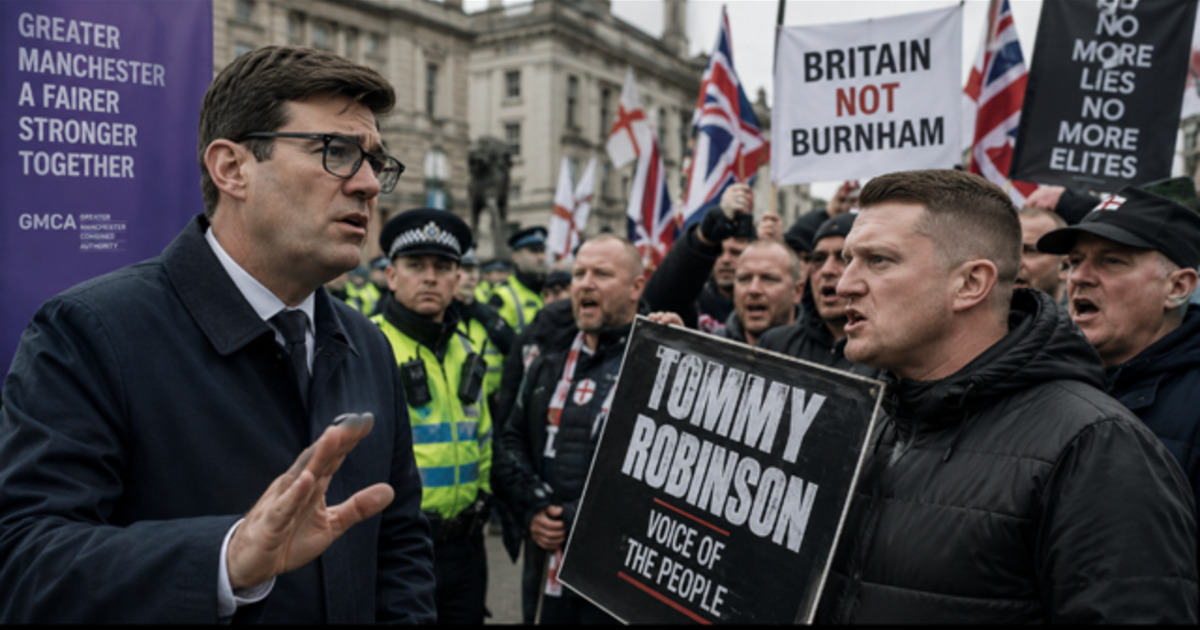
The one challenge the governments of a broad range of EU countries and that of the UK face in common is that hard-right ethnonationalist ideologies are rising strongly in political influence in nearly every European nation.
For Burnham, it will be no easy task to lead a fractious Britain that is infected — and profoundly challenged — like Germany, France, the Netherlands, Italy and other European nations by those forces.
Given weakening economies across most of Europe, it offers little surprise, but also little comfort to realize that the hard right seeks to make the most of the constant overpromising and underdelivering of their respective countries’ political elites.
The ID card puzzle
The fact that Burnham has just announced the abolition of efforts to get a workable ID card system introduced in the UK is certainly more wind in the sails of the hard right.
ID cards are, after all, the only means to know who is in country legally or not. The excuse is that proposed scheme is very expensive.
What is ultra-cynical in this context is that Nigel Farage fiercely opposes the UK government’s proposed digital ID cards. The Reform UK leader has condemned the scheme as an “anti-British card” and a step towards mass surveillance, arguing it will penalize law-abiding citizens.”
The obvious consequence of the continued non-existence of ID cards is that this will further fan the flames of hatred of foreigners.
The only way to come “clean” on that no doubt politically charged issue would be having ID cards, but that is not in Farage’s political interest.
Conclusion
That penchant to overpromising based on mellifluous rhetoric is a challenge that Andy Burnham, with all his skills and proclivities, will have to be very much aware of.
But then again, with his long political experience at running things, not just national ministries but also a major European industrial city conurbation, Andy Burnham may just be the prime minister Britain now needs.
Takeaways
Many politicians' penchant to overpromising based on mellifluous rhetoric is a challenge that Andy Burnham, with all his skills and proclivities, will have to be very much aware of.
Burnham established himself as a classic social democratic politician, similar to the ones to be found in Northern Europe like former German Chancellor Helmut Schmidt who was Mayor of Hamburg.
Pushing devolution may yield Andy Burnham a quick public relations win, insofar as it conveys a message to voters that he wants to bring governance closer to them.
For Burnham, it will be no easy task to lead a fractious Britain that is infected — and profoundly challenged — like Germany, France, the Netherlands, Italy and other European nations by those forces.
The fact that Burnham has just announced the abolition of efforts to get a workable ID card system introduced in the UK is certainly more wind in the sails of the hard right.
Note to journalists: You may quote from this text, provided you mention the name of the author and reference it as a new Strategic Assessment Memo (SAM) published by the Global Ideas Center in Berlin on The Globalist.