
Tax Systems Compared: What Germany Can Learn from Poland
Faced with anemic economic growth, German politicians should look at Poland to reform the hyper-complex German tax system.
April 23, 2026

Note to journalists: You may quote from this text, provided you mention the name of the author and reference it as a new Strategic Intervention Paper (SIP) published by the Global Ideas Center in Berlin on The Globalist.

Based on courageous structural reforms introduced more than a quarter century ago, Poland has become the economic powerhouse of Europe.
In contrast, neighboring Germany suffers from a prolonged period of anemic economic growth. To overcome that, the German government wants to reform the hyper-complex German tax system.
While the focus on the re-vitalization of the German economy as its top priority is to be welcomed, the question is whether it will succeed.
As it happens, Germany has come to a point where it has a great deal to learn from neighboring Poland.
Case in point: a fair and efficiently administered tax system.
The German tax system drowns in complexity
The challenge in Germany is that a phalanx of status-quo interests has so far prevented a genuine tax reform.
One large block of opposition comes from all those who benefit from the tax system remaining very opaque and detail-driven.
The other large block are political forces those who, largely for ideological reasons, dispute that a simplified tax system, with lower tax rates but fewer opportunities to exempt parts of income from taxation, would not only be fairer, but more effective.
Today’s Germans should heed lessons from the old Romans
Meanwhile, the defense of fiscal insanity rages on. Indeed, the head of tax at Germany’s Federal Finance Ministry recently doubled down at a conference, arguing that the obsessive pursuit of Einzelfallgerechtigkeit (“justice in each individual case”) is uniquely German. As if that were an admirable asset.
What is clear at this juncture is that a tax system this opaque, this obsessed with “individual justice” has become not only a threat to proper pursuit of the public interest, but that it shackles Germany’s economic growth.
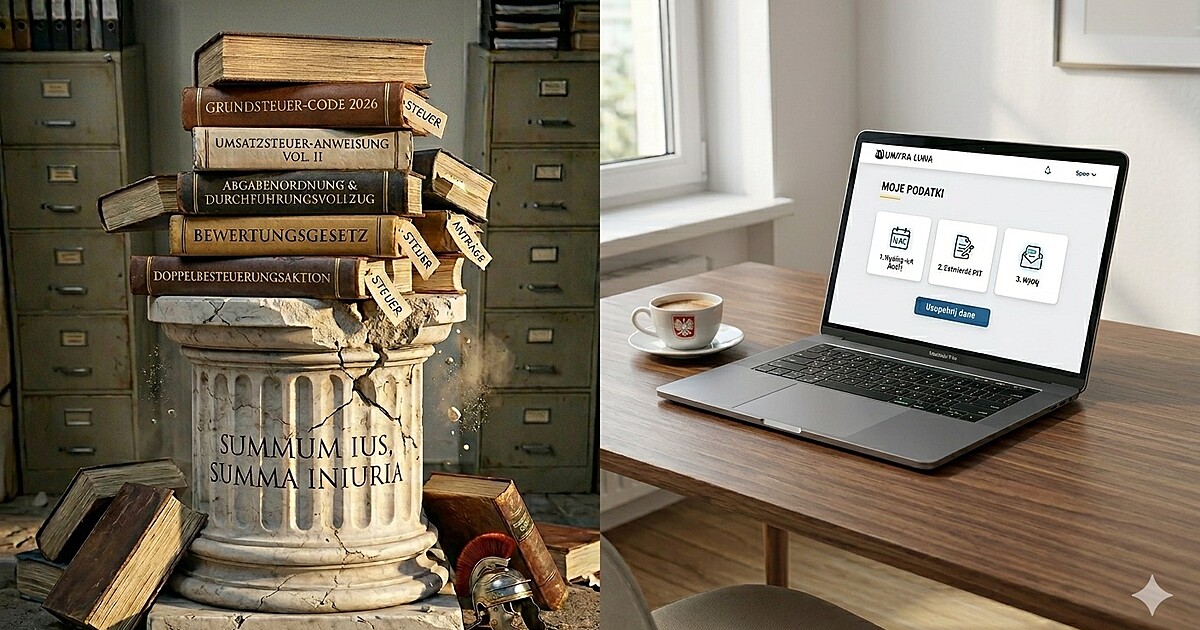
The Romans had the right message for reforming the German tax system today: “summum ius, summa iniuria” – the more sophisticated the law, the greater the injustice.
Given the features of the German tax system, that is a lesson which, 2,000 years later, is still to be learned in today’s Germany.
How to do it right: Poland
Now take a look at Poland: Here, the tax returns for individuals only require a few standardized pages.
For income tax, Poland has only two tax rates: 12% and 32%. The tax liability begins with an income above the tax-free allowance of 30,000 PLN (about 7,000 €). For incomes up to 120,000 PLN (about 29,000 €), 12% must be paid.
For every zloty above that, 32% is due. In addition, individuals with higher incomes are subject to a so-called “solidarity tax” of 4% on annual income exceeding 1 million PLN PLN (about 240,000 €). This surcharge was introduced to ensure an additional contribution from top earners and applies alongside the standard progressive income tax rates.
Few exemptions
While Poland offers a considerably lower nominal tax rate than in Germany, there are hardly any expenses in Poland that can be exempted from taxable income.
Some donations can be deducted, as can, for example, childcare costs, some social security contributions, internet costs and costs for the purchase of new technology. That’s it.
Income tax is not only due for income from employment but also for other income, e.g., from business activities. Entrepreneurs can choose between the standard progressive rates, a 19% flat tax, or even a simplified lump-sum tax on revenues, depending on the nature of their business (for example, business consulting services taxed at 15%).
In case they opt for the 19% flat tax, one has to accept certain restrictions (e.g., no tax-free allowance and limited deductions). These options provide flexibility and often result in a lower effective tax burden.
More significantly, this makes Poland an increasingly competitive location both for individuals and for small businesses.
Different types of income are generally treated separately. However, losses can be carried forward within the same category of income over several years. All of this keeps the income tax system simple and transparent.
A user-friendly tax system for employees
For an employee in Poland, the system is also user-friendly: The employer pays the monthly due taxes to the tax office.
The entire process and communication are electronic: Through the “Twój e-PIT” (Your e-tax) portal, the tax administration provides a pre-filled tax return online at the end of the year.
If you don’t claim any additional deductions, all you have to do is electronically confirm. Otherwise, you add your few additional pieces of information and wait for the corrected tax notice. Everything is completed by the end of April of the following year at the latest.
Smartly targeted tax incentives
Poland has also introduced several measures that make its tax system more attractive compared to other European countries.
For example, employees under the age of 26 benefit from a “Zero PIT” (zero tax) scheme, which exempts their employment income from tax up to a certain threshold, significantly reducing the cost of work for young professionals.
In addition, there are family and social tax credits, such as deductions for children or for senior citizens who remain active in the labor market.
Attracting skilled workers back to Poland
Moreover, Poland has introduced a special “return relief” to encourage individuals who have lived abroad to move back.
Under this scheme, a person who becomes a Polish tax resident after several years abroad can benefit from a four-year exemption from income tax on a significant portion of their income.
The relief is available to those who have not been Polish tax residents for at least three years prior to their return and applies to both employment income and business income.
This measure is meant to attract skilled workers back to Poland and has already proven popular among professionals returning from other EU countries, the United States, or the United Kingdom.
Message to Germany: Digitalization and courage help
The Poles benefit from the fact that the digitalization of the entire administration is far advanced. Thanks to the issuance of a citizen’s ID number (Pesel), everyone can handle their tax and administrative affairs electronically. Having to visit an office is only necessary in a few cases.
From my own experience, I can say that the effective tax rate for higher incomes is comparably high in Germany and Poland.
Paying taxes is hardly anyone’s favorite hobby, even if it’s clear that a functioning state with its services is worth the money. Today, this is far more the case in Poland than in Germany.
Was the modernization of Poland and the state easy? No. After the political change in 1989 and on the path to EU membership in 2004, it took considerable courage to overcome internal resistance.
In Poland, this courage was found, and today the simple tax system enjoys broad acceptance among the population—across all political camps, even those otherwise at odds.
Conclusion
No wonder no one in Poland wants to learn from the German tax example. But that does not apply the other way around. Germany could learn a lot from the straightforward Polish approach to taxation.
Poland shows that smart tax reform possible – if you just do it.
Author’s acknowledgement:
I would like to thank Joanna Narkiewicz-Tarłowska, Managing Director, Vialto Partners Poland, for her kind support to get the facts on the Polish tax system right.
Takeaways
Germany has come to a point where it has a great deal to learn from neighboring Poland. Case in point: a fair and efficiently administered tax system.
The Romans had the right message for reforming the German tax system today: “summum ius, summa iniuria” – the more sophisticated the law, the greater the injustice.
While Poland offers a considerably lower nominal tax rate than in Germany, there are hardly any expenses in Poland that can be exempted from taxable income.
Thanks to the issuance of a citizen's ID number (Pesel), everyone can handle their tax and administrative affairs electronically. Having to visit an office is only necessary in a few cases.
No wonder no one in Poland wants to learn from the German tax example. But that does not apply the other way around. Poland shows that smart tax reform possible - if you just do it.
Note to journalists: You may quote from this text, provided you mention the name of the author and reference it as a new Strategic Intervention Paper (SIP) published by the Global Ideas Center in Berlin on The Globalist.