
Why I Love Live Music
In an age of political deadlock and institutional paralysis, an evening at a concert is a reminder that human cooperation can still produce harmony.
September 5, 2026
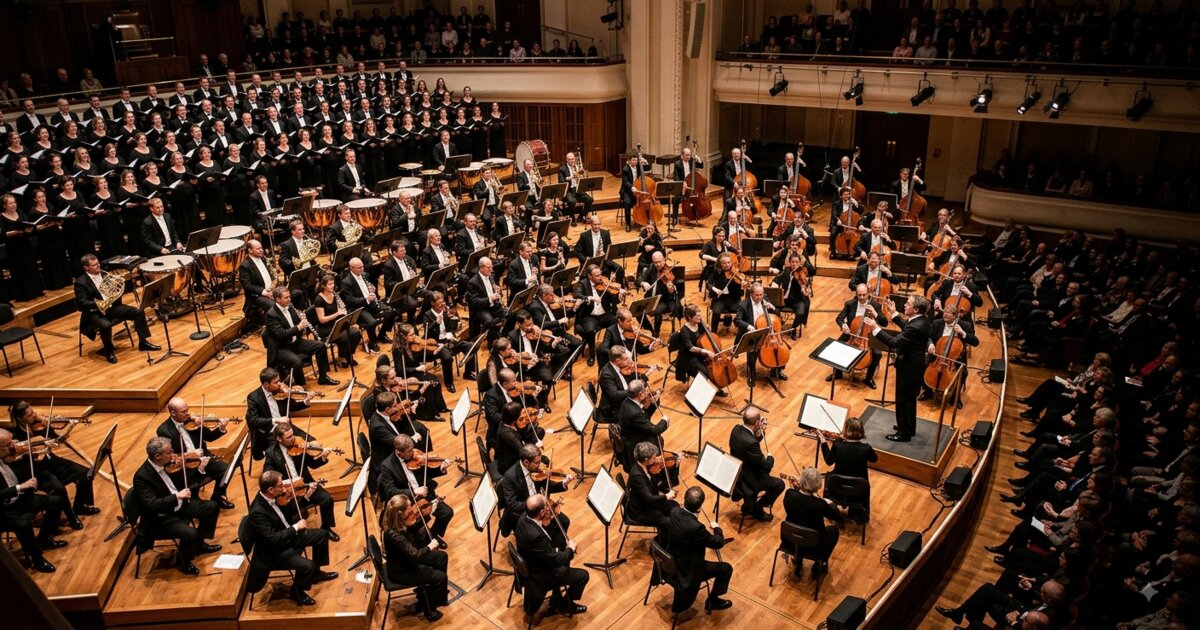

I am not a musical expert of any kind, but for me the appeal of live music has always been great. The reason is simple.
I spend my days immersed in the analysis of politics and the economy, domains that of late are defined by mutual obstruction as contending sides concoct elaborate schemes designed to block the schemes of the other.
Contrasting arrangements
Unsurprisingly, this does not just annoy the public at large, but also the people who are professionally occupied in those fields. It is dismaying to see politics and economics across Europe, the United States and well beyond become a ritualized show.
Political systems are no longer vehicles for forward movement. They devolve to a fine-tuned choreography of actors more or less malevolently strutting around one another. One’s daily occupation inevitably becomes more frustrating.
Well, work must go on. One cannot simply walk away from it. But one can escape from it in the evenings. My favorite activity during that time of the day is to go to a concert. The relief is immediate and palpable. While live music is also finely choreographed, a concert usually arranges temperaments, instincts and desires toward a productive outcome.
Real cooperation
Musicians gather not to outmaneuver one another, but to listen, align and create something that depends on the presence and attention of each.
Their coordination is neither accidental nor frictionless, but purposeful. Out of their shared discipline emerges something whole — that is, something that exists, unmistakably, in and for the moment it is performed.
Regardless of what genre of concert I attend, I admire not only the beauty of the result, but the direction and ultimate clarity of the process. Cooperation is not just a slogan for performing musicians, and the product is audible and real.
Harmony rather than noise
Listening to live music certainly makes sure that what used to be called one’s C drive is wiped clean.
At the end of yet another day spent tracing the 3 Ps (patterns of paralysis in public life) this experience has a restorative effect. It does not resolve the tensions I spend analyzing during my working hours, but it puts them into their proper place. A concert reminds its listeners that cooperation remains a pivotal human trait.
It is rejuvenating to see that a collective effort need not culminate in deadlock and that humans, operating with an understanding, can produce harmony rather than noise.
Deadlocked systems
The contrast invites a broader reflection on the societies we have built. In both the European Union and the United States, political systems are shaped by institutional fragmentation, strategic veto points and overall deadlock.
In Washington, polarization has turned routine governance into an endless exercise of extreme brinkmanship.
In Europe, the multitude of actors, i.e., EU member states, political parties and a continent’s-worth of public- and private-sector institutions, often translates into lowest-common-denominator outcomes, whether in energy policy, fiscal reform or defense coordination.
The cost of dissonance
These systems seem ill suited to confront the urgent challenges of our time. Given the dismal economic growth trends in most countries, inaction should not be the result of common purpose.
Yet, in too many of our political and economic systems, coordination is directed at negation. The concert hall operates under the opposite logic. There, each participant contributes to a shared outcome, and the cost of dissonance is immediately apparent.
Chasing coherence
The comparison between the process of music and that of politics is not necessarily perfect. Democratic politics must accommodate conflict, pluralism and deeply contested interests in ways that music does not.
Yet the experience of collective performance treats its listeners to something that feels increasingly absent in Western governance. The pursuit of coherence is demanding, but understanding is not beyond reach. Institutions can be designed, or redesigned, to reward alignment rather than perpetual veto.
Important resonance
Perhaps this is why concerts, beyond their aesthetic appeal, resonate quite deeply in the human fabric. They offer, however briefly, a model of social interaction in which individual excellence is not diminished but fulfilled through cooperation.
In delivering these performances, musicians cast contemporary politics in sharper relief. They suggest a pathway not consumed by paralysis, but focused on creating positive outcomes.
Takeaways
Politics in the West have become a ritualized show. They are no longer vehicles for forward movement, but stages for a fine-tuned choreography of actors strutting around one another.
Given the dismal economic growth trends in most countries, inaction should not be the result of common purpose. Yet, in too many of our political and economic systems, coordination is directed at negation.
Musicians in concert offer a tonic. It is rejuvenating to see that humans working together can produce harmony rather than noise.
The experience of collective performance treats its listeners to something that feels increasingly absent in Western governance. The pursuit of coherence is demanding, but understanding is not beyond reach.
In both the European Union and the United States, political systems are shaped by institutional fragmentation, strategic veto points and overall deadlock.
Concerts offer a model of social interaction in which individual excellence is not diminished but fulfilled through cooperation.