The Philippines’ Middle Power Opportunity
The Philippines must overcome its legacy of dynastic politics to be taken more seriously internationally as a middle power.
September 10, 2026
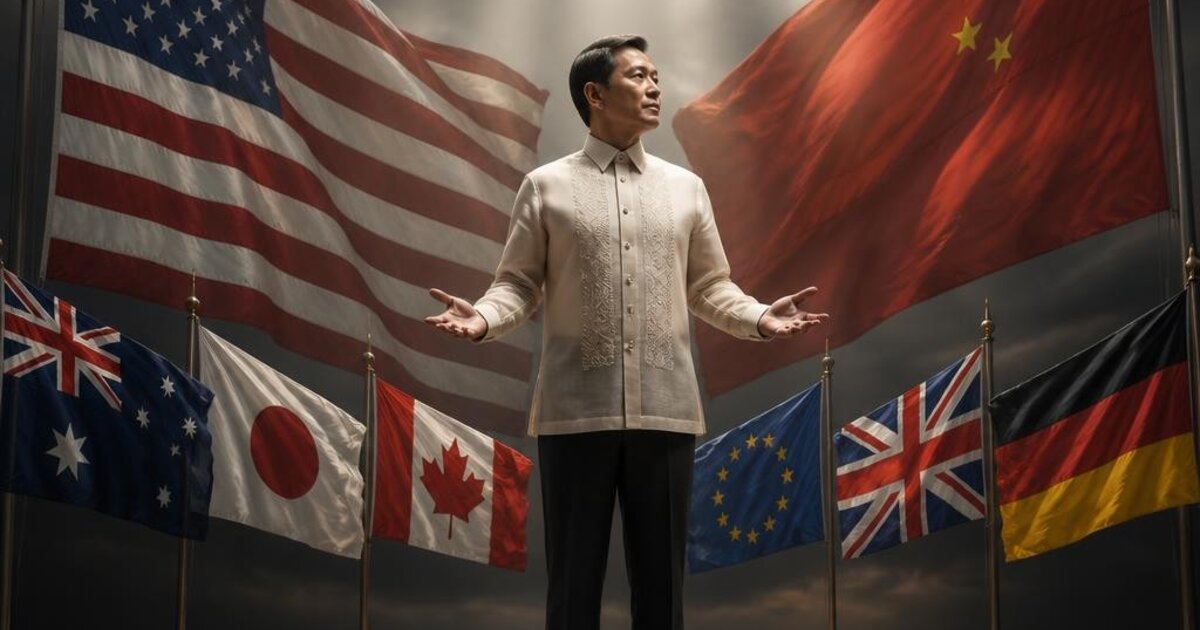

The world at large seems increasingly gripped by discussions about the relevance (or not) of middle power countries.
This is a natural reaction at a time when the United States and China, each for their own reasons, seem keen on re-creating a bipolar world with its mechanisms of dominance and the stronger or lesser degrees of submission by all other nations.
Does the Philippines matter?
The Philippines, ranking 14th in the world with its population of nearly 118 million, has not established itself as a middle power.
Part of the explanation is that its economy, with a GDP of $512 billion, ranks only in 35th place globally.
Why the debate matters to the Philippines
From its own national perspective, the Philippines certainly has much to gain from taking a leading role as a critical middle power in the western Pacific.
For starters, it needs more options in its regional affairs, especially as it counters China’s push for control over the South China Sea. For that reason, it has been strengthening relations with a range of other middle powers.
Inking strategic partnerships with Australia, Japan and Canada
Manila started its middle power efforts in its own region by officializing a strategic partnership with Australia in 2023.
In 2026, its middle-power diplomacy has picked up pace. In May, Philippine President Ferdinand Marcos Jr. and Japanese Prime Minister Takaichi Sanae declared a comprehensive strategic partnership between their two countries.
Then, in July, Marcos and Canadian Prime Minister Mark Carney officially elevated Canada-Philippines relations to a strategic partnership. Under Carney’s leadership, Canada has been at the forefront of the movement for middle power cooperation.
Also in July, the Philippines upgraded its relationship with the European Union to an enhanced partnership.
Maritime disputes in the South China Sea
It goes without saying that countries such as the Philippines are directly affected by the breakdown of the rules-based international order.
Great power rivalry is redefining geopolitics in every region, but China’s move toward maritime assertiveness that started in the 2010s was an early harbinger of the changes to come.
China claims about 90 percent of the surface area of the South China Sea. Its “nine-dash line” boundary intrudes on the maritime claims of several other countries, including the Philippines.
Manila never accepted the nine-dash line. It not only continues to claim its Exclusive Economic Zone in what it calls the West Philippine Sea. It also had the courage to stand up to China by having an arbitral tribunal established in 2013 under the UN Convention on the Law of the Sea.
Backed by international law
Predictably enough, China responded to such claims with three moves — harassing foreign nations’ ships, unilaterally exploring for resources and extracting them as well as constructing artificial islands.
In 2016, the tribunal determined that major elements of China’s claim were unlawful, including its nine-dash line, land reclamation activities and other activities in Philippine waters.
To no one’s great surprise, China declared the tribunal’s findings null and void. Relations between the Philippines and China in the South China Sea remain highly volatile and marked by frequent maritime clashes.
10-year anniversary of tribunal decision
The Philippines’ former president, Rodrigo Duterte, was elected soon after the tribunal’s decision. But he chose to pursue an appeasement approach toward Beijing.
In sharp contrast, President Ferdinand Marcos Jr., who took office in 2022, has taken a firm stance toward China. He upholds the 2016 arbitral award and publicly condemns Chinese aggression. He is also the one who has bolstered maritime security alliances with international partners such as the United States, Japan and Australia.
International support for the country’s courage
The Philippines officially commemorated the 10th anniversary of the Philippines-China South China Sea Arbitral Tribunal Award on July 12, reaffirming that the ruling is final, binding and cannot be diminished.
Philippine leaders were joined for the occasion by 13 other nations, including the United States, Japan, Australia, Canada, Germany, Italy and the United Kingdom.
Those nations reaffirmed that the award is “final, legally binding, and definitive … and that there is no legal basis for China’s expansive maritime claims in the South China Sea, including those based on ‘historic rights.’”
The Philippines’ middle power balance sheet to date
The Philippines should feel proud of the strong partnerships it has forged and the support it has earned on the global stage. But it needs to do much more work at home to become a true middle power.
In particular, it must strengthen its economic performance and improve its democratic credentials. After all, in the 1950s and early 1960s, the Philippines boasted one of Asia’s leading economies.
Indeed, it ranked second in the region, surpassed only by Japan. That is remembered in the Philippines as a golden age.
However, subsequently the country suffered greatly under the corrupt and violent regime of President Ferdinand Marcos (1965–86).
The Philippines as an inspiration for the region?
The Philippines has bounced back, showing solid annual GDP growth of 5.5 percent from 2010 through 2024. Strongly performing economic sectors include business process outsourcing, shipbuilding, semiconductors and tourism.
But the Philippines could be doing much better. For that to become a reality, it must tackle the poor level of education, healthcare and infrastructure, as well as the country’s endemic corruption.
The lack of economic opportunity at home has driven some 10 percent of the Philippine population overseas. Today, many Filipinos rely on migrants’ remittances.
The Philippines should note Vietnam’s economic dynamism. That country, which endured decades of war and authoritarian governance, has overtaken the Philippines in per-capita GDP ($5,100 for Vietnam versus the Philippines’ $4,440).
The Philippines’ flawed democracy
The Philippines has been an electoral democracy since Ferdinand Marcos was overthrown in the 1986 “People Power Revolution.” But the country needs to work to improve its democratic governance.
The Economist Intelligence Unit classifies the Philippines as a “flawed democracy.” It ranked 62nd out of 167 countries surveyed. Government corruption, political dynasties and human rights abuses undermine the quality of Philippine democracy.
Held back by competing dynasties
What hinders overall progress is that the country’s politics is a battleground for elite family dynasties. Populism wins over effective leadership, and showmanship rules over substance. In 2022, Filipinos elected the son of the disgraced former President Marcos. The daughter of Marcos Jr.’s predecessor, Sara Duterte, is the current vice president.
A bitter political feud with Marcos Jr. led to her impeachment by the House of Representatives. She now faces a Senate trial.
Nevertheless, in a true testament to the resilience of the country’s dynastic politics, the younger Duterte will likely be a very popular candidate at the next presidential election, scheduled for 2028.
Time for some housekeeping
It is perhaps this lack of seriousness that stops the country from establishing a stronger international presence as a middle power. The opportunity to take a greater role on the global stage is there. First, some housekeeping may be in order.
Takeaways
Manila knows it needs more options in its regional affairs, especially as it counters China’s push for control over the South China Sea.
Manila started its middle power efforts in its own region by officializing a strategic partnership with Australia in 2023.
In 2026, the Philippines’ middle-power diplomacy has picked up pace.
In sharp contrast to his predecessor, Philippine President Ferdinand Marcos Jr. has taken a firm stance toward China.
The Philippines’ politics are a battleground for elite family dynasties. Populism wins over effective leadership. That stops the country from establishing a stronger international role as a middle power.