Does Anybody Still Care About Aiding the World’s Most Desperate Peoples?
Why has the world largely turned its back on the more than 500 million people who live in the poorest and the most corrupt nations?
February 18, 2026
A Global Ideas Center, Strategic Assessment Memo (SAM) from the Global Ideas Center

You may quote from this text, provided you mention the name of the author and reference it as a new Global Ideas Center, Strategic Assessment Memo (SAM) published by the Global Ideas Center in Berlin on The Globalist.

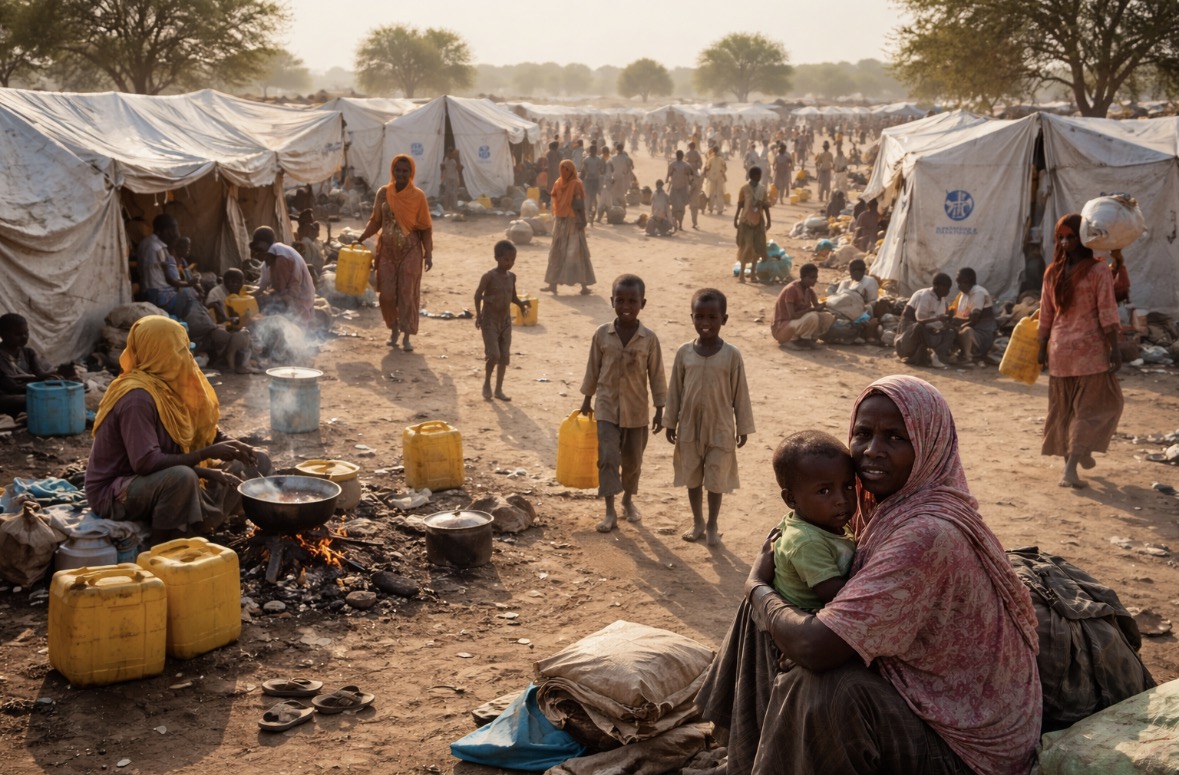
A massive humanitarian crisis is surging ahead in the world’s poorest countries with no relief in sight. Foreign aid is heading downwards as mass starvation, disease and violence is heading upwards.
Where is the news in that, you might wonder?
The “news” is that the prospect for an improvement of the current situation is actually deteriorating. U.S. President Donald Trump, for one, has used vile language to deride many of these countries.
Meanwhile, many West European countries face multiple financial pressures, including providing money for defense and keeping up the welfare state.
On top of that, let’s face it, the leaders of most of the poorest nations are primarily concerned about their own power and wealth, rather than the plight of the more than 500 million people they should be serving.
The low-income countries have consumed tens of billions of dollars of official assistance and charitable donations in support of development projects that have overwhelmingly failed.
The perception abounds that the governments of these countries take the aid and bribes from crooked foreign investors and buy mansions in London and Paris, swell apartments in Dubai and government funds in private accounts in Swiss banks.
We can act
Yet a massive humanitarian crisis is rolling ahead with minimal relief in sight.
This is a crisis that has consequences for us all. Local conflicts become regional and threaten international security. The numbers of displaced persons multiply and fuel the refugee trail to Europe, adding to already high political tensions.
If we have the will, and our humanitarian values are still important to us, we must recognize that constructive actions are indeed possible.
The hard facts
I am talking about the 24 countries* that the World Bank categorizes as low-income countries (LICs), many of which are ranked in the new Transparency International 2025 Corruption Perceptions Index (CPI) as the most corrupt.
Blithely, economists at the World Bank in their new Global Economic Prospects 2026 Report stress: “The main lesson of the last 25 years is that when developing economies have the right policies, they control their own destiny.”
What is no less true is that countries that have the wrong policies, notably with regard to corruption and containing violence, ensure the absolute poverty of the overwhelming majority of their citizens.
The UN’s failings
We used to turn to the United Nations to provide leadership in striving to curb conflict, relieve starvation and address the many health problems that abound.
But the United Nations is in trouble these days. It has been forced to cut many of its programs and is struggling to even keep its headquarters’ doors open as the U.S. procrastinates in paying its dues.
The leading developed countries used to add to UN support with bilateral official development assistance (ODA) programs, but these are being sharply cut.
After the U.S. shuttered U.S. AID and slashed many humanitarian programs, it increasingly told its NATO partners to boost their arms spending –the result is bigger defense budgets and lower levels of official development assistance.

Refugees
Wars in Afghanistan and Syria led millions of people to flee their homes and become refugees. The current conflicts in Sudan and Democratic Republic of Congo (DRC) are adding to the numbers of displaced persons.
In addition, climate change and desperate poverty are forcing large numbers of people off their lands. Today, more than 20 million refugees are striving to survive in the world’s poorest countries – approximately one-half of the world’s total number of refugees.
Corruption
Transparency International’s new Corruption Perceptions Index (CPI) ranks a total of 182 countries. South Sudan and Somalia are perceived to be the most corrupt nations, according to an analysis of 13 different international opinion polls.
Somalia has been a failed state for years, riven with violence, warring factions and, according to Freedom House, negligible political rights, virtually zero press freedom and totally rigged electoral processes. Conditions in Sudan are no better and the country’s economy literally collapsed last year, with a more than 23 percent GDP decline.
Afghanistan is among the absolutely most corrupt: no country in history received more official development aid and squandered it so disastrously. The recently published final report of the U.S. Special Inspector for Afghanistan stresses the misuses of tens of billions of U.S. aid and how it contributed to rising corruption across the country. ranks close to the bottom.
The World Bank’s softballing
One might think that given the rampant corruption in many of the poorest nations that the World Bank would explicitly address the issue in striving to aid these countries.
The new report by the Bank mentions corruption briefly. It advocates government policies that better manage public resources and that encourage foreign direct investment – after all many of these countries have large mineral resources, and a few have tourist potential.
However, companies that wade into these countries in search of mining rights face both security and bribery pressures. The direct investment is only likely to come from companies with explicit foreign government backing, or directly from governments.
Russia’s and China’s dirty business
The Russians, for example, are providing security to the ruling elite in the Central African Republic in exchange for valuable minerals. The Chinese are the largest investors doing opaque deals with governments. President Trump has proposed a peace plan for the DRC involving mineral rights for U.S. investors.
The hard fact is that even if foreign investment increases, the revenues will in all probability move swiftly out of the host countries, back to the homes of the investment firms and into the foreign bank accounts of local government officials. Illicit financial flows from a number of these countries have long exceeded foreign aid inflows.
Why should we care?
The World Bank states that food insecurity has intensified due the combination of conflicts, climate change natural disasters and population displacement. The result is that approximately 140 million people in LICs “face an acute food insecurity crisis or worse—an increase of 30 percent since 2020.”
The hazards of directly providing foreign aid to thoroughly corrupt authoritarian regimes are enormous. Nevertheless, there is much that the international community can – and must – do.
Yes, we can make progress
Imagine President Trump redoubling his efforts to secure peace in the DRC, assuming that he can keep focus on this bloody war, then he has the power to make progress.
He could get the warring parties to finally agree to implement the peace terms that they jointly signed in Washington in early December 2025, which they unfortunately subsequently ignored.
In addition, the U.S. and European governments need to try and exert pressure on the United Arab Emirates, Egypt, Saudi Arabia and Turkey to cease arms supplies to the rival armies in Sudan. There needs to be a meaningful international effort to try and force a ceasefire.
Jan Egeland, Secretary-General of the Norwegian Refugee Council, who recently traveled in Sudan, says the situation is, “the largest humanitarian crisis on earth.”
In a U.S. television interview, Egeland called for a “surge” in humanitarian aid to the hardest hit regions of Sudan. In fact, it is not just Sudan.
The world’s wealthiest nations have the capacity to relieve the enormous human suffering that is now taking place in many parts of the LICS and that is likely to increase.
Shaming the corrupt
Finally – and perhaps this is indeed just my wishful thinking – international pressure is needed on the governments of most of the LICs to recognize the legitimate roles of civil society organizations and independent media so that domestic pressures can be mobilized to counter corruption and hold governments to account.
Is it too much to hope that the governments of most low-income countries could be shamed into reform? Surely, they cannot relish their nations being viewed across the globe as the most corrupt ones on the planet.
*Low-Income Countries as defined by the World Bank: Afghanistan, Burkina Faso, Burundi, Central African Republic, Chad, Democratic Republic of Congo, Eritrea, Gambia, Guinea-Bissau, Liberia, Madagascar, Malawi, Mali, Mozambique, Niger, Rwanda, Sierra Leone, Somalia, South Sudan, Sudan, Syria, Togo.
Takeaways
The low-income countries have consumed tens of billions of dollars of official assistance and charitable donations in support of development projects that have overwhelmingly failed.
Afghanistan is among the absolutely most corrupt: no country in history received more official development aid and squandered it so disastrously.
Sadly, the leaders of most of the poorest nations are primarily concerned about their own power and wealth, rather than the plight of the more than 500 million people they should be serving.
A Global Ideas Center, Strategic Assessment Memo (SAM) from the Global Ideas Center
You may quote from this text, provided you mention the name of the author and reference it as a new Global Ideas Center, Strategic Assessment Memo (SAM) published by the Global Ideas Center in Berlin on The Globalist.