I Was in Damascus. I Left with Respect
The atmosphere in Damascus has shifted, even if material conditions have not. I moved through a city marked by energy, anxiety and moments of hope.
February 19, 2026
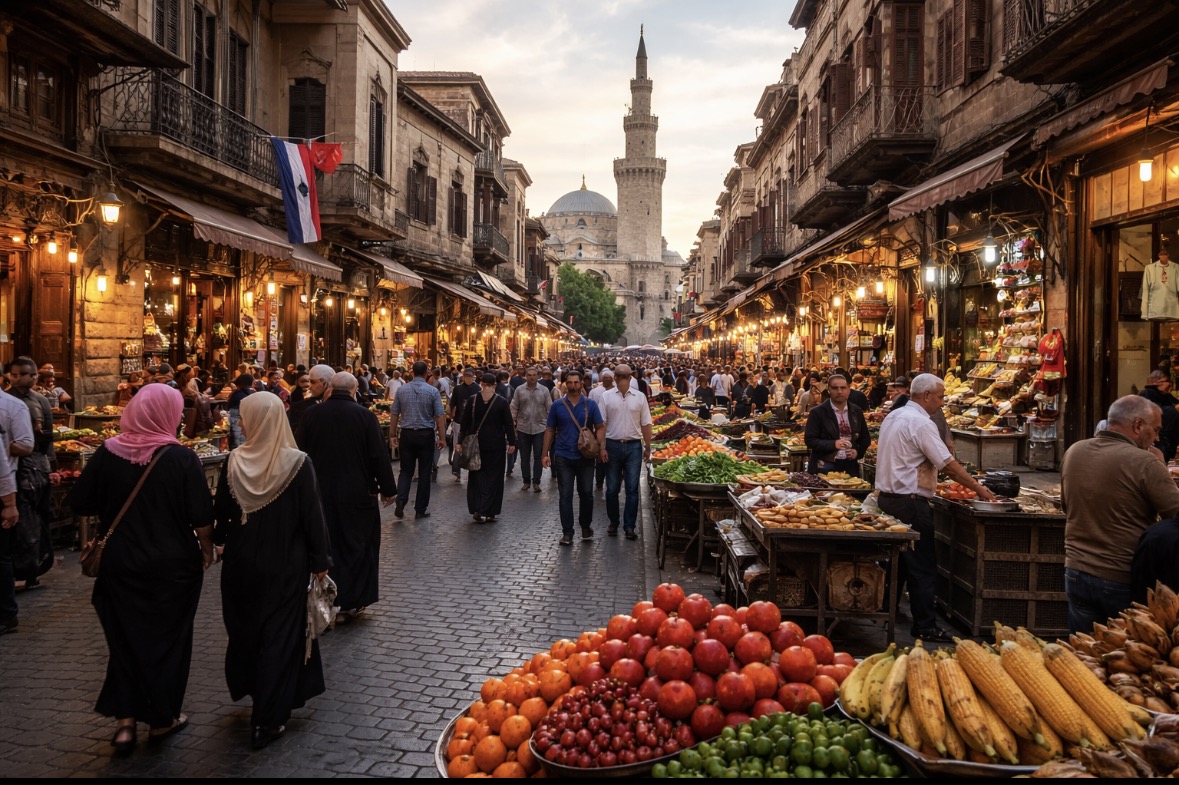

I was just in Damascus and found myself unexpectedly struck by the energy of the streets. Not the sort of energy that translates as full recovery, nor the kind that pretends the last 15 years did not happen. But a practical energy.
Of course, the damage is still visible. The buildings are tired, the infrastructure worn down, the economy clearly strained after civil war, sanctions and foreign intervention. But the streets were alive in a way I had not expected.
It was the noise and dynamism of Damascus, which left me in awe. A kind of ordinary insistence on daily life. It did not erase what the Assad dynasty had done to this country. Nothing erases that. But it interrupted the narrative of paralysis that so often frames Syria from the outside.
A story of resilience worth listening to
I believe the resilience of Syrians is a lesson worth listening to.
From afar, the story is still written in extremes. A former jihadist now leads the transitional government. Depending on who is speaking, Ahmad al-Sharra is either an inevitable tyrant waiting to strike against his own people, especially women, or he is a savior.
On the ground, what one encounters is something less theatrical, more subtle and complicated — and perhaps more politically interesting: a society testing the limits of speech after decades of fear.
Equally striking, especially for those who approach Arab societies through a fixed – and Orientalist – lens, is how familiar much of Damascus feels.
The rhythms of daily life are not so distant from those of any other urban neighborhood, for example, of Istanbul. Cafés are full. Women are moving through public space without visible hesitation. You see the small frictions and accommodations of urban coexistence.
Yes, Damascus was never reduced to rubble in the way Aleppo was. Assad preserved it as a showcase but also controlled it as a prison.
The architecture of silence has cracked
What seems to be shifting now is not the material condition of the city — that will take years — but the atmosphere. People talk. They criticize. They measure their words less carefully than before.
This does not mean a democratic transformation is underway. It does mean, however, that the architecture of silence has cracked.
I like political cracks. They can be messy and uncertain, but they show where the real pressure has been building. Again, they may not promise immediate outcomes but definitely allow space. Breathing and “being” space.
You notice this not only in conversations, but as you move through the city.
Walking about town
Enter the spectacular Umayyad Mosque, where women use the space to gather in groups of four and let their children run freely so they can have ten minutes of peace without being constantly interrupted.
They can eat a small bite from their bags, in a place where no one asks anything of them, at least for the time being.
You might also walk around the National Museum, whose beautiful garden is filled with bitter orange trees, and whose interior houses pieces displaying the thousands of years of civilization that have lived on this land.
That is, what remains after ISIS attacks and looting in Palmyra. The Umayyads, the Romans, the Byzantines, the Ottomans. One is reminded that Damascus is one of the most ancient cities in the world among those still inhabited, its origins dating back to the third millennium BCE.
Feeling liberated when the “walls no longer have ears”
Mahmoud, a man in his late forties whom I spoke to in the museum garden, was originally from Deir ez-Zor and moved to Damascus when the war broke out.
“I don’t know if this new regime is good or bad. It is too soon. Life on the street has not changed much. We still struggle to make ends meet. But what I can say is that we definitely feel much freer to talk and say what we think. We used to say the walls had ears. We took down the walls and the ears with them.”
This was a sentence I heard repeatedly for the rest of my trip, from almost everyone I spoke to.
Suq al-Hamidiye (Hamidiye Bazaar) is crowded with people grabbing bites of traditional maarouk, the date-stuffed star-shaped bread, but many shops are largely empty.
One trader who owns a family business selling traditional handmade Damascene ornaments with sadaf told me: “Our wellbeing depends on tourists coming and buying from us. I don’t know what this current government is doing. At least they are not meddling with our lives. That is already much better.”
Turkey in the background
I have always supported Turkey’s decision to open its doors to Syrian migrants and refugees when the civil war broke out. Many of those refugees have now returned home.
Unsurprisingly, as a Turkish speaker, I have never felt more at home outside Turkey than is the case in Damascus these days. It felt as though everyone spoke some Turkish, many of them, especially children, impeccably so.
At the bazaar, in traffic, in cafés and grocery stores, anyone who realized I was Turkish greeted me with that familiar regional gesture: hand on the heart, a slight tilt of the head.
This does not mean Syrians did not face hardship or racism in Turkey. “At first it was fine,” a middle-aged woman told me. “Then around 2017, we became the problem blamed for everything going wrong.”
A couple I met on the narrow streets of Bab Touma exclaimed: “Have we really reached the days when we see tourists from Turkey in Damascus, mashallah.”
Conclusion: “This” is better than Assad
Surely, it is not a bed of roses, I am not a proper tourist and much can go wrong during a transitional period. But what I felt, and what I was repeatedly told, is that “this” is better than Assad.
The disgust and hatred towards his rule is palpable across Damascus. I have rarely seen anything like it. Not even for Egypt’s Mubarak or Tunisia’s Ben Ali.
Takeaways
The atmosphere in Damascus has shifted, even if material conditions have not. I moved through a city marked by energy, anxiety and moments of hope.
"I don’t know if this new regime is good or bad. What I do know is that we definitely feel much freer to talk and say what we think. We used to say the walls had ears. No longer."
What one encounters on the ground in Damascus is a society testing the limits of speech after decades of fear.
as a Turkish speaker, I have never felt more at home outside Turkey than is the case in Damascus these days. It felt as though everyone spoke some Turkish, many of them, especially children, impeccably so.