Southeast Asia and the Iran War
The Iran War has an adverse impact on Southeast Asia’s economic development. It is also likely to push the region further into the arms of China.
April 17, 2026

Note to journalists: You may quote from this text, provided you mention the name of the author and reference it as a new Strategic Assessment Memo (SAM) published by the Global Ideas Center in Berlin on The Globalist.

Southeast Asia plays an increasingly important pole in the world economy. And yet, it is too often still considered a mere annex in discussions of today’s emerging multipolar world. Especially from a Western perspective, this is wrong-headed.
China and Southeast Asia
Just remember that China has had its eye on Southeast Asia for a very long time. Case in point: In pre-modern times, Chinese emperors collected tribute from Southeast Asian regimes.
Indeed, China and Southeast Asia have long been knitted together by economic linkages and Chinese migration to Southeast Asia. About 70% of people of Chinese descent who live outside of China actually live in Southeast Asia.
A strategic location
Southeast Asia is also a strategic location linking the Indian and Pacific Oceans, through which much of China’s energy imports pass. Thus, it is a source of perpetual anxiety in Beijing. It fears that a hostile power might close off the trade route.
China has become Southeast Asia’s largest trading partner, with bilateral trade reaching approximately $1.055 trillion by 2025, driven by the China-ASEAN Free Trade Area (ACFTA). Key trade includes electrical machinery, electronics, and manufacturing components. The relationship is deepening, with ASEAN also becoming a top trading partner for China.
China has made significant foreign direct investment in the Southeast Asian economies, which are a key manufacturing hub for Chinese companies, particularly in electronics and clean energy, with over 90 percent of trade in 2025 comprising manufactured goods.
Major investments, particularly through the Belt and Road Initiative, are driven by manufacturing shifts and supply chain diversification in countries like Indonesia, Thailand and Vietnam, often positioning China as a top three investor.
How the Iran war hits Southeast Asia hard
The increase in energy prices provoked by the Iran war is hitting Southeast Asia hard. The region’s dependence on imported energy has been rising rapidly, driven by surging demand and declining domestic fossil fuel production.
Except for Brunei, all Southeast Asian countries are net oil importers, while Thailand and Singapore are major gas importers. Looking ahead, Southeast Asian energy demand and import dependency are set to rise.
How the Philippines have reacted
In the Philippines, where I am now living, the government declared a state of national energy emergency. It also secured a commitment from Iran for the safe passage of Philippine-flagged vessels and oil shipments through the Strait of Hormuz, rolled out fuel subsidies to public utility drivers, farmers and fisherfolk to alleviate the impact of high fuel prices.
Next, it directed government agencies to implement energy-saving measures and is accelerating the deployment of renewable energy projects (solar, hydro, wind) to reduce reliance on imported fuel.
Ripple effects throughout Southeast Asia
In light of the regional economies’ high dependence on the global economy through their participation in global supply chains, disruptions to the world economy will also ripple through Southeast Asia.
Another hit to the Southeast Asian economies is coming about as a result of the millions of Southeast Asian migrants, particularly from the Philippines and Indonesia, who work across the Middle East.
There are over 2.4 million Filipinos and hundreds of thousands of Indonesians employed in that region, particularly in Saudi Arabia and the UAE. These workers dominate sectors such as construction, hospitality and domestic services.
Remittances from the Middle East are therefore vital to the workers’ home country economies, with roughly 10 percent of the Philippines’ GDP supported by these workers.
As of March 2026, large numbers of Filipinos were in the repatriation pipeline due to safety concerns and closed airspaces.
Into the clutches of China?
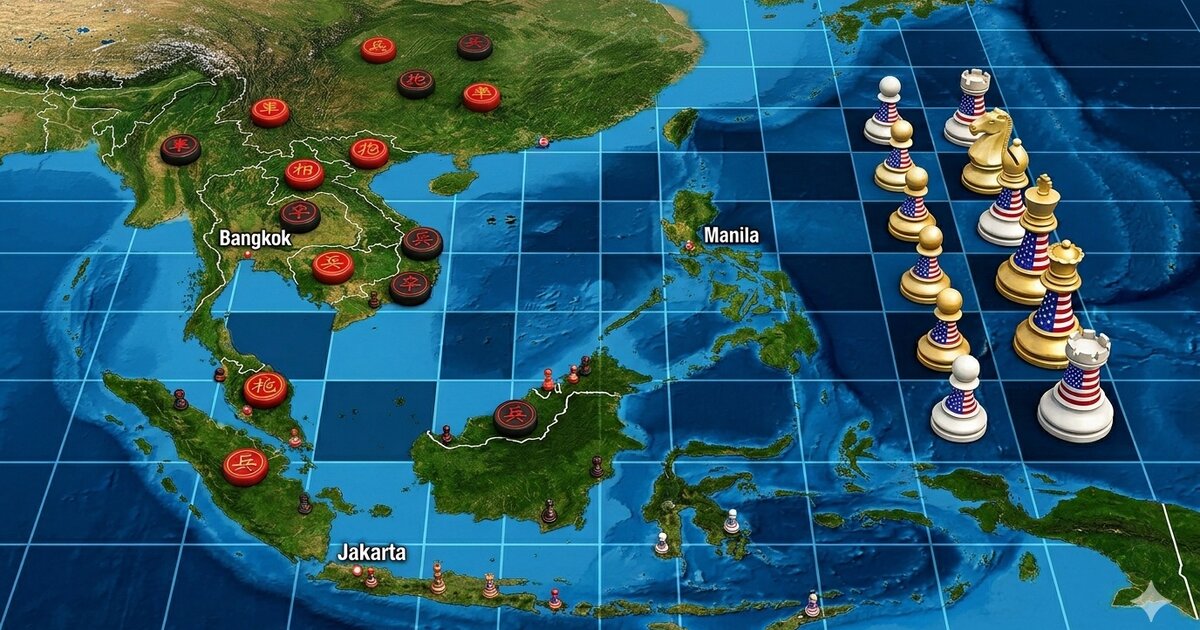
The Southeast Asian countries have long been courted by both the U.S. and China.
For example, Indonesia – ASEAN’s largest country and largest economy – has had close relations with the United States since the overthrow of the Sukarno regime and the installation of the Suharto regime in 1967. The U.S. has long also had close relations with the Philippines, a former colony and today an ally.
Meanwhile, the United States and Singapore maintain a robust, 60-year strategic partnership built on strong defense, economic and technological ties. The relationship is anchored by the 2005 Strategic Framework Agreement and the 2015 Enhanced Defense Cooperation Agreement. Singapore serves as a crucial logistics hub for the U.S. Navy.
On the other hand, Cambodia and China maintain an “ironclad” friendship, characterized as a comprehensive strategic partnership with deep economic, political, and security ties.
Some say that Cambodia has become a de facto Chinese colony, which China uses to undermine ASEAN’s relations with the U.S. Laos has developed a similar relationship of dependence on China.
How the U.S. withers in Southeast Asia
Over the past decade or so, the position of the United States has been withering in Southeast Asia.
The U.S. is perceived as being more interested in using Southeast Asia in its rivalry with China, rather than being seriously interested in the region.
Moving beyond that, the Trump administration has adopted a very transactional approach to trading relations with Southeast Asia. Donald Trump’s erratic tariff war has considerably undermined the U.S. position in Southeast Asia – which benefits none other than China.
At the same time, the United States as a market has also become less relevant to trade-oriented economies of Southeast Asia. Donald Trump pulled the U.S. out of the Trans-Pacific Partnership. The U.S. is also not a member of the Regional Comprehensive Economic Partnership.
And there is no likelihood of the U.S. joining any Southeast Asian trade deal in light of America’s protectionist tilt.
The U.S. as a balancer to China in Southeast Asia?
In an ideal world, the U.S. could and should provide a useful balance to China in Southeast Asia. U.S. businesses would have much more to gain from such a situation which they had broadly obtained until the return of Donald Trump to the U.S. presidency.
To governments and people all over the ASEAN region, the U.S. war on Iran only confirms the general impression that the United States is an erratic, militaristic and unreliable country. It is broadly viewed as a source of global economic and political instability.
To be sure, China is not a democracy. And it has no qualms to push the ASEAN countries to be deferential and sensitive, if not submissive, to Chinese concerns.
Even so, compared to the United States, China does have the benefit of being a strong economic partner and a beacon of stability and predictability in the eyes of the Southeast Asian countries. Looking ahead, the countries of Southeast Asia will likely draw ever closer to China.
Takeaways
Southeast Asia is too often still considered a mere annex in discussions of today's emerging multipolar world.
The Iran War is not only having an adverse impact on Southeast Asia’s economic development. It is also likely pushing the region further into the arms of China.
The U.S. is perceived as being more interested in using Southeast Asia in its rivalry with China, rather than being seriously interested in the region.
Donald Trump’s erratic tariff war has considerably undermined the U.S. position in Southeast Asia – which benefits none other than China.
All over the ASEAN region, the U.S. war on Iran only confirms the general impression that the United States is an erratic, militaristic and unreliable country.
compared to the United States, China does have the benefit of being a strong economic partner and a beacon of stability and predictability in the eyes of the Southeast Asian countries.
Note to journalists: You may quote from this text, provided you mention the name of the author and reference it as a new Strategic Assessment Memo (SAM) published by the Global Ideas Center in Berlin on The Globalist.
Read previous
Southeast Asia as a Powerhouse
April 17, 2026