Global Governance: How the West Plays Into China’s Hands
The Chinese cannot believe their good luck. How Europe must change its ways now to limit the fallout.
January 25, 2026
A Global Ideas Center, Strategic Intervention Paper (SIP) from the Global Ideas Center

You may quote from this text, provided you mention the name of the author and reference it as a new Global Ideas Center, Strategic Intervention Paper (SIP) published by the Global Ideas Center in Berlin on The Globalist.

This analysis was published in the business section of the Frankfurter Allgemeine Sonntagszeitung under the headline “The Many Mistakes of the West” on January 18, 2026.
The current president of the United States and his MAGA movement discredit the idea of globalism at any opportunity they get. While its proponents argue globalism aims to solve complex global issues that virtually all nations in the world face in a multilateral, cooperation-oriented manner,[1] the Trump camp discredits it as an evil concept to destroy the United States.
In his mildest, most diplomatic form, Donald Trump set the stage in his first speech before the United Nations General Assembly in September 2018. “We reject the ideology of globalism, and we embrace the doctrine of patriotism. Around the world, responsible nations must defend against threats to sovereignty not just from global governance, but also from other, new forms of coercion and domination.”
Mimicking Chinese emperors
However, at the outset of his second term in office, the U.S. President made it clear that his form of “patriotism” is one of unabashedly pursuing a take-no-hostages form of imperialism, predominantly in its commercial variant.
Trump’s goal is not only to relentlessly dominate the global agenda on a daily basis. He has also proven keen to establish – for the U.S.’s and especially his own family’s and patrons’ purposes – a system that is strongly reminiscent of the tribute system established in the ancient Chinese empire. At that time, foreign nations had to pay tribute to the Emperor of China not only to secure his favor, but also to be accepted at court in the first place.
Viewed superficially, this adoption of ancient Chinese practices by the contemporary United States may be considered an ironic turn of history. Through a strategic lens, however, it plays strongly into Xi Jinping‘s hands.
How Trump plays directly into Xi’s hands
Trump has just announced the exit of the United States from a total of 66 UN organizations. According to U.S. Secretary of State Marco Rubio, they are not worth “the blood, sweat and treasure of the American people.”
The net effect of this move can hardly be considered to be in the U.S. national interest, as Trump’s move effectively clears the field for vastly more Chinese influence not just over UN affairs, but far more broadly in the domain of global soft power. While China’s soft power strategists can hardly believe their good luck, this is a development that would shock the late Joe Nye, the long-time advocate of a U.S. soft power strategy.
To make China’s manifold overtures toward its own form of promoting globalism more credible, Xi could not have hoped for any better validation than the U.S. than Donald Trump’s adoption of a hyper-mercantilist and deeply imperialist approach to international relations.
To be sure, a United States acting ever more in a lawless manner in global affairs detracts massively from the perceptions of the downsides of China’s own approach.
China systematic approach
To usurp the space previously occupied by the United States, Xi Jinping has proceeded in a four-step fashion to roll out China’s own soft power offer to the global community. In their sum total, they make up the Chinese approach to globalism.
First off, in 2021, he presented the Global Development Initiative at the United Nations General Assembly in New York. This was followed in 2022 by the Global Security Initiative at that year’s Munich Security Conference, then in 2023 the Global Civilization Initiative at a gathering of foreign parties in Beijing and finally, at the summit meeting of the Shanghai Cooperation Organization in 2025, the Global Governance Initiative.
Skilled statecraft
The propaganda dimension of laying out this comprehensive agenda by the Chinese leadership is undeniable. At the same time, the Chinese were remarkably keen on casting their nation’s self-interest in all four initiatives as expressions of interests common to nations across the globe.
More remarkably yet, the Chinese effort to present their version of globalism is mimicking the steady succession of institutional and governance pronouncements presented by various enlightened U.S. administrations from the early 1940s on forward.
U.S.-driven proposals to set up the Marshall Plan and the GATT as well as the World Bank and the IMF certainly always served America’s commercial and financial interests quite directly. In their day, the architects of those concepts always saw to it that the proposals were cast in the spirit of common advantages.
After January 20, 2025, the U.S. government completely abandoned this approach. Much worse, the Trump administration has deliberately maneuvered itself into a position where it is widely perceived as acting extremely unilaterally.
Indeed, Donald Trump’s determination to act no longer in the U.S. tradition of a benevolent hegemon, but rather as a malevolent one in the eyes of most non-autocratic nations around the globe directly enhances the ability of the Chinese to appear as acting benevolently.
The fact that Trump has been able to see through his approach basically completely unchecked by the U.S.’s system of “checks and balances” – especially the mighty U.S. Congress and the U.S. Supreme Court – has led to great consternation throughout the entire world of democratic nations.
Europe’s strategic trilemma #1: Guilt by association
All of this has significant consequences for Europe that extend far beyond the current sentiment of complaints across much of Europe about the American “love” withdrawal which by itself is already vastly reshaping the transatlantic relationship.
The first strategic problem Europe faces on the global level is guilt by association. Whether for matters of sheer convenience, lack of courage, competence, resources or entrepreneurial or political momentum in key areas, the Europeans often sailed globally under the wing of the United States.
For that reason, the guilt by association with the United States affects Europe not just in its bilateral relationship with the U.S. Europe’s long-standing “sidekick” role is now also coming to haunt the continent globally as it appears tainted because of that.
Zeroing in only on the Chinese perspective, the Europeans’ role as long-standing sidekicks of the Americans offers a convenient “bycatch” when it comes to shaping the concept of global relations or globalism since it implicitly discredits the Europeans.
Europe’s strategic trilemma #2: Overreach via an unattractive regulatory “empire”
Viewed from the vantage point of many countries around the world, including most in the Global South, the EU practice of wanting to play global regulatory police appears preposterous for a whole host of reasons.
First, the “sticks” involved in the EU’s approach were not accompanied by any real carrots. Second, and even worse, the cost of adaptation was mostly put on those countries that, for the most part, are at a lower level of economic wealth.
Third, and possibly most destructively, is the will/wallet gap that makes not only exposes a sheer mockery, but also the arrogance of grandiloquently establishing global rules that the entire world should follow. Worse, even in their own home countries, the Europeans no longer have the level of economic means at their disposal that would be needed to cover the significant costs of the various behavioral transformations which they even decreed for the entire global community.
Europe’s strategic trilemma #3: Secular decline
It is one thing for Europeans to realize that they lack the level of aggregate market power. but the European failure to establish competitive, deep and broad capital markets is truly unacceptable because it has immense consequences. A decline in its innovation potential is the most significant one.
While the United States still has almost unlimited capital market potential to finance innovation, China has used forced savings, state power, IP theft as well as a strong focus on MINT disciplines and being a provider of patient capital to its technology firms to see through innovation.
This mix has enabled the country to move from a mere mass producer of low-value add consumer products to becoming a global leader in innovation across an ever-wider range of sectors. China now even represents a serious challenge to the longstanding U.S. dominance in breakthrough technologies. The CCP leadership is determined to dominate the world using cutting-edge innovation as its engine of growth.
Meanwhile, the constant European refrain that things could be better in Europe if only it had a truly integrated market rings ever hollower. After all, it has been sung for over 30 years with no tangible results to show for. The self-evident goal to establish a European capital market that matches the economic power that the European Union still possesses remains out of reach.
Given the structurally lower level of economic growth in Europe, at least the young generation of leaders in the Global South, many of whom are well-versed in economics, realize that they can expect very little from Europe in terms of any meaningful material transfers.
What makes them truly lose confidence in Europe is the fact that, for at least two decades now, the continent has grandiosely declared that it pursues what it considers common global interests, while at the same time the backlog of structural reforms at home is piling up in its own member countries.
It is as if EU countries suffer from the same maldevelopment that often affected developing countries during the 20th century. That is not a track record that developing countries with their own positive growth dynamics are likely to be willing to bank on any longer.
All of which evidently makes China’s offerings, despite evident drawbacks, considerably more enticing.
The Trump administration undercuts the power and relevance of the West
A main drawback of President Trump’s approach to international politics is that it makes it much more difficult, if not impossible, to point out the disadvantages of the Chinese approach.
In fact, there is a growing global consensus that the U.S. is actually the worst violator of shared global values. His nepotistic and truth-distorting tactics, essentially adopting the principles and methods of autocratic regimes such as Moscow or Ankara in American domestic politics, from the media to the electoral system and the court system to public procurement – directly undermines the very foundations of the idea of the West for the foreseeable future.
The EU and the U.S. moving in opposite directions: Advantage China
The really surprising thing about the analysis presented here is that China – despite the high degree of state control of the economy, the granting of subsidies and the unilateral pursuit of direct and indirect export promotion strategies – can somehow present itself as a representative of a liberal(!) trade policy.
The withdrawal of the U.S. under Trump from any constructive role at the institutional level, if not from the very idea of a community of values, means that China can pretend to be in line with the order established after 1945 within the framework of the WTO, the OECD, including the IMF and the World Bank.
This is not only because the United States has abandoned this concept. Worse still for the future role of the fragmented West on trade policy is that, from the perspective of the countries of the Global South, the difference between the United States and Europe in this regard could not be greater.
While the U.S. under Trump has returned to the most aggressive era of its protective tariff policy and imperialist trade policy since the 1890s, the EU is also moving away from a cooperative international order in a way that is diametrically opposed to that of the U.S.
The EU is committed to transferring its social, climate and human rights concepts to the field of international trade as an integral part of global production regimes. It is pushing this through via laws on supply chains and taxonomy. These may well be well-intentioned, but they lack credibility because they place the burden of adaptation primarily on their (mostly poorer) trading partners.
The West is thus moving in opposite directions, one of which is resented and the other sincerely disliked. While the U.S. is tearing up the existing international trade system in an imperial, largely coercive way, the EU is keen on superimposing its own values onto the international trade system. That effort also creates a great deal of resistance among potential trade partners, especially in the Global South.
China as the last representative of “free” international trade
Paradoxically, this development allows China to position itself as the last representative of “free” international trade vis-à-vis the rest of the world, even though it clearly does not deserve this label.
Because its approach is “free” only in the perverted sense that China advocates a trade regime to its trading partners around the world that is not overburdened by either the cultural norms favored by the EU or the hyper-imperialist strategies of economic coercion employed by the U.S.
And it is “free” also in the cynical sense that, while it is ostensibly based on national sovereignty, it makes use of slave labor and the destruction of the environment as long as selling Chinese products “freely” without hindrance.
The U.S. and the EU as big losers
Despite all Donald Trump’s claims about the omnipotence of the U.S., top U.S. politicians must be aware that, in the face of the Chinese challenge, their country is more dependent than ever on cooperation partners in the Western world.
The current relapse into brutal, power-based imperialism, as evidenced by U.S. trade policy – coupled with the ambitious but rather unsuccessful value imperialism of Europe, which is trying to impose its social and climate policy ideas on the rest of the world via EU trade policy – is causing enormous damage to the West.
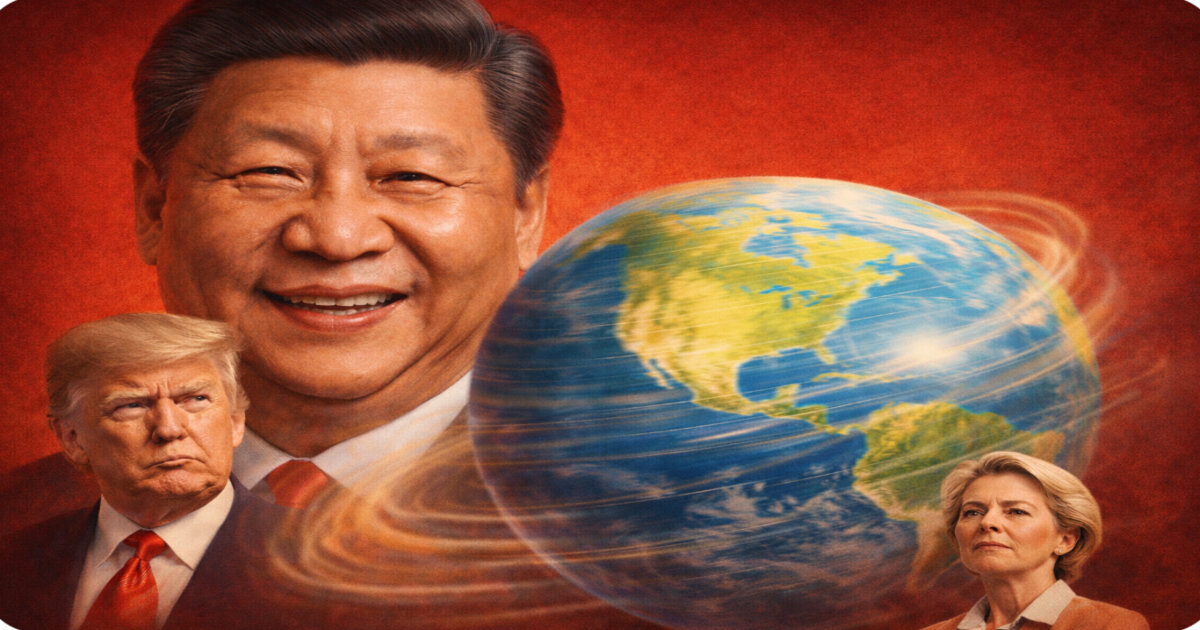
Meanwhile, China’s “globalist” leaders have more than enough reason to smile. They can hardly believe their luck in the face of the seemingly endless blunders of the entire West.
Takeaways
At the global level, Europe now has to deal with guilt by its (all-to-close) association with the United States.
That is the price for opting to sail globally under the wing of the United States -- whether for sheer convenience, lack of courage, competence, resources, political will or entrepreneurial momentum.
The Global South is tired of the EU's will/wallet gap and proposing global rules that the entire world should follow which aren't even sufficiently observed at home.
The young generation of leaders in the Global South, many of whom are well-versed in economics, realize that they can expect very little in terms of any meaningful material transfers from a Europe in secular decline.
Paradoxically, China can advocate a trade regime to its trading partners that is "free" in the sense of not being overburdened by either the cultural norms favored by the EU or the hyper-imperialist strategies of economic coercion employed by the U.S.
The brutal, power-based imperialism of the U.S – coupled with the EU's value imperialism – is causing enormous damage to the West.
China's “globalist” leaders have more than enough reason to smile. They can hardly believe their luck in the face of the seemingly endless blunders of the entire West.
A Global Ideas Center, Strategic Intervention Paper (SIP) from the Global Ideas Center
You may quote from this text, provided you mention the name of the author and reference it as a new Global Ideas Center, Strategic Intervention Paper (SIP) published by the Global Ideas Center in Berlin on The Globalist.