How Putin Comes Up Short Compared to Catherine the Great
Even after a more than quarter-century reign, Vladimir Putin comes up woefully short compared to Catherine the Great’s aspirations of empire.
March 24, 2026

Note to journalists: You may quote from this text, provided you mention the name of the author and reference it as a new Strategic Assessment Memo (SAM) published by the Global Ideas Center in Berlin on The Globalist.

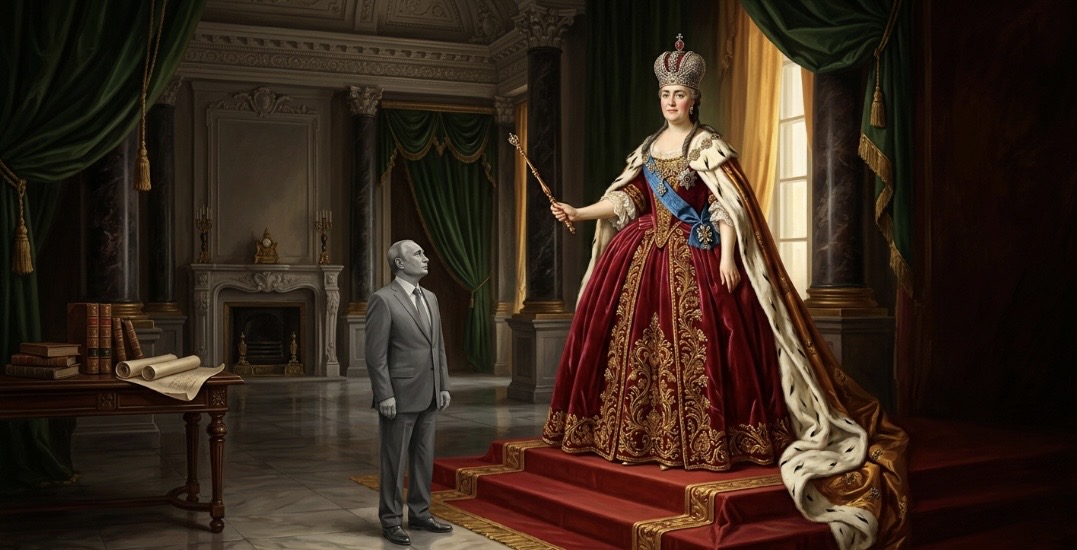
To his utter dismay, Vladimir Putin must realize that he comes up short compared to the only woman leader in Russian history, Catherine the Great.
Putin may have borrowed her vocabulary and aspirations of empire, but has proven incapable to match her capacity to turn war into lasting power.
Outperformed by a woman
This is all the more embarrassing for Putin as, from the first day of his rule in 1999 onward, he has built his political persona on two core tenets:
First, the image of a hard‑edged restorer of Russian greatness – a 21st‑century strongman correcting the “geopolitical catastrophe” of the Soviet collapse.
And second, as a man to whom women essentially are a non-entity in politics. His political regime is built on a peculiar hypermasculine form of political theater marked by male‑on‑male domination and the destruction of enemies.
Looking down on women
Women are relevant only to the degree that they are loyal to and supportive of the cause of a (supposedly) besieged, militarized nation. Putin’s Russia degrades women to be mere symbols, mostly as mothers and patriots.
Just like Donald Trump, Putin has made sexist or dismissive remarks about prominent women (e.g. Hillary Clinton), or directly intimidated women (e.g., by bringing his dog to a meeting with Angela Merkel knowing full well that she had a phobia about dogs).
This reinforced his swaggering macho style that treats assertive women as irritants or overly emotional. This is probably done in order to cover up his own level of insecurity.
Enter Catherine II
Yet, when Putin’s achievement as an imperialist are set against those of Catherine II, the 18th‑century Russian empress who actually redrew the map of eastern Europe, the contrast is brutal.
Over roughly three decades, Catherine extended Russia’s borders by about 520,000 square kilometres. Under her rule, “New Russia” was absorbed, the lands north of the Black Sea and Crimea (today largely in Ukraine), the North Caucasus, Belarus, Lithuania and Courland.
There are some fascinating parallels between the Empress and Putin. Both came to Russia from Germany, as Catherine was born in Stettin, Prussia (now Szczecin, Poland), and Putin spent his career as a KGB resident in Dresden.
Neither had any realistic prospects to become Russia’s ruler. Catherine became Empress as a result of a palace coup and Putin was dragged out of obscurity in 1999 and appointed by Boris Yeltsin as his successor.
Both were married, but had no spouse while they ruled Russia.
Finally, both faced an open rebellion, and dealt with it with great cruelty. Catherine had the Cossack rebel Yemelyan Pugachev publicly drawn and quartered. Putin ordered Yevgeny Prigozhin, the leader of the Wagner mercenary force who led a march on Moscow, to be blown up in a plane.
But where Catherine turned wars into enduring imperial gains, and ushered in what is still believed to be the Golden Age of the Russian Empire, Putin’s invasion of Ukraine has produced, a partial occupation and a grinding stalemate.
As to the Golden Age, Putin took a country that was enjoying the greatest prosperity in its history and dramatically weakened Russia’s long‑term economic and strategic position.
Not just a tale of different centuries
This is not just a tale of different centuries. It is a story of a male autocrat who glorifies imperial history but cannot replicate its successes—especially not those achieved by a woman.
Catherine II ruled Russia at a time when it was still consolidating its great‑power status. By the time she died in 1796, the borders told the story of a ruler who had translated military victory into durable statecraft.
Her conquests were not ephemeral, but cemented by treaties, populated by colonization projects and recognized, whether grudgingly or otherwise, by other great powers.
Her campaigns were integrated into a broader diplomatic and administrative strategy that converted battlefield triumph into lasting territorial and political order.
Where Catherine, a woman managed to turn war into settlement, Putin comes up empty.
Putin: Great ambition, little achievement
Putin’s Ukraine war began with similarly maximalist ambitions but has led to very different outcomes. The original design was a short, decisive “special operation”: the rapid seizure of Kyiv, to be followed by the presumed collapse or capture of the Ukrainian government, resulting in the subordination of Ukraine to the ruler in Moscow.
After years of fighting, Russia holds roughly a fifth of Ukrainian territory. However, the gains came in 2014 and in the early days of the full-scale invasion, while the political objective of subordinating Ukraine has completely backfired.
Ukraine is more consolidated as a nation‑state, more deeply integrated into Western military and political structures and, above all, more hostile to Russia, with hostility certainly enduring for generations to come. And, of course, none of the territories Russia claims to have annexed have been recognized internationally.
Where Catherine obtained treaties, Putin only has open‑ended disputes.
Crucially, his military moves have come at the cost of Russia’s broader strategic environment: the war has triggered rounds of sanctions and accelerated Europe’s energy and security decoupling from Moscow. It has also expanded NATO.
All of that is the very opposite of a successful imperial restoration.
Myth vs. performance
The particular irony in all this is that Putin is very keen on imperial history. Indeed, he talks about Russian history every chance he gets, including in meetings with Donald Trump and interviews with Tucker Carlson..
He has invoked historical “Novorossiya” to justify his designs on southern and eastern Ukraine and wrapped the annexation of Crimea in 2014 in the language of 18th‑century precedent.
Catherine’s conquest and integration of Crimea are part of the canon from which he draws legitimacy. Only he did not deliver.
The true Putin dialectic
This outcome is almost unbearable in terms of symbolism. After all, Putin’s regime is built on a patriarchal worldview that treats women primarily as mothers and nurturers, not as human beings having political agency, never mind having the capability of being strategic actors.
Against that backdrop, the most successful builder of “Russian” power in the very territories he claims to be restoring is a woman who commanded armies, bent great‑power diplomacy to her purposes and left a territorial legacy that he cannot reproduce.
If that is not the most powerful rebuke to the gender mythology he has promoted throughout his rule, what is?
Strenghtening his enemies?
Putin claimed that he was putting Russia’s enemies into their place. His invasion of Ukraine in 2022 was not only supposed to drag that country back into the Russian sphere of influence and away from the Western orbit.
It was also meant to scare NATO enough to force it to withdraw back to its 1997 borders – before the Western alliance was joined by former communist nations and three Baltic States.
Instead, Putin’s warpath resulted in two new members to join NATO Sweden and Finland. Ominously enough, Finland shares a 1,340 kilometer border with Russia and some people in Finland would dearly like to get back the Finnish territories the Soviet Union annexed after World War II.
By contrast, Catherine operated ruthlessly and effectively. Unlike Putin, who keeps losing well-wishers and allies (e.g., Nikolas Maduro in Venezuela and Ayatollah Ali Khamenei in Iran), she formed opportunistic coalitions and shared the spoils where necessary.
Above all, she knew when to translate military pressure into diplomatic results. That is precisely what is missing in Putin’s approach.
Conclusion
Putin set out to place himself in the Olymp of the great state‑builders of Russian history.
Thankfully, measured against Catherine the Great, he currently looks less like an heir and more like an imperial midget.
Putin may have borrowed Catherine’s vocabulary and aspirations of empire, but has proven incapable to match her capacity to turn war into lasting power.
Takeaways
Even after a more than quarter-century reign, Vladimir Putin comes up woefully short compared to Catherine the Great’s aspirations of empire.
Putin may have tried to follow the example of Catherine the Great, but has proven incapable to match her capacity to turn war into lasting power.
For Putin, the comparison to the Russian Czarina is especially grading. After all, he is a man for whom women essentially are a non-entity in politics.
Catherine the Great and Putin share a special connection. Both came from Germany to Russia as nobodies. Catherine was born in Stettin, Prussia (now Szczecin, Poland), and Putin spent his career as a KGB resident in Dresden.
The most successful builder of Russian power in the very territories Putin claims to be restoring is a woman. Catherine commanded armies and successfully bent great‑power diplomacy to her purposes.
Putin going on the warpath in Ukraine has completely backfired. Not only has it resulted in Sweden and Finland joining NATO. In addition, the alliance's determination is greatly enhanced..
Note to journalists: You may quote from this text, provided you mention the name of the author and reference it as a new Strategic Assessment Memo (SAM) published by the Global Ideas Center in Berlin on The Globalist.