The West Waves the Welcome Flags for World’s Dirty Cash
Money laundering expands as autocracy rises and anti-corruption enforcement declines.
March 28, 2026

Note to journalists: You may quote from this text, provided you mention the name of the author and reference it as a new Strategic Intervention Paper (SIP) published by the Global Ideas Center in Berlin on The Globalist.
Just recently, a “bomb” exploded in downtown Frankfurt when it finally became apparent that the Hilton Hotel there is part of the overseas investment network of the Iranian regime. Booking.com has suspended the hotel from its reservation service on news that a major investor in the hotel represents the Iranian Revolutionary Guards Corp (IRGC).
One more hit over the head
If Europeans needed one more hit over the head to understand the full scope of the unacceptable complacency of their governments from the UK, Luxembourg, Austria, Switzerland, France, Germany and Italy regarding money laundering and investment activities by oligarchs and kleptocrats and their agents, this certainly must have been it.
The question is: Will those countries’ governments act with more circumspection, rectitude, determination and courage this time around? Their past record of de facto aiding and abetting these activities is certainly a matter of great shame for all of those governments.
Not limited to Europe
Of course, the problem is not limited to Europe. It has long been part of the financial landscape. The welcome mat for dirty cash continues to attract funds on a vast scale also into the U.S., United Arab Emirates, Singapore and Hong Kong.
What is new is the rapidly rising scale of global financial crime, which are often met with declining efforts by many governments to rigorously enforce of anti-corruption laws and regulations, as well as expanding use of cryptocurrencies as tools for transferring dirty cash across the globe.
The damage to broad-based support for democracy is palpable.
The numbers
When I did research on the scale of money laundering back in 2020, the best data I could find suggested that the volume was between $1 trillion and $1.5 trillion annually. In 2023, the Nasdaq-Verafin research organization estimated that $3.1 trillion in illicit funds – or more than double – flowed through the global financial system.
Since then, the problem has gotten worse. The newly published Nasdaq-Verafin Global Financial Crime Report, states: “Since 2023, illicit financial activity has surged by $1.3 trillion, pushing the scale of global financial crime to an estimated $4.4 trillion at a 19.2% compound annual growth rate.”
Money laundering and authoritarianism go hand-in-hand
The rise in money laundering goes hand-in-hand with the continuing momentum behind authoritarianism. And remember that every authoritarian is a kleptocrat.
The new Global Democracy 2026 Report, published by the Varieties of Democracy Institute (V-Dem), offers further disconcerting news: “Democracy is back to 1978 levels for the average global citizen.
The gains of the “third wave of democratization,” starting 1974 in Portugal, are almost eradicated… Almost all aspects of democracy register far-reaching declines during the last decade – a dramatic reversal.”
Trump’s hyper-lax approach
V-Dem added that, “the USA loses its long-term status as a liberal democracy – for the first time in over 50 years.”
One prominent feature of the Trump administration over the past year has been the large-scale abandonment of enforcement of anti-corruption laws and regulations.
For example, under Trump in 2025, the Securities and Exchange Commission ended its two-year fraud investigation into the crypto-currency dealings of Justin Sun – yes the entrepreneur who came to global prominence for paying $6 million for a banana at auction.
That is the same Mr. Sun who said he was a major investor in Trump’s personalized meme coin, known as $STRUMP, and who invested $75 million in World Financial Liberty. (WFL’s founders are Donald Trump and his international envoy the New York real estate magnate Syteven Witkoff, and their sons.)
The SEC as a wallflower
And, to take one more example, President Trump pardoned Chanpeng Zhao, who had served four months in jail and whose company, the world’s largest Bitcoin crypto enterprise, BiFinance, paid a $4.3 billion fine in 2023 for money laundering, including funding terrorist organizations.
The SEC dropped fraud investigations into BiFinance last year. Mr. Zhao has entered into an array of business dealings with the sons of President Trump and Mr. Witkoff, with BiFinance being a WFL advisor.
Where is the UK?
As it happens, some of the grandest streets in North-West London are favored by the world’s oligarchs, organized crime czars and the agents of authoritarian leaders. The billionaire mansions, and UK property more generally, have long attracted even the greatest global scoundrels, from Iran’s regime to vast cyber-crime tycoons in Asia. They continue to do so.
The British authorities have been slow to curb the money launderers, perhaps because they loved so much cash flowing into the City of London via multiple holding companies. They are typically established in many jurisdictions to hide the identities of those companies’ true beneficial owners – the kleptocrats, crime bosses and major tax evaders.
Progress is slow
Progress is slow, but it does happen. Last October, the British finally imposed sanctions on Ali Aliakbar Ansari “for his role in financially enabling the work of the Islamic Revolutionary Guard Corps (IRGC).”
Ansari is a financial agent who reportedly owns, on behalf of his clients and via multiple holding companies, UK properties worth more than $100 million, including a mansion on The Bishops Avenue. Ansari is believed to have invested major sums in Europe on behalf of Mojtaba Khamenei, Iran’s newly appointed Supreme Leader.
UK baby steps
It was also only last October that the UK Government announced that it planned to bring fraud and money laundering charges against Chen Zhi, head of the Prince Group, based in Cambodia, that controls the world’s largest cyber-scam organization.
The Prince Group is believed to have more than 100 companies across the world and scores of prison compounds in Cambodia where kidnapped people with computer skills are deployed to scam the savings of tens of thousands of people across the globe.
Under intense pressure, the Cambodian government which had long protected Chen Zhi’s operations, agreed in January to extradite him to China. Among his vast global investments are London properties worth more than $140 million, including an Avenue Road mansion.
So many welcome foreign cash
Over many years, Russia’s most powerful oligarchs owned giant mansions in the UK. They were welcomed by the British authorities for bringing cash into the country.
UK authorities have failed to ensure that real estate agents undertake serious due diligence on their largest foreign clients. A number of the wealthiest oligarchs moved to Dubai after sanctions were imposed when Russia launched its invasion of Ukraine.
They are not alone. For example, BiFinance’s Changpeng Zhao, has noted that he is a UAE citizen and the country has no extradition treaties.
Rarely, but sometimes, the Swiss authorities do wake up
Then there is Switzerland, whose bank secrecy laws have long been a comfort to kleptocrats and tax evaders alike. Swiss authorities have consistently turned a blind eye to the kinds of clients that many branches of Swiss banks in Switzerland, as well as Swiss-owned banks have prized.
Lebanon’s financial crisis in 2021 caused to a considerable degree by the theft of hundreds of millions of dollars from the central bank, launched international criminal investigations. The trail led to the Geneva branch of Europe’s largest bank, UK-headquartered HSBC.
The Swiss financial authority FINMA asserted: “In its checks, the bank failed to recognise the indications of money laundering presented by these transactions; it likewise failed to satisfy requirements for the initiation and continuation of customer relationships with politically exposed persons, and was thus in serious breach of its due diligence obligations.”
The authorities told HSBC to swiftly end its relationships with “problematic” clients from across the Middle East, leading HSBC to end its relationships with over 1,000 clients that, according to The Financial Times, each held accounts of over $100 million. No doubt, however, those clients found welcoming banks, perhaps in Switzerland, or Austria, Liechtenstein, Luxembourg, or London.
Weak EU enforcement
To a very large extent, the EU has failed to pursue cross-border, large-scale bribery by multinational corporations. Perhaps, one might have expected increasing enforcement by some EU countries to counter the effect of the U.S. sharply curbing its enforcement of the Foreign Corrupt Practices Act. Unfortunately, this has not happened.
The OECD is of little help as well. Data on prosecutions, for example, in 2024 and 2025, by signatory countries to the OECD Anti-Bribery Convention, which covers 48 countries, has not been released by the OECD.
Instead, it has hidden the hard numbers in a new report that bunches all the data together for the 1999-2024 period. The fact is that successful prosecutions by EU countries in recent years have been minimal.
Germany’s problematic example
Deutsche Bank, notably the financial institution that Jeffrey Epstein and Donald Trump turned to when no other large bank would take their accounts, has a long history of being investigated and occasionally prosecuted for corruption-related offences.
The fines, when rarely imposed, have been small relative to the bank’s profits. No top executive has ever been prosecuted.
To date, while the UK finally sanctioned Ali Aliakbar Ansari – perhaps years after he started investing there on behalf of the IRGC – the EU has not seen to it that it sanction the financier. This despite reports that he has been involved in deals in Germany, Austria and the Netherlands.
The official excuse in Germany is that it cannot impose unilateral sanctions, but needs full EU enforcement. What then, I wonder, are the grey bureaucrats in Brussels waiting for?
Disturbing Prospekts
Detecting money laundering, meanwhile, is becoming far more complicated and there is no evidence that Western countries are increasing the resources necessary for investigations and prosecutions.
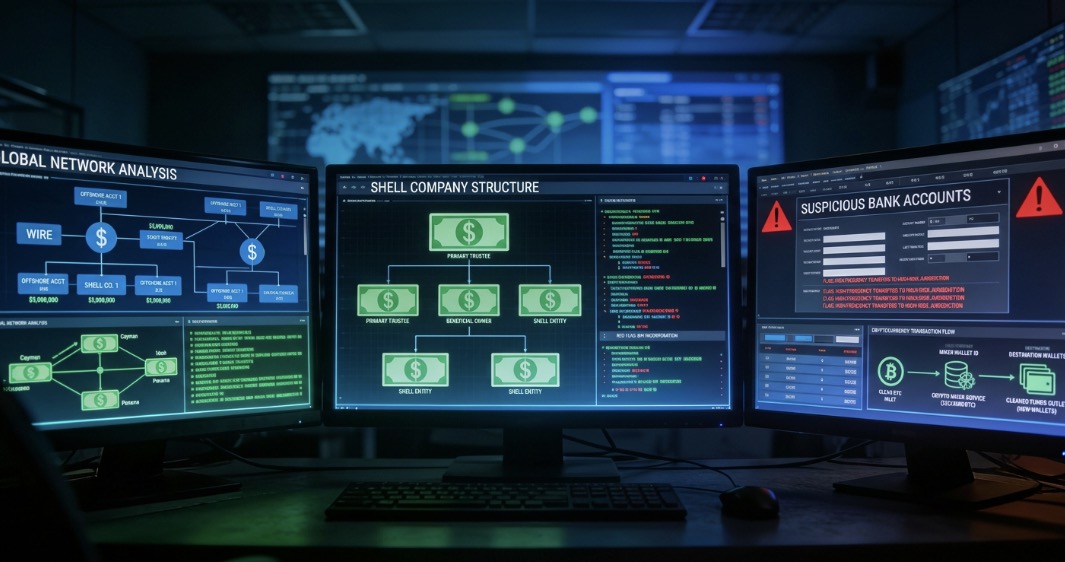
Crypto-currencies are rapidly becoming a major money laundering vehicle for organized crime and for terrorism financing, as cases against the Prince Group brought by authorities in Singapore, the U.S. and the U.K. underscore. At the same time, the scale of cyber scams is rising rapidly,
The FBI’s 2024 Internet Crime Complaint Center (IC3) stated that it received 2,000 complaints daily from individuals claiming that they have been defrauded. It estimated cybercrimes in the U.S. amounted $16.4 billion just in 2024.
That figure probably underestimates the volume by a most considerable degree. How so? Many individuals and many corporations that have been hacked and paid ransoms are not reporting.
Conclusion
The trends on dirty money flows and autocracy are deeply concerning. Meanwhile, then the concrete actions against investigations and against efforts to tighten money laundering loopholes are appaling.
An epilogue
Most recently, on March 19, 2026, in “Case No. 6:25-cv-127-JDK,” U.S. Federal Judge Jeremy Kernodle set aside the anti-money laundering rule for residential real estate and enjoined the U.S. Treasury from nationwide enforcement. In sum, real estate agents need not bother with any concerns about money laundering when selling properties.
Takeaways
Will European governments finally act with more circumspection, rectitude, determination and courage against money laundering?
Since 2023, illicit financial activity has surged by $1.3 trillion, pushing the scale of global financial crime to an estimated $4.4 trillion at a 19.2% compound annual growth rate.
Over the past year, the Trump administration has abandoned the enforcement of anti-corruption laws and regulations.
The British authorities have been slow to curb the money launderers, perhaps because they loved so much cash flowing into the City of London.
There had been hopes that increasing enforcement by some EU countries would counter the effect of the U.S. sharply curbing its enforcement of the Foreign Corrupt Practices Act. Unfortunately, this has not happened.
The official excuse in Germany to proceed against money laundering is that it cannot impose unilateral sanctions, but needs full EU enforcement. What then are the grey bureaucrats in Brussels waiting for?
Note to journalists: You may quote from this text, provided you mention the name of the author and reference it as a new Strategic Intervention Paper (SIP) published by the Global Ideas Center in Berlin on The Globalist.