Why Donald Trump Is China’s Most Valuable Asset
Given Trump’s approach to global diplomacy, is it really the “prisoner’s dilemma” that keeps the West from a coordinated strategy on China?
May 14, 2026

Note to journalists: You may quote from this text, provided you mention the name of the author and reference it as a new Strategic Assessment Memo (SAM) published by the Global Ideas Center in Berlin on The Globalist.

Beijing has spent decades hunting for Western technology, funding Confucius Institutes and building Belt and Road projects. Yet, it turns out that none of that has done as much to weaken the West’s urgent need for a coordinated strategic response to the competitive onslaught by China as one man in the Oval Office.
China’s leaders are pursuing a hyper‑strategic agenda in advanced manufacturing, green tech and more. The Australian Strategic Policy Institute now finds China leading research in 69 of 74 critical technologies.
The country also practices a very one-sided approach to trade policy. These two developments combined should provide enough of a wake-up call in Washington and every Western capital.
A strategy without a leader
Policy experts have not been idle. The Washington-based Information Technology and Innovation Foundation has produced a serious blueprint with more than 100 recommendations to slow China’s advance and rebuild Western strength.
The report calls for a new COCOM‑style export control regime, tighter limits on Chinese access to Western labs and universities, coordinated strategies against Chinese firms in third markets and restrictions on China’s access to Western capital.
There is just one problem: that strategy assumes a United States that actually wants to lead one.
That used to be a reasonable assumption. For decades, America’s credibility and predictability gave it enough political gravity to keep like‑minded democracies in its orbit. Under Donald Trump, that concept has vanished.
Instead of building a coalition to manage China’s rise, Trump is busying himself with wrecking the very idea of Western partnership – unless, of course, it takes the form of outright submission to Washington.
China and Russia off the hook
Trump’s trade policy hits U.S. allies across the world hard, while letting China and Russia, the two primary strategic rivals, off the hook.
During his most recent presidential campaign, Trump had always talked about how he wanted to use a very tough tariff policy on China to force it to become much more cooperative. Soon after taking office, he changed course, cutting China all sorts of slack.
Meanwhile, the trade policy community in Washington points to the game‑theory concept of the “prisoner’s dilemma” – which illustrates the paradox that two rational individuals (or, in this case, nations), each acting in their own self-interest, may choose not to cooperate even though it is in their best interest to do so.
Using this to explain the West’s lack of cohesion on China, while not irrelevant, is a complete cop-out. The split in the West has a name: Donald J. Trump.
Gutting the research base
The damage done by Trump on the China / Western competitiveness issue does not stop at the trade front.
At the very moment when competition with China demands more public investment in science and technology, Trump is taking a wrecking ball to the vast public funds which the U.S. federal government has traditionally provided to underpin the U.S. research base.
Slashed grants, demonized universities, shuttered lab programs, foreign scientists turned away — each one of these Trumpian policy steps is a strategic gift to Beijing.
A loner’s instincts
Why is Trump acting in this manner? Trump has always been a loner and outsider in his business career. He thus instinctively treats alliances as something to be avoided, not a strategic asset.
Unsurprisingly, countries like Canada, Germany, France and the United Kingdom are testing hedging strategies toward China.
That is less an act of cowardice than a rational response to a U.S. president who has signaled that he does not care whether his country’s long-time partners sink or swim.
The silence of the “adults”
The uncomfortable truth about Washington’s trade and tech policy scene today is that very few dare speak truth to power any longer.
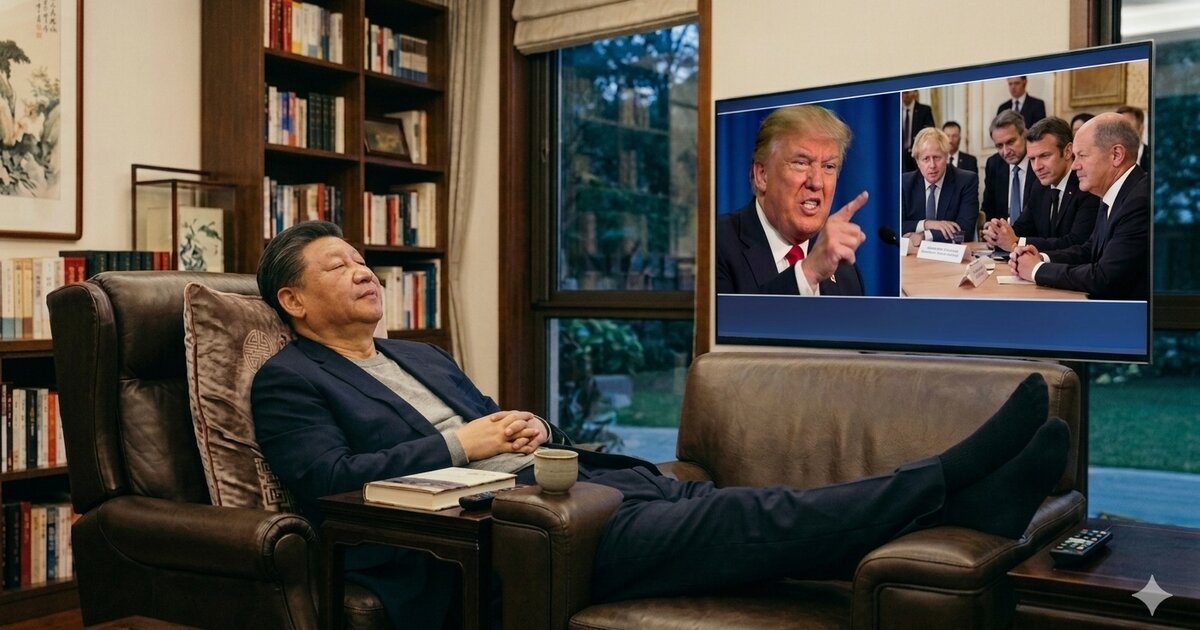
Trump’s hyper‑imperial posture makes China’s job easy. Beijing does not have to “divide the West.” The president of the United States is doing it for them, in full view of the world.
Any serious China strategy requires the opposite of Trumpism: coalition‑building, respect for multilateral commitments, sustained investment in research, as well as alliances treated as critical national infrastructure, not expendable props.
What is especially galling is the presumed “adults in the room”, first and foremost Scott Bessent, the U.S. Treasury Secretary, know all of this. And yet, they remain silent, preferring to turn into cowards, if not sycophants.
Until the United States can recover that kind of leadership, Donald Trump will remain the Chinese Communist Party’s single most valuable foreign asset — more useful to Beijing, in strategic terms, than he is to his bosom buddy Vladimir Putin, another congenital loner in high office.
Takeaways
China's very one-sided approach to trade policy should provide enough of a wake-up call in Washington and every Western capital to cooperate on trade strategy.
Trump's hyper-imperial posture makes China's job easy. Beijing does not have to "divide the West." The president of the United States is doing it for them.
Any serious China strategy requires the opposite of Trumpism: coalition‑building, respect for multilateral commitments, sustained investment in research, as well as alliances not as expendable props.
The Washington trade policy community points to the game‑theory concept of the "prisoner’s dilemma" to explain the West’s lack of cohesion on China.
The split inside the West on the strategic trade policy has a name: Donald J. Trump. Being silent on that is a complete cop-out.
Slashed grants, demonized universities, shuttered lab programs, foreign scientists turned away - each one of these Trump policy steps is a strategic gift to Beijing.
Donald Trump will remain the Chinese Communist Party's single most valuable foreign asset — more useful to Beijing, in strategic terms, than he is to his bosom buddy Vladimir Putin.
Note to journalists: You may quote from this text, provided you mention the name of the author and reference it as a new Strategic Assessment Memo (SAM) published by the Global Ideas Center in Berlin on The Globalist.