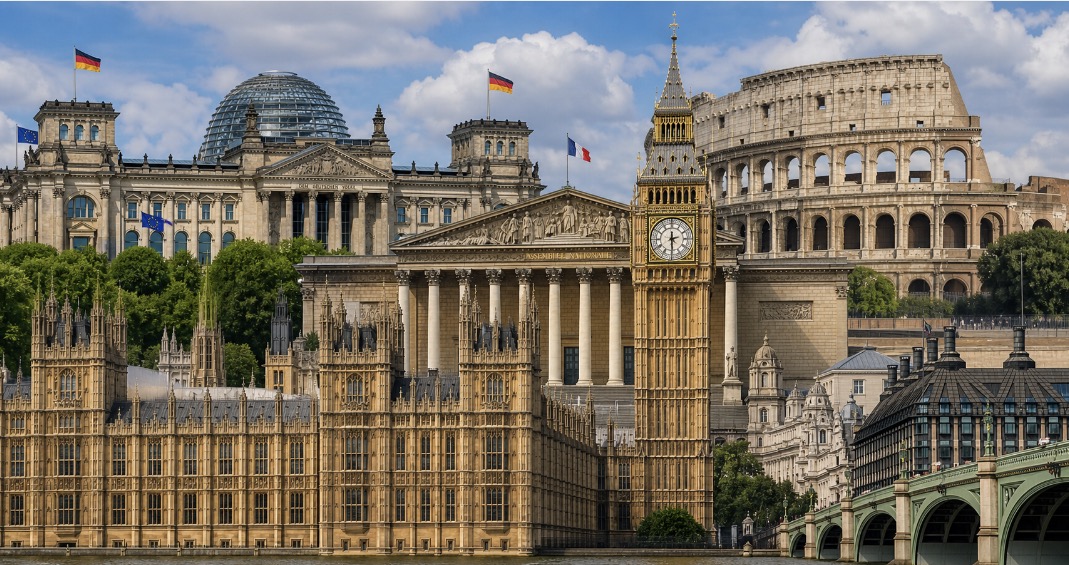
The 2029 British General Election Will Be Fought Over Europe
It is high time for a bold prediction.
May 12, 2026

Note to journalists: You may quote from this text, provided you mention the name of the author and reference it as a new Strategic Intervention Paper (SIP) published by the Global Ideas Center in Berlin on The Globalist.

Like a petulant phantom, the theme of Europe has haunted British general elections for decades.
Remember 1992 and the “No, No, No!” chant and other Maastricht machinations of the then-departed prime minister, Margaret Thatcher, echoing around John Major’s campaign? Those chants ended up in the heavy clang of “Let’s get Brexit done!” in 2019.
The next general election, currently scheduled for May in 2029, will be no different. The noise, however, from this unruly specter, will be cacophonous. The central issue of the 2029 general election will be Europe, specifically the economic savagery caused by Brexit.
Glory to Reform?
Reform UK, the far-right populist party headed by Nigel Farage, an architect of Brexit, scored historic wins in the local elections held in early May. The party added hundreds of seats and gained control over several councils.
It wasn’t the usual “mid-term hammering” of the incumbent party of government, it was the beginning of a new multi-party political era in Britain.
With the party, barely four years old, leading in the polls for the general election in 2029, it may be hard to imagine Europe being the prominent theme.
It would seem, given the party’s standing, that Europe is a resolved issue in the minds of the majority of Britain’s voters – a distant tryst, long forgotten.
Europe is far from forgotten
However, Reform UK’s poll local election victories and current nation poll lead are not a vote of approval for Brexit.
Like most populist parties, Reform mostly provides a space for people to yell, wail and protest at the state of the established parties.
Immigration is just one of their moans. Wages, class-sizes, house-prices, hospital waiting lists and the cost of living are among the others.
The economic dire straits of Britain
But it isn’t just Reform voters who have these concerns. The economic dire straits of Britain, laid bare by the woeful state of the public finances, are hurting everyone.
They range from those who access public services to businesses who are being choked of capital by ever-spiraling taxation. The British economy, because of its departure from the EU, is in a slow-motion atrophy.
Brexit as economic self-mutilation
The Brexit withdrawal agreement effectively severed Britain from its largest tariff-free trading partner.
In an astonishing move for a nation that for centuries has prided itself with good reason to have a clear grasp of its economic self-interest in international affairs, Britain swapped free access to the mightiest trading block in the world for relative isolation.
The unilateral trade deals it has signed since have not and will never fill the void left by its departure from the European single market.
Just consider the trade deal signed with India, the only one of real consequence in the last ten years. It is embarrassingly limp when compared to the strutting, all-encompassing deal agreed between India and the EU this year – a trade deal the UK would have been a beneficiary of had it still been in the European Union.
The UK will also miss out on the benefits of the recent EU trade deals with Canada, Australia and the MERCOSUR block.
Favoring the politics of anti-growth?
The withdrawal from the single market also led to a dramatic reduction in the UK of available labor and research-and-development initiatives. Cut off from ideas, people and markets, the growth trajectory of many British businesses has been stunted.
A case-in-point is the British defense sector, a key export industry which employs directly and indirectly over 390,000 British workers. In this era of frantic European rearmament, British firms have been forced to perch on the cliffs of Dover.
They stare longingly at the continent, as they are shut out from European weapons procurement schemes. It is estimated that the annual loss in GDP of this one exclusion alone could run into the billions of pounds.
Some exceptions
A few industries have not been harmed by Brexit. The banking sector has not suffered the decline some predicted Brexit would bring about. Revenues have been buoyant.
Financial services, though a key component of the British economy, will never be able to compensate for the economic harm suffered by the rest of the economy, no matter how much they flourish.
Not only will their revenues be insufficient, but as Thatcher’s bankers gambit taught us in the 1980’s, a booming City of London does little for unemployment in the north. With a Brexit-throttled economy, this is truer today than it ever has been.
Big losses
The net figures speak for themselves. In late 2025, Bloomberg Economics estimated that the Brexit has cost the British economy between £180 billion and £240 billion in lost output, annually.
Analysis by The House of Commons Library of the U.S.-based National Bureau of Economic Research 2025 report into the impact of Brexit estimates the annual loss of tax revenue to be between £65 billion and £90 billion per year. That’s a lot of hospitals and schools.
The harm cannot be hidden for much longer
There thus is no denying that Brexit failed, spectacularly, on virtually every economic front.
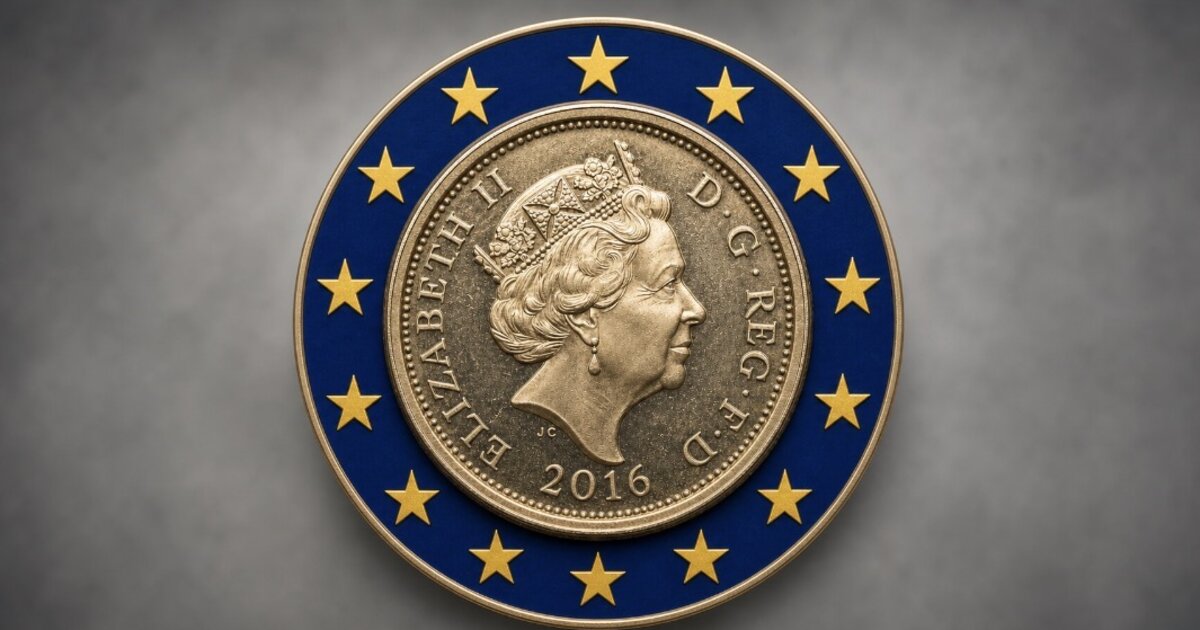
Daily lives are being negatively impacted due to an economy that is not growing at the speed it needs to. The desperate quest for growth keeps on hitting a dead-end, a towering wall painted blue, with a ring of twelve gold stars.
With significant economic growth unlikely, and UK government borrowing almost at its limit – the current debt to GDP ratio stands at 93.8% and the 10-year gilt return recently went beyond 5%, the British economy is caught in a fiscal vortex. It will get worse.
Taxes will continue to rise, as will cuts to spending on public-services. The market’s reaction to Liz’s Truss’s notorious tax-slashing budget during her 49-day premiership demonstrated the fragility of Britain’s public finances. In the three years since, the situation has worsened.
Hard to rebut daily realities
Though apparent in the minds of most economists, eventually the connection between eighteen-hour waiting times at hospital emergency rooms and Brexit will be made in the mind of the voter. And once it has it will be hard to deny or rebut.
The case is already being made. The chancellor of the exchequer, Rachel Reeves, in her Mais lecture spoke of the “deep damage” of Brexit to the British economy.
And in Sir Keir Starmer’s speech after the local election defeat he spoke about the need to “set a new direction” with the EU in order to put “Britain at the heart of Europe,” is evidence enough of his true instinct, though he will never act entirely according to his instinct and reverse Brexit entirely.
After all, bravery is not his strong suit. But the case being made is too subtle, and even it was more explicit, the trust between the voter and the prime minister, and his chancellor, has been shattered.
Labour Party leadership gambles
Others in the Labour Party, more trusted figures, such as London Mayor, Sir Sadiq Khan, are being more thrusting.
Sadiq Khan not only recently decried the economic impact of Brexit but called for Britian to rejoin the single market in this current parliament and for Labour to campaign to rejoin the European Union at the next election.
The thrice elected mayor is not only a popular figure, but a powerful one, too. It is perhaps only a matter of time until other senior members of the Labour Party leadership begin to vocalize their behind-the-scenes grumblings and break ranks publicly.
They will be confident doing so as over 80% of their voters, and Labour party members, would vote to rejoin the EU. Those within the parliamentary Labour Party not only sense an acute electoral threat if they don’t, but they also fear annihilation as a political force.
A group of Labour backbench MPs headed by Anneliese Dodds produced a pamphlet in March of this year entitled “Common Endeavor” advocating for a more aggressive realignment with the EU in the form a Swiss-style deal.
They are only too aware of the electoral danger of remaining blindly loyal to the Labour manifesto pledges made in 2024. The Labour Party is currently losing more supporters to the pro-EU, left-of-center Green Party than they are to the far-right, Brexit supporting Reform UK.
A Green Party pro-EU option?
The Green Party has, in the space of a few months, shaken off their malaise and miasma of un-electability which has shrouded them for decades, to capture the attention – and votes – of the center-left voter.
It too attained a record haul of council seats in the local elections. It has achieved this through the dynamic and charismatic leadership of Zack Polanski.
He connects to the voter through empathizing on core issues such as the crumbling state of hospitals, over-stretched schools, public-sector pay, the environment, and foreign policy.
Polanski isn’t blaming the immigrant for all the ills of the nation. He never mentions immigration – except to praise it, and yet his party soars in the polls.
The Green Party’s success at February’s Gorton and Denton parliamentary by-election cannot be overestimated. It has found a formula to not only beat Labour, but also Reform UK.
The Green Party has voiced the possibility that it will campaign in 2029 on reentry into Europe Union. The core argument for its position will be the economic pain caused by Brexit to the daily lives of the voter.
Its campaign will force The Labour Party to show its hand on Europe, and to admit that the piecemeal sectoral alignment attempted through Stramer’s reset has not gone far enough to repair the economic damage.
What about the Lib Dems?
The Liberal Democrats, Britain’s third-largest party by number of MP’s, will, given its fervent pro-European union stance, willingly join the battle.
They are keen to convince the electorate that Brexit is the cause of their ills, and Europe – be it through membership of the single market or full re-accession of the union, the remedy.
Reality checks
Neither the Green Party nor the Liberal Democrats will win the general election, but their non-negotiable price to support any minority Labour administration will be a radical reset of UK relations with Europe.
According to a recent YouGov poll, they are pushing at an open door. National sentiment is already with them. Over half of those polled support rejoining the European Union, with only 32% against.
For the first time ever, support to rejoin the European Union is above fifty percent in every age category polled, with the support among 18–25-year-olds at a staggering 83%.
Young people’s political frustration
The young people are feeling the pain and marginalization of Brexit more than any other group. Should, as is to be expected, Europe be on the ballot in some form in 2029, a youth surge should be expected.
It is also to be remembered that according to legislation currently working through the British parliament, 16-year-olds will gain the right to at the next general election.
Of all the options polled, a full-throated rejoining of the European Union was the most popular option in all age categories. It was considered preferable to the half-way-house of membership of only the single market or a Swiss-style deal.
Other recent polls show even wider margins for rejoining, and there are no outliers showing support for remaining out of the European Union.
Polls are not elections
Polls, however, are not elections. They are markers and trendlines of the national mood. All, however, lean in favor of Europe.
And as one month yields to another month, the lean becomes ever sharper. Harold Wilson claimed a week was a long time in British Politics. Three years is eons.
But if the drumbeat of Europe is beginning to bang in the mind of voters and politicians already in 2026, by the time of the next election 2029 the thud will become deafening.
The case for reintegration into Europe
The UK economy will not miraculously repair itself in three years. The case for reintegration into Europe will only grow stronger.
As a result, Reform UK will find itself increasingly on the defensive – but without much of a defense or a credible economic plan.
Nigel Farage, who was campaigning for a far more severe withdrawal agreement than the one eventually signed, will not be able to find an argument to rebut the case of economic harm.
Farage and others will likely blame extraordinary geopolitical and geoeconomic events – from COVID 19 to the Ukrainian war – for the UK’s economic downturn. Of course, events happen, always, and Britain will be affected by them, always.
The end of the Brexiteers’ stand-alone fantasies
It was always a fanciful assumption by the Brexiteers to believe that the British economy would be able to exist successfully in a political or economic vacuum.
The hopes for the U.S. stepping in most mercifully and gainfully for the UK in lieu of its access to Europe have been completely shattered as well.
The futility of nationalism
Belting out the national anthem at top voice and furiously waving the Union flag, as Farage loves doing in his performative approach to politics, will achieve nothing other than a sore throat and achy arms.
It will do little for the balance of payments deficit, the inflow of FDI or widening the UK’s fiscal headroom. The populist’s mono-policy of blaming the brown man for all the nation’s woes soon will be found wanting. Eventually, truth prevails.
What about the Conservatives in all this?
The Conservative Party was chopped down to an embarrassing stump in the last national election. It lost 223 seats to win only 121. After defections to Reform UK, the number now sits at 116.
So shellshocked by their defeat, and so terrified for the future, the MPs are keeping on message about Brexit – for now.
Remember that the EU Withdrawal Agreement has the Tories’ signature on it. For that reason, they will be the among the last to call it a flop.
Outside of the parliamentary party, however, Conservative voices are calling and have consistently called for closer alignment and rejoining.
Despite the perpetual Conservative psychodrama about Europe, it is not to be forgotten that the Conservative Party, has from Churchill onwards not just advocated for closer European integration, but passionately believed in it – and driven it.
The current bundle of Conservative MPs may be silent about reversing Brexit, but they are also silent about defending the economics of Brexit.
Note as well that no member of the Conservative shadow cabinet is hailing Brexit as an economic success for Britain. The voter will hear this silence at the next general election.
Hard-nosed EU?
Some may argue that Europe will be hardnosed in any renegotiation. But after the Ukraine war, Iran and the ongoing whiplash of the Trump presidency against NATO, it’s all a numbers game.
Despite its projection of nonchalance, Europe will bend over backwards and then twist sideways to have the UK back in the club.
The recent concessions offered to Iceland, a country of just over 400,000, to convince them join the EU, suggest that the previously thick red lines of Schengen, monetary union and the common fisheries policy are thick no more.
At best, they will be smudged into a faint pinkish blur in order to entice the world’s seventh-largest economy and a military powerhouse back into the union.
Join that EU?
True, the EU is a bloated organization ribboned with rules, but who cares? Its benefits far outweigh its failings. It is a mighty trading block with the world’s most advanced and educated consumer body.
There is no intelligent reason not to be part of it. Brexit has proven that. Moreover, at a time when the core pillars of Britain’s social justice infrastructure are beginning to buckle, the country needs any economic resuscitation option it can garner.
And while we Britons sensed the failings of an overly bureaucratized EU early, our long-time sentiments are now a familiar chant at the top levels of political leadership in even the most pro-EU nations of Europe.
Conclusion
The UK’s 2029 general election will be the election where the economic carnage of the British economy, laid bare, will be given a name – and that name will be Brexit.
The British electorate will be forced to reconcile with the economic chaos brought into their daily lives by leaving the European Union.
With the new political voices, and ever mounting evidence, the British voter will be urged, and perhaps convinced, to slay the demons of nationalist politicians’ false promise.
Takeaways
The UK’s 2029 general election will be the election where the economic carnage of the British economy, laid bare, will be given a name – and that name will be Brexit.
While we Britons sensed the failings of an overly bureaucratized EU early, this is now a familiar chant at the top levels of political leadership in even the most pro-EU nations of Europe.
With the new political voices and ever mounting evidence, will British voters be ready to slay the demons of nationalist politicians’ false promise?
Despite its projection of nonchalance, Europe will bend over backwards and then twist sideways to have the UK back in the club.
The current bundle of Conservative MPs may be silent about reversing Brexit, but they are also silent about defending the economics of Brexit.
Note to journalists: You may quote from this text, provided you mention the name of the author and reference it as a new Strategic Intervention Paper (SIP) published by the Global Ideas Center in Berlin on The Globalist.