2026 Looks Awfully Like 1914: A Historian’s Warning
In “The Coming Storm,” historian Odd Arne Westad argues that today’s great power rivalries closely resemble a time in the past — and the warning signs are flashing.
May 31, 2026
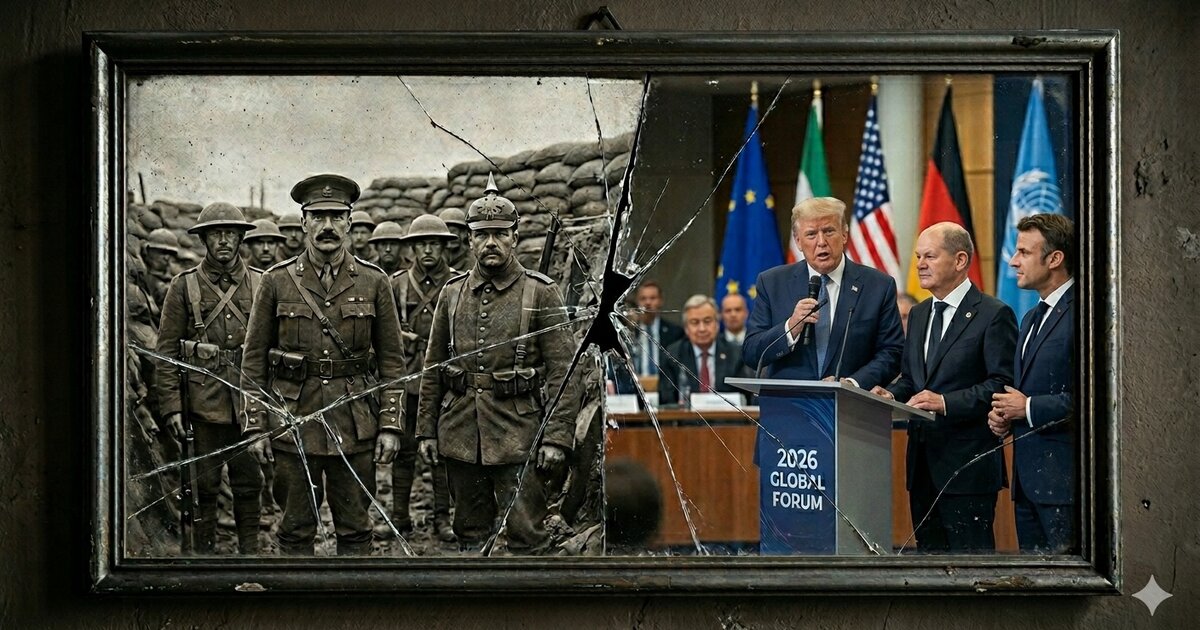

Many analysts may say the world is in a new Cold War, but it isn’t, writes Odd Arne Westad in his new book, The Coming Storm: Power, Conflict and Warnings from History.
Westad, a renowned historian of the Cold War at Yale University, argues that the period leading up to World War I is a much more accurate and troubling parallel.
The Cold War was an ideological contest between two camps led by the United States and the Soviet Union. In contrast, today we live in a world with a much less pronounced ideological divide in a more multipolar world, like that of the late 19th century.
A more dangerous time
True, the Cold War did pass through some dangerous periods. However, overall, it was a far more stable and predictable time than the world of today.
Moreover, the Cold War was brought to an end essentially by negotiation. Today, there seems to be little appetite for compromise in the various sets of intense rivalry-riddled relationships involving the United States, China, Russia and Iran.
The paramount similarity between the late 19th century and the world of today is that China is now challenging U.S. global dominance, while the late 19th century saw the unification and rise of Germany, which contested the dominance of Britain in Europe.
Britain then, the U.S. now
World War I followed a period of intensifying economic globalization. However, in Britain, until then the dominant world power, towards the end of the 19th century there was a sense that the system was not delivering, much as is the public sentiment in the United States today.
After being the leading proponent of free trade in the 19th century, Britain began withdrawing from the international system it had created. In its place, it resorted to tariffs and protectionism – again, like the United States today.
Echoes of Chamberlain
At the time, the British statesman Joseph Chamberlain, though he never became prime minister (he is not to be confused with his son Neville, who served as Britain’s Prime Minister from 1937 to 1940) was the driving force for breaking away from the free trade system. He thus played a role that is broadly similar in direction to that of Donald Trump today.
In a similar vein to America’s own gilded elite today, Britain also had its Edwardian gilded elite, which saw to it that the level of economic inequality was driven up even further.
The early 20th century was also characterized by rapid technological change. While that improved the overall lot of humankind, new technologies would also be turned to very destructive purposes. Just consider poison gas, aerial bombardment and stronger warships.
A cult of violence
The early 20th century followed a 19th century that had suffered little from great power conflict, certainly much less than earlier centuries had. But politics then saw a shift towards both the extreme left and right, along with a cult of violence.
The assassination of Archduke Franz Ferdinand, heir to the Austro-Hungarian throne, is a well-known event. In this context, Westad points out a truly startling fact: More heads of state were assassinated through terrorist action between 1900 and 1914 than at any other time in human history.
These factors did not push the world to war. But they did make it more difficult to step back as tensions rose following the assassination of Archduke Franz Ferdinand.
Are we better of today?
Westad recognizes differences between the current period and before World War I. Today, we know how events ended in 1914, which should be enough to inoculate us from future war.
In contrast to 1914, we have the United Nations and other international organizations, which are well placed to help manage political differences in a multipolar world, although the current U.S. administration has little interest in multilateral organizations.
Also, today we have weapons of mass destruction, which should act as deterrents to conflict, although recent threats to use them are a worrying sign.
The Taiwan flashpoint
Overall, the author has a very simple but challenging message: the need for great power compromise around issues that are of real significance.
And while he examines a number of hotspots, Westad recognizes that Taiwan is the most likely site for war between the U.S. and China, which could easily turn into an absolute disaster.
These tensions will likely be there for a very long time and must be well managed – something which is not happening now.
At the same time, Westad argues that US and Chinese administrations thinking rationally about Taiwan is imaginable.
This could entail the United States declaring that under no circumstances would it support Taiwanese independence, while China would declare it would not use force against the island, unless the latter declared its independence.
Conclusion
Westad’s hope for peace is inspired by the bold thinking that led President Richard Nixon to visit Chairman Mao Zedong and the desire to defrost U.S.- China relations.
In sum, Westad’s book offers a chilling warning of how things can go awry when international systems start to accelerate towards conflict – and the immense costs of war whose consequences can shape the world for generations.
Takeaways
While the Cold War was brought to an end essentially by negotiation, today there seems to be little appetite for compromise in the various sets of intense rivalry-riddled relationships involving the United States, China, Russia and Iran.
World War I followed a period of intensifying economic globalization. We just exited an even more intense period of economic globalization.
Towards the end of the 19th century, Britain - until then the dominant world power - was gripped by a public sentiment that the global system was not delivering. That is very similar to the mindset prevailing in the United States today.
The early 20th century was characterized by rapid technological change. While that improved the overall lot of humankind, new technologies also turned to be very destructive. Just consider poison gas, aerial bombardment and stronger warships.
Just as a century ago, the early 21st century has brought rapid -- and possibly very destructive -- technological innovations.
Curious fact: More heads of state were assassinated through terrorist action between 1900 and 1914 than at any other time in human history.