
Francis Fukuyama: History Continues. What Will Be the Fate of Western-Style Liberalism?
For many people, an order based on equal recognition of all people is not a satisfying outcome.
September 26, 2026
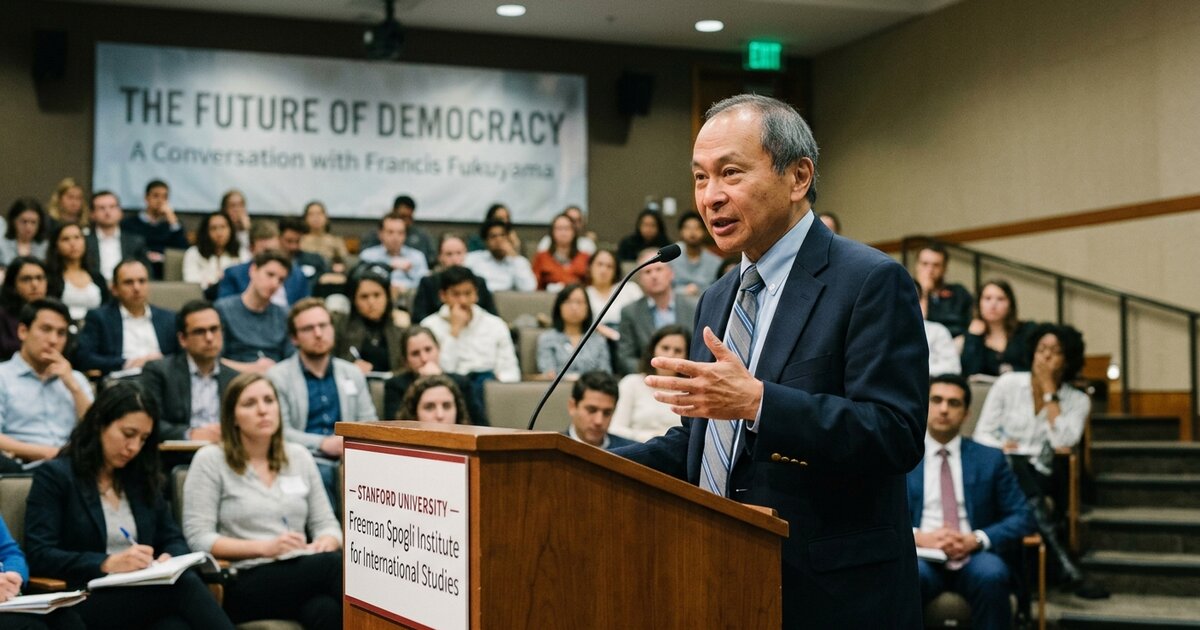

Francis Fukuyama earned international fame after The National Interest published his essay “The End of History?” in the summer of 1989, before the fall of the Berlin Wall.
The article, and the book that followed it, would later come in for a lot of criticism — although most of the critiques are misguided.
Fukuyama, who worked for the RAND Corporation when he wrote the essay, never claimed that nothing significant would happen in history from then on, as so many critics insinuated he did.
Critics should read past the title
Fukuyama simply doubted that an alternative to the liberal system would be found after the market economy’s clash with communism, which was heading toward its dissolution. He wrote about the end of history in a Hegelian sense.
Yet the essay and book came to be seen as an expression of “naïve liberal triumphalism,” likely by those who never read very far beyond the title.
History is not just a list of events
Fukuyama’s chief retort to the critics was to point out that his thinking was influenced by Alexandre Kojève, the Russian-French philosopher and Hegel interpreter. Kojève saw historical development less as a struggle for material resources than as a “competition for recognition” among peoples.
In his new book, The Last Man: Where Is the World Heading? Fukuyama, now a professor of political science who teaches at Stanford University, again turns his attention to the structure of human history.
A new kind of struggle
He again follows Hegel in describing most of human history as an unequal struggle between “masters and servants.” It was not until the French Revolution, Fukuyama writes, that the principle of equality was established as the only rational solution to the human struggle for dignity.
That principle would provide a foundation for the liberal social order that emerged from the revolution, and it subsequently spread to large parts of the world.
Peace and prosperity are not enough
It is now proving quite clear that, for many people, a liberal order based on equal recognition of all people is not a satisfying outcome. Many do not want to be recognized as equal to every other person on earth, but as superior in certain respects.
The problem facing liberal societies is that they concentrate on the mere pursuit of peace and prosperity. And while they have in many ways delivered those things, they have no answer for a type of human yearning that arises specifically at the “end of history.”
Unresolved issues
According to Fukuyama, it is a yearning characteristic of someone who is alien to struggle, risk and ambition — someone Nietzsche described as the “last man.”
According to Fukuyama, the realm of these last men has existed for some time. The extremism running rampant on the political right and left, according to Fukuyama, is for such people a way a revolt against the “flattened horizons” created by liberal societies.
Today’s people resist the call to be boundlessly open, tolerant and unprejudiced.
It is about respect
In Fukuyama’s eyes, material scarcity and injustice still exist in today’s liberal world. However, he believes the anger of the populists is fueled much more by resentment against a society that does not evenly distribute respect.
This anger drives them to use political power to restore the balance. They do not funnel this anger toward the creation of new institutions that could correct their subjective grievances. Rather, they simply want to destroy as much of the existing order as possible.
A history of predictions
Fukuyama’s insights about political radicalization in large parts of the still-liberal Western world have merit.
Fukuyama is noted for having been several months ahead of others in understanding the direction history was moving. For example, in May 1989 he advised James Baker to prepare for German reunification.
At that time, the Germany experts in the U.S. State Department still considered such a development highly improbable. Fukuyama also predicted the dissolution of the Warsaw Pact in 1991, earlier than others.
What does Fukuyama see today with a view to the future?
Fukuyama now finds reasons for concern about the future of liberal democracy. He identifies two problems in liberal societies.
On the one hand, they appear doomed to form ever larger and more complex governments, with countless laws and regulations that push even large data processing programs to their limits.
In principle, Fukuyama believes this process can be reversed and the laws simplified. But no society has made much progress in that direction.
Apparently, it is very difficult to find a middle ground between paralyzing procedural compliance and openly authoritarian rule.
The individual within society
The second problem that stubbornly pursues liberalism, according to Fukuyama’s observation, has to do with the limits to moral freedom.
Liberalism protects the individual’s freedom of choice. That freedom is considered a part of the dignity of all people. But it has always been understood to have some limits: One must not deprive others of their rights and must generally adapt to the demands of living together with other people who also have rights.
But over time, according to Fukuyama, the idea of moral autonomy has expanded even beyond the moral systems of traditional religions. The individual can set up his own social rules, and the only limit is that he must not cause physical harm to others.
Constitutional patriotism is an abstraction
For Fukuyama, diversity helps to promote creativity and innovation. But diversity for its own sake is not inherently a good thing.
Liberal societies tolerate diversity only within certain limits. But even in a liberal society, it takes work to arrive at a consensus about its nature and extent.
Fukuyama is convinced that a liberal society needs a national identity, in which liberalism itself ideally is at the center.
In the United States, this means loyalty to the Constitution and the Declaration of Independence. In Germany, the “constitutional patriotism” propagated by Jürgen Habermas demands unity within an increasingly diverse German society.
The problem, according to Fukuyama, is that such civil identities are weak in modern liberal societies — in large part because they are so diverse.
Why populism is an easier sell
National identities in eras past were usually built on a shared history, language, culture and religion, as well as a common food culture, common holidays and, yes, shared race and ethnicity. And indeed, those identities exerted a much stronger emotional pull.
Much of the appeal of today’s right-wing politics, from Narendra Modi’s movement in India to Christian nationalism in the United States, rests on the narrower but stronger sense of community such movements provide, according to Fukuyama’s analysis.
From this, he deduces that the central challenge for today’s liberals is to strengthen the sense of national identity without slipping into an openly illiberal direction.
Nothing on the horizon
To make matters worse, liberalism and liberal democracy appear to be plagued by a phenomenon Fukuyama calls the “last problem:” Liberalism, when it succeeds, produces peaceful and prosperous societies “that seem to flatten the human horizon.”
These societies may be better than the dictatorships, theocracies or aggressively nationalist societies from which they emerged.
But a people’s memory is shaped by generational cycles, according to Fukuyama, and a nation eventually forgets that which drifts away in its history’s wake.
Looking for a cause
In addition, expectations of politics are growing faster than political institutions can change.
This drives discontent, because people would want to continue fighting for a “just cause” even if they had no clear idea of what a just society should look like.
Fukuyama concludes that, to this day, no one has landed on a new architecture that could accommodate the “last man at the end of history.”
But the goal to develop one remains. In this sense, the story continues.
Takeaways
The critics of Francis Fukuyama’s “End of History” always failed to understand what the thesis was. Following a Hegelian approach, he simply doubted that an alternative to the liberal system would be found after its clash with communism.
Liberal societies’ triumph led to the rise of the “last man” — a character who is alien to struggle, risk and ambition, but yearning for recognition.
For many people, a liberal order based on equal recognition of all people is not a satisfying outcome. They do not want to be recognized as equal to every other person on earth, but as superior in certain respects.
Fukuyama is noted for having been several months ahead of others in understanding the direction history was moving. For example, in May 1989 he advised James Baker to prepare for German reunification.
Liberal democracy appears to be plagued by what Fukuyama calls the "last problem:" Liberalism, when it succeeds, produces peaceful and prosperous societies "that seem to flatten the human horizon."
According to Fukuyama, modern liberal societies must solve the problem of weak civic identities. Much of the appeal of today's right-wing politics rests on the narrower but stronger sense of community their movements provide.
Fukuyama concludes that, to this day, no one has landed on a new architecture that could accommodate the "last man at the end of history." But the effort to find one must continue.