
A Short Global History of the Fork
The democratization of eating utensils only occurred in the early 20th century. Do you know what the decisive step was?
February 12, 2026
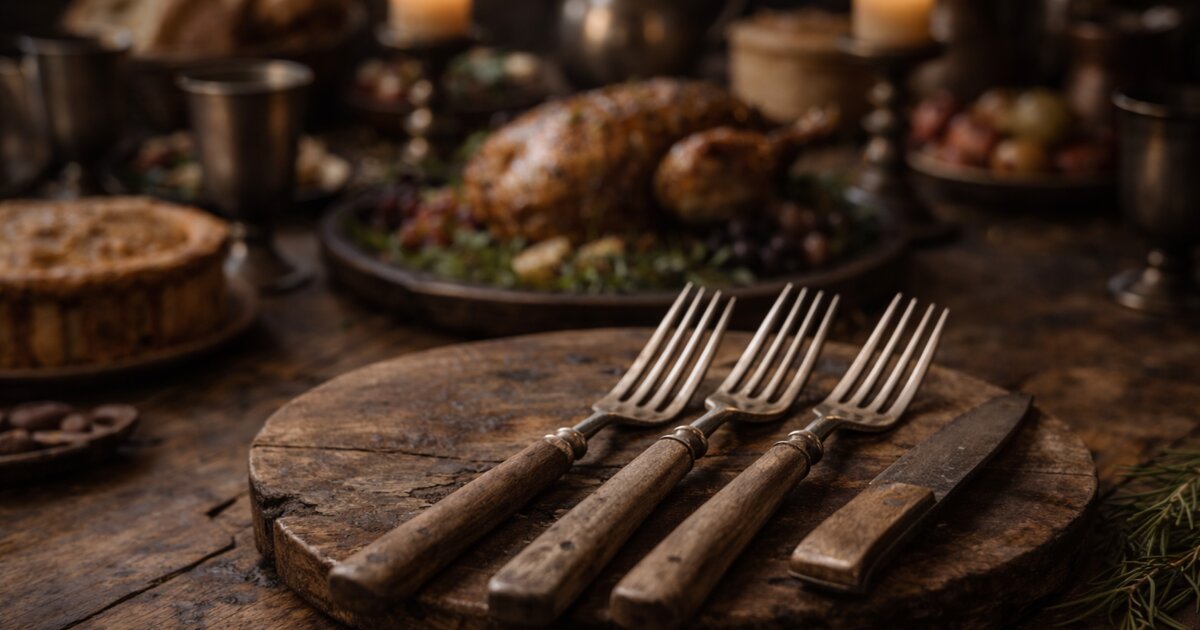

Utensils have always been contentious. When the Greek niece of Byzantine Emperor Basil II, Maria Argyropoulina, was married in 1004 to Giovanni Orseolo, son of the Doge of Venice, its head of state, she horrified the Venetian oligarchy.
How so? Simply by using a golden two-pronged fork which she had brought in her dowry in order to spear the morsels her eunuchs chopped her food into.
Fingers as natural forks
While an early version of the fork must have been known, having long been used in cooking and ceremonies by the Ancient Egyptians, a prominent Venetian cleric begged to differ.
He apparently proclaimed, “God in his wisdom has provided man with natural forks – his fingers. Therefore, it is an insult to Him to substitute artificial metal forks for them when eating.”
God’s vengeance?
When Maria Argyropoulina – along with her husband and their son – died two years later of the plague, it was considered God’s vengeance.
I slightly empathize with the priest. As diners across the Middle East, India and Africa know, food eaten with the fingers tastes so much more delicious. Think of roti with dhal, fufu with stews, kota and kebabs and more.
Or, in other time zones, think of a gnawed chicken leg, those last flakes pried from behind the gills of a fish, spring rolls, spare ribs, tacos, shrimp, a Silver Queen corncob dripping with butter… The list is endless.
When forks became fashionable
Only when Catherine de’ Medici, wife of Henri II of France, brought home souvenir forks from a trip to Italy did they become fashionable. (Me, I ferry home quarter wheels of Parmesan).
However, with just two tines, they weren’t of much use for conveying any range of foods to the mouth. This changed only in the early 1700s when the canny Germans added extra prongs.
Knives led the way
As to knives, those have a much longer pedigree. They started off as sharpened flints, man’s earliest tools.
But knives didn’t really transform into useful utensils until around 3000 BC, the Bronze Age, when copper mixed with tin created a harder metal, allowing for long tapered blades with sharp edges.
Right until the late 16th century, you brought your own knives with you when invited out to dine. What stood in their way was that their use encouraged table manners Cardinal Richelieu of France disapproved of. Think of guests picking their teeth with their hunting knives.
Such practices provoked him to rule that any knife to eat with should have a rounded end – et voilà! the dinner knife was created.
But what about the further evolution of the fork? Because without the hunting knife’s sharp point to spear their meat to gnaw at like a lollipop, diners required some implement to hold it down to cut into it.
Stainless steel and the democratization of eating utensils
Still, it took centuries before any such elegant dining equipment reached the poor, and then only from 1913, once Sheffield metallurgist Harry Brearley revolutionized the cutlery industry with the invention of stainless steel, making it affordable for all.
Takeaways
As diners across the Middle East, India and Africa know, food eaten with the fingers tastes so much more delicious
Right until the late 16th century, you brought your own knives with you when invited out to dine.
The democratization of eating utensils reached the poor in 1913, once Harry Brearley revolutionized the cutlery industry with the invention of stainless steel, making it affordable for all.