
A Test Even More Severe Than Watergate
The erosion of the rule‑of‑law culture is not confined to Orban’s Hungary or PiS’s Poland. It is currently underway in the United States.
May 27, 2026

Note to journalists: You may quote from this text, provided you mention the name of the author and reference it as a new Strategic Intervention Paper (SIP) published by the Global Ideas Center in Berlin on The Globalist.

Richard Nixon’s “Saturday Night Massacre” sought to place the U.S. Justice Department under total White House control. The then-Attorney-General and the Deputy Attorney General resigned. But ultimately Nixon failed and justice prevailed.
Now Donald Trump, through his Acting Attorney General Todd Blanche (who used to be one of his private defense lawyers) has secured total control of a special government fund.
He has artfully converted it to the financial benefit of Trump’s family, the financial benefit of those who are loyal to him irrespective of their criminal records, and to the distress of all his perceived enemies who he wishes to jail.
Blanche vs. democracy
In a document fit for a king, hence harkening back to the feudalist era, Blanche signed a one-page official statement that the U.S. government would be “FOREVER BARRED and PRECLUDED” from prosecuting any tax claims against Trump, his sons and their businesses.
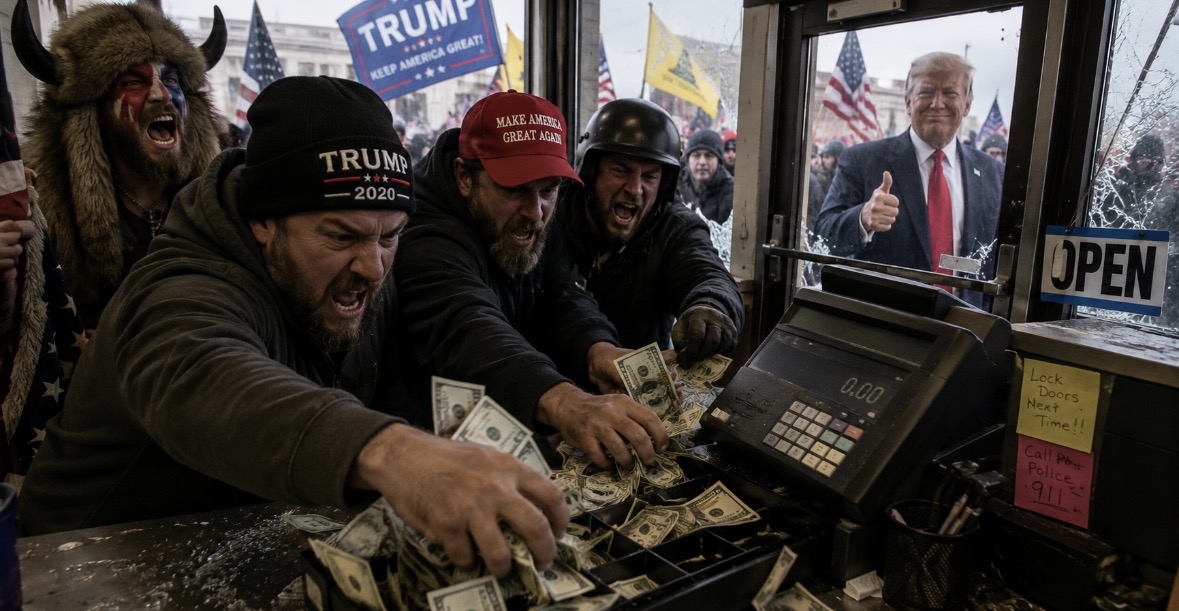
Then the Justice Department announced a $1.776 billion slush fund, to be operated in secret and used to compensate whoever Trump likes – such as the convicted felons who stormed the U.S. Capitol on January 6, 2021.
Trump’s enemies list
Trump has a long list of enemies and increasingly these include journalists. On Air Force One, returning from Beijing on Friday, Trump accused David Sanger, a senior reporter at The New York Times of treason for asking a question about the Iran war, adding that Sanger only publishes the fake news directed by his editors.
For many decades, U.S. administrations under both Republican and Democratic leadership, as well as the country’s professional, political and civic elites have been telling the world about the U.S.’s superiority with regard to its legal and constitutional mechanisms.
Gutting of the most basic principles of democracy
That self‑image is now confronting a test. The outcome will depend less on Donald Trump.
Rather, it depends on how – or even whether – America’s political class, legal profession, media and civil society manage to respond to stop this continued gutting of the most basic principles of any, never mind a mature democracy.
Toward a strange form of regional convergence?
If unsuccessful, the conversion of the United States into a banana republic becomes ever more a reality. Indeed, the U.S. is well on its way, for no barrier to corruption in government is more important than the rule of law where every citizen is treated equally.
That is a form of regional convergence with the most regressive regimes in Latin America that should leave any upstanding American completely speechless and resolved to prevent such a development.
Rewarding the January 6 rioters
The immediate trigger is a highly controversial “Anti‑Weaponization Fund” worth nearly 1.8 billion dollars, created by the U.S. Department of Justice as part of a settlement in a lawsuit Trump brought against the Internal Revenue Service over the leak of his tax returns.
In exchange for dropping his claim, the government has agreed to establish a fund that will compensate people who claim to have been victims of “political weaponization” of the justice system under previous administrations.
Although officials insist that Trump personally cannot apply, the fund is plainly designed to benefit his allies and supporters, and it may well extend to individuals convicted in connection with the storming of the Capitol on January 6.
Subversion via “creative” uses of existing legal instruments
The architecture of this scheme matters because of what it reveals about the direction of U.S. constitutional practice. It does not rely on the overt suspension of law, but on the creative use of existing instruments.
In this case, it (ab)uses a federal settlement fund originally designed to pay court judgments against the state in order to channel public money toward a politically defined constituency.
The line between a neutral mechanism of legal redress and a clientelist patronage tool is being deliberately blurred. Yet the decisive question is not whether Trump is willing to cross that line. It is whether the country’s institutions will let him.
The broader responsibility of American elites
This is where the broader responsibility of American elites comes into view. They have always presented the U.S. constitutional order as resilient because it is built on more than formal rules.
In their telling, it rests on a culture of self‑restraint, a shared understanding that certain uses of state power are off‑limits – even if they are technically lawful.
Lofty and proud patriotic rhetoric aside, that culture – notably the reference to the “spirit of the Constitution” – always needs to be tested in the real world.
That is now what is at stake. If a U.S. President can convert legal settlement mechanisms into a nearly billion‑dollar compensation pool for his own political camp – and this blatant abuse is met with a shrug among virtually all Republican politicians – then the problem is no longer one man’s norm‑breaking. It is a collective abdication.
Trump makes – and breaks
Just how fickle (or immature?) U.S. democracy is at this stage, became apparent in the latest primaries for Republican candidates for the Congressional elections in November.
Trump’s backing is decisive. If Republicans want to keep their seats, they better not anger Trump. All Republicans know it.
If the Democrats win Congress in November, then the investigations of Trump and his henchmen will start. Until then, the man in the White House considers himself the supreme ruler, no irony intended. But the success of those investigations with regard to real sentences or even removal from office is to be doubted.
The responsibility is Congress’s
A legislature that takes its own role seriously cannot be content with symbolic denunciations. It must use every constitutional tool at its disposal.
They include challenging dubious settlements in court, tightening the legal framework of federal compensation funds, imposing reporting and approval requirements, as well as considering censure or even impeachment if red lines are crossed.
If, instead, one party treats the fund as an acceptable price for loyalty to a leader, and the other is effectively reduced to scoring talking points in the daily messaging war.
Why is that so? Because the U.S. Constitution and political procedures do not provide for sharper instruments for the opposition. Under those circumstances, the U.S. Congress effectively consents to the transformation of neutral legal instruments into partisan spoils.
The legal profession
American lawyers, judges and law professors have built entire careers on the idea that the U.S. legal system embodies an unshakable commitment to the rule of law. That proud claim is more more ritualized than real in the Age of Trump.
It will not survive if the profession responds to this moment meekly, whether by “virtue” of evasive technicalities or partisan-driven sophistry.
The country’s bar associations, former Justice Department officials, conservative legal networks and law schools face a stark choice. If they do not stand up now, they turn the practice of law in the United States into just another branch of loyalty politics.
Civil society and media
U.S. media have been rightfully proud of their investigative traditions and their insistence that public and political power must be subject to scrutiny.
But what is clear now is that genuinely systemic shifts have too often been conveniently explained away as mere partisan skirmishes. And yet, a compensation scheme that could pay out to the people convicted of the January 6 attacks is not simply “one more controversy”.
It is a decisive step toward political clientelism clad in a thinly veiled legalistic scheme. If media outlets treat this as a passing story and fail to articulate why this is an immense transgression, they will themselves have become complicit in the erosion of the boundary between rule of law and patronage.
Business and financial elites
For decades, U.S. business and financial elites have been proud to advertise the U.S. legal system to their global counterparts as a stable, predictable framework that underpins investment and innovation.
Yet many in business have long been reluctant to speak out when that system is bent for political ends, as long as tax cuts and deregulation measures kept flowing.
The question is whether this will be different now. The emergence of an absurd, politically defined compensation mechanism should be a wake‑up call. A U.S. federal government that has quite literally been hijacked to reassign legal redress funds to pay presumable political “victims” is a massive departure even from any standard of the rule of law.
Seen from Europe
These developments in Washington come as a shock not because they do confirm the validity of anti‑American prejudices, but because they expose a shared vulnerability.
The erosion of the rule‑of‑law culture is not confined to Orban’s Hungary or PiS’s Poland. It can occur even in a democracy with functioning courts and a very sophisticated legal profession.
The current case shows how quickly presumably neutral, technocratic tools can be grotesquely abused for ultra-political purposes once elites lose the will to restrain themselves – and how much depends on whether those elites are prepared to treat that politicization as intolerable.
Conclusion
The United States remains a democracy. Its courts can still limit executive power. However, as of now, no one should hold their breath whether the U.S. Supreme Court under John Roberts will rise to meet its clear constitutional responsibilities.
In determining Trump v. USA in 2024, the Roberts’ court said the President has immunity for all official acts, while never defining this latter term. Now, the Supreme Court may be forced to be more precise.
So far, it has turned itself into a politicized body that basically approves whatever Trump wants and stretches what it considers constitutional provisions to ends never even remotely imagined before.
If the “Anti‑Weaponization Fund” survives essentially intact, then the damage will be deeper than any single scandal. It will mark the moment when the country’s elites decided that the notion of American exceptionalism meant not a higher fidelity to law. What is underway in the United States would even have made Viktor Orban in Hungary blush.
Takeaways
What the U.S. faces if Donald Trump succeeds with his conversion scheme for a legal settlement mechanism, the problem is no longer one man’s norm‑breaking. It is a collective abdication.
For many decades, U.S. administrations, both Republican and Democrat, as well as the country’s professional, political and civic elites have been telling the world about the superiority of its legal and constitutional mechanisms.
U.S. political, business and civic elites now face a test even more severe than Watergate.
In 1973, Richard Nixon had to place the U.S. Justice Department under total White House control. Two attorneys-general resigned. But ultimately Nixon failed and justice prevailed.
If the effort to stop the slush fund to benefit the January 6 rioters is unsuccessful, the conversion of the United States into a banana republic becomes ever more a reality.
Note to journalists: You may quote from this text, provided you mention the name of the author and reference it as a new Strategic Intervention Paper (SIP) published by the Global Ideas Center in Berlin on The Globalist.