Dealing with Donald Trump is Like Trying to Catch a Falling Knife
Europe is no longer protected by warm transatlantic sentiment. It is less constrained by Trump than by its own lack of readiness.
February 5, 2026
A Global Ideas Center, Strategic Intervention Paper (SIP) from the Global Ideas Center

You may quote from this text, provided you mention the name of the author and reference it as a new Global Ideas Center, Strategic Intervention Paper (SIP) published by the Global Ideas Center in Berlin on The Globalist.


Donald Trump has blown up any notion of the United States continuing to act as a benevolent hegemon to Europe and the so-called “free world”. Even before, that benevolence always came with significant commercial and financial benefits the country and its corporations derived from U.S. international engagements and alliances.
Trump’s approach represents a systematic weaponization of interdependence. To him, tariffs, threats of tariffs, secondary sanctions, informal pressure on countries, industry sectors and companies are not outliers but instruments of routine statecraft.
The U.S. government is now using access to its market, its currency and its technological ecosystems as levers to engage in continuous acts of extortion that are, perversely, primarily directed at its own allies.
For the EU, that turns every major issue into a risk management problem – but one in which the other side is constantly escalating the risk.
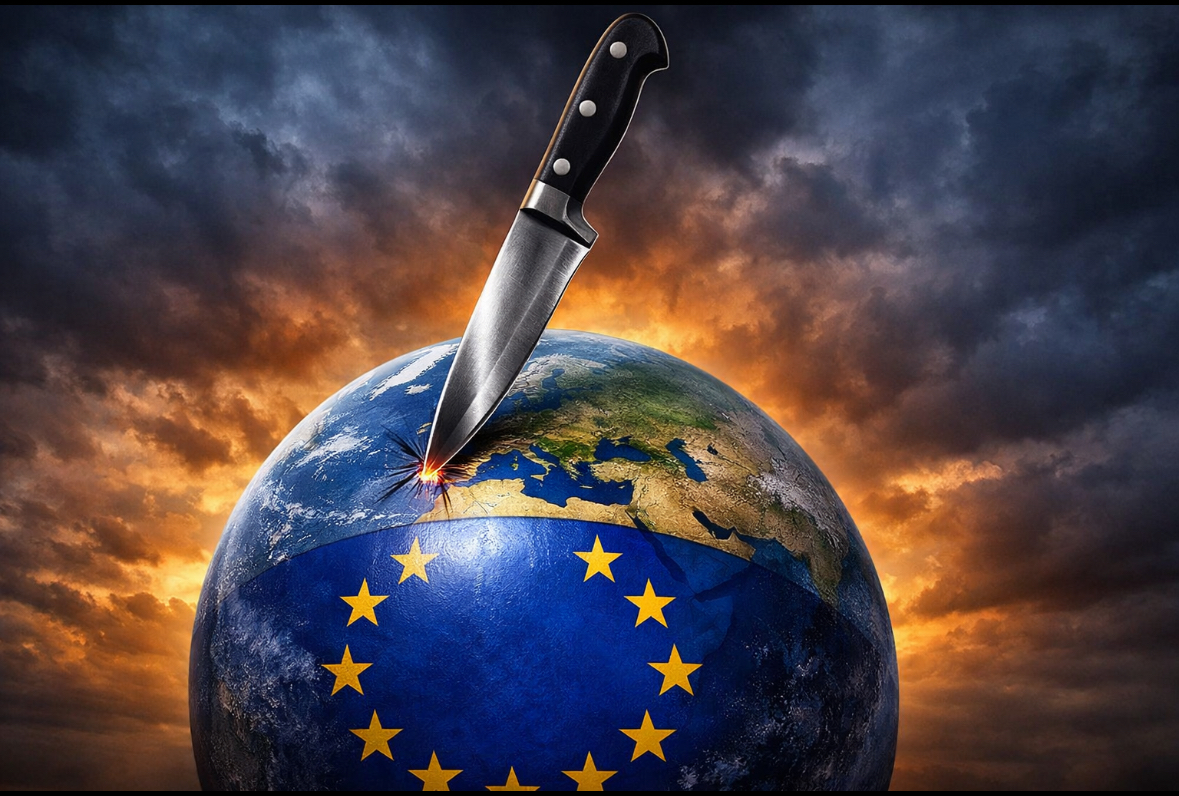
The falling‑knife metaphor
In the world of finance, “catching a falling knife” refers to intervening in a rapidly deteriorating situation (such as a plunging asset price) where predicting the bottom is nearly impossible and where premature action often leads to further losses.
Applied to EU–U.S. trade, the metaphor implies that the EU is never able to shape events but constantly scrambling to limit damage in an environment of asymmetric initiative and escalating pressure from Washington.
Each time Trump announces or hints at a new tariff package or a new linkage between trade, defense spending and foreign policy subservience, if not submission, the EU faces a grim choice.
Should it agree to asymmetrical concessions on industrial tariffs to avert broader sanctions? Adjust its regulations to placate U.S. concerns while insisting that “nothing fundamental has changed”?
The misapplied precautionary principle
That the EU member nations find themselves in this position is ultimately the consequence of its misapplying the famed precautionary principle.
In EU law and practice, the precautionary principle is applied in situations of scientific uncertainty. It is designed to undertake protective measures when there are reasonable grounds for concern about the possibility of serious or irreversible harm.
The underlying idea is to shift policymaking from “wait for full evidence” to “act early to avoid large, potentially irreversible risks”, especially in health, environment and safety regulation.
First, do no (self-)harm
The paradoxical fact is that policymakers in countries across the EU failed to apply the precautionary principle where it matters the most. EU nations are woefully unprepared for a full‑scale transatlantic trade war, or a deeper security rift in a world shaped by Russian aggression and Chinese assertiveness.
Above all, Europe was caught in a reckless belief that the United States would forever act in a benevolent fashion, gently prodding the Europeans, but not really showing brutally that the presumed European emperor had no clothes.
A precautionary culture applied to international relations would have been about more than converting real uncertainty into purely rhetorical calls for strategic autonomy. To make matters worse, whether toward the United States, Russia or China, this morphed into a culture of strategic denial.
For years, the EU chose merely to talk of strategic autonomy or strategic sovereignty. And yet, it never fully internalized the possibility that a U.S. administration might treat one day Europe as a target rather than a partner.
Nobody to blame but ourselves
It was us Europeans who offered ourselves up to Trump’s brutality. We chose not to build robust buffers. We chose not to invest seriously in autonomous software or payment systems, not to fully de‑risk crucial supply chains, not to develop a credible and politically unified toolbox of anti‑coercion measures.
We preferred to believe that the post‑war arc of transatlantic relations – despite quarrels over Iraq, over data or antitrust – would always reliably bend toward cooperation.
When coercion replaces cooperation
That ill-fated belief is now colliding with a harsher reality. Trump has long shown a penchant even inside U.S. domestic politics to take openly punitive approaches to anybody and everybody who did not fall into full submission to him. It isn’t just Democrats, but also many Republicans that have come to experience his utter vituperativeness.
The same applies internationally.
A truly precautionary European approach to the United States would have started from a sober premise: U.S. benevolence is not a dependable variable. U.S. interests are.
Rather than assuming alignment, the EU should have systematically stress‑tested its dependence on favorable American decisions – in security, energy, technology and finance.
Credulity and complacency as strategic doctrine?
The EU never asked itself how much coercion its current level of exposure invited. It did not identify critical choke points where unilateral U.S. measures would create maximal damage and then move step by step to reduce that vulnerability.
Instead, all that “precautionary” Europe could muster is to focus on repairing the imbalance in negotiation dynamics. So it has been walking into talks with the U.S. side primarily focused on “saving the relationship.”
Indeed, the EU has for decades behaved like a tough regulator at home and, vis-à-vis the United States, like a romantic partner who is now sorely disappointed about the withdrawal of transatlantic love. Throughout, it has refused to see the warning signs, many of which preceded Trump’s return to the Oval Office.
The core problem? Wishy-washy Germans
The core problem is that Germany, Europe’s largest economy and, theoretically, its most important country, to this day does not have any form of strategic culture. In fact, Bismarck seems to have been the last German leader who could be considered having those qualities. And he left office back in 1890!
After 1945, to be sure, Germans basically subcontracted their strategy to a succession of U.S. governments, first as a consequence of a war lost, later on as a matter of selfish convenience. Under those circumstances, a culture of strategic thinking never developed. And to the extent that it exists (meekly), it is still mired in bureaucratese.
There is no denying that this fundamental German deficiency has harmed all of the EU.
The path forward
That path forward is politically hard. It requires honesty with European publics about the limits of American reliability, without lapsing into anti‑Americanism. It primarily requires Berlin to stop outsourcing strategic judgement to Washington by default, and to accept that “European sovereignty” is not a slogan but an expensive and, yes, a contested project.
Most of all, it requires abandoning the comforting fiction that the transatlantic relationship is self‑correcting. It is not. Relationships between powers are maintained, or eroded, by choices actively made.
Conclusion
Trump’s imperialism has its benefits for Europe. He has made it unmistakably clear that Europe cannot continue to live in a world where dealing with Washington means trying to catch a falling knife – improvising bootstrapped solutions after each shock, consoling itself that things could have been worse.
It is high time for the EU member countries to finally apply the internal philosophy of precaution into its foreign policy strategy. This requires accepting that real prudence sometimes means stepping back, re‑arming and building a system where one is better shielded from falling knives. That is the real transatlantic challenge Trump forces Europe to confront.
Takeaways
In the world of finance, “catching a falling knife” refers to dealing with a rapidly deteriorating situation where predicting the bottom is nearly impossible.
Applied to EU–U.S. trade, the EU is hardly able to shape events but constantly scrambling to limit the damage from Trump's asymmetric escalation moves.
The EU's famed precautionary principle is applied in situations of scientific uncertainty to guard against the possibility of serious or irreversible harm.
Leaders all across the EU have failed to apply the precautionary principle where it matters the most -- in internationale relations.
For decades, the EU has acted as a tough regulator at home and, vis-à-vis the United States, like a romantic partner who is now sorely disappointed about the withdrawal of transatlantic love.
The path forward requires honesty with European publics about the limits of American reliability, without lapsing into anti‑Americanism.
It is high time for the EU to finally apply the internal philosophy of precaution to its foreign policy strategy. That is the real transatlantic challenge Trump forces Europe to confront.
A Global Ideas Center, Strategic Intervention Paper (SIP) from the Global Ideas Center
You may quote from this text, provided you mention the name of the author and reference it as a new Global Ideas Center, Strategic Intervention Paper (SIP) published by the Global Ideas Center in Berlin on The Globalist.