Germans’ New National Sport: Blaming Friedrich Merz for Everything
Blaming the current chancellor cannot conceal the deeper, collective responsibility for Germany’s nearly 20 years of drift.
June 19, 2026

Note to journalists: You may quote from this text, provided you mention the name of the author and reference it as a new Strategic Assessment Memo (SAM) published by the Global Ideas Center in Berlin on The Globalist.
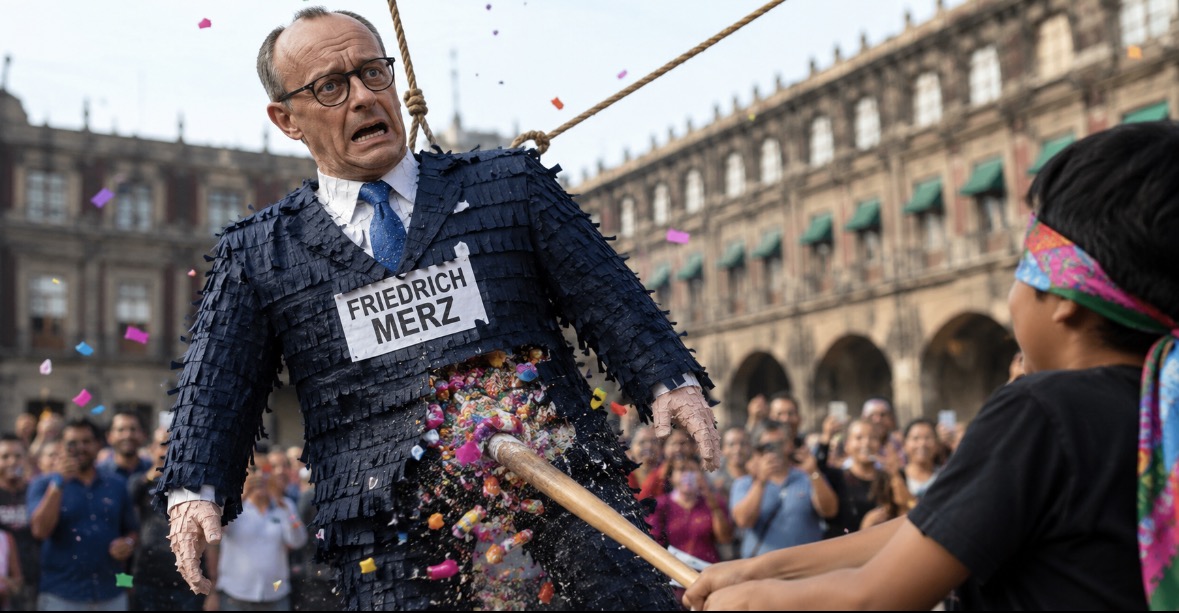
Germans are eagerly engaging in a new national sport. They blame Friedrich Merz, the head of their federal government, for all of the country’s woes.
That impulse says less about Mr. Merz than about the political maturity of the Federal Republic.
Who drives the “it’s all Merz’s fault” narrative?
Without any question, Mr. Merz certainly has his flaws, whether in terms of his communications or his management style.
The anti-Merz mood is driven by a combination of two forces: First, there are the left-of-center politicians and the large media segment that is sympathetic to it.
They simply bemoan the fact that the previous government, the “traffic light” coalition with the Social Democrats and Greens, was voted out of office.
The other driving force is that many Germans still idealize Angela Merkel’s long, somnolent time as German Chancellor between 2005 and 2021.
Ducking the hard choices
The net effect of this is that this yearning for nostalgia has allowed the German political class both on the left and the traditional right to avoid the more awkward question of tackling the hard choices on governance and reform.
Turning the current chancellor into a national piñata has also produced an unintended consequence. In the polls, it has strengthened precisely the very force which Germany’s mainstream parties profess to contain, the far‑right Alternative für Deutschland.
Goodbye to hard-headed virtues
Germany’s post‑war success rested on two estimable virtues: economic realism and a willingness to embrace structural reforms. Over the past two decades, both have eroded.
The symptoms are now visible in faltering growth, chronically weak investment and a policy debate strangely detached from global competitive pressures — or, at best, unable to translate rhetoric into action.
Angela Merkel’s hand at the tiller
Merkel was a neophyte when she took office as Chancellor when it came to the complex issues of economic, fiscal and social policy.
She decided early on to smooth over any of the inescapable conflicts, whether on infrastructure spending, education, digitalization, fiscal sustainability, labor markets, energy or industrial strategy.
Because she was largely unwilling to confront the structural constraints of an aging, export‑dependent economy, the result was stability without direction. In many ways, she chose to reign as the nation’s anesthetist, her projection of calmness covered up what was essentially an escapist act.
Merz’s economic message: Relic from another era?
In today’s Berlin, it is fashionable to dismiss Merz’s economic message as a relic from another era. But is that really so?
Many of the themes he raises — demographic headwinds, the burden of an ever‑expanding welfare state, suffocating regulation — have become more urgent, not less.
To wave them away as retrograde obsessions is to indulge in Merkel-style self‑deception yet again.
Tackling in 2026 what was on the agenda already in 2005
Consider this political thought experiment: Had Merz, rather than Merkel, taken the chancellery in 2005, Germany would likely have had its present argument about socio-economic trade‑offs and priorities two decades earlier.
Instead, the country used the long upturn of globalization as an excuse to avoid painful debates about competitiveness, social insurance and the state’s role in steering investment.
The problem with “competitive overpromising”
Responsibility for Germany’s current drift is widely shared. After all, all major parties have engaged in what might be called “competitive overpromising” — ever more generous pledges on pensions, benefits, climate spending or tax relief, with little regard for fiscal realities.
Over time, this pattern has systematically fueled voter frustration.
The AfD simply exploits frustration
The AfD has exploited that frustration. The response of the established parties to date — to avoid tackling the underlying issues, from reviving growth to redesigning migration, education and climate policy — is self‑defeating.
The party that most loudly promises to “say what others won’t” inevitably profits when the the economy is turning downward and the political mainstream confines itself to mere posturing.
The “firewall” against the AfD: An excuse for inaction
Germany’s centrist parties have erected what they call a Brandmauer, a “firewall” against the far right, which translates into a pledge of no co‑operation with the AfD at any level.
In practice, ritualized references to this firewall have been abused as an excuse for achieving very little progress in actual policymaking.
To the mainstream parties, clinging to the firewall mantra offers a very short-sighted form of mutual reassurance.
While many AfD proposals are half‑baked, illiberal or unconstitutional, voters increasingly see the invocation of the firewall as the governing parties’ convenient cover-up for their own paralysis.
How to achieve a fresh start?
Escaping this impasse will require more than a new face in the chancellery or another governing coalition. That is a political experience tying the contemporary UK and Germany closely together.
What Germany needs is a leaner, more focused state, a serious assault on bureaucratic obstruction, greater technological openness and a renewed respect for economic reality.
If and when that happens, Germany can deliver better results on competitiveness, defense, digitalization and decarbonization — and finally rely much less, or so one hopes, on elaborate ideological disputes as a substitute for result-oriented politics.
The hardest task
The hardest task for the German people and its political leadership alike will be to accept that their country’s past success relied on a unique constellation of globalization tailwinds that has now faded.
Those benign conditions allowed Berlin to postpone difficult trade‑offs for years, and to compensate domestic “losers” of policy battles more generously than many of Europe’s “winners”.
That pattern greatly distorted the mechanics of German politics by allowing decision-makers to avoid making tough decisions. It makes corrective action that much harder today.
More honesty about trade‑offs
Above all, German politicians need to be more honest with voters about trade‑offs. As the AfD’s constant rise in the polls indicates, the permanent incantation of the Brandmauer cannot substitute for finally delivering overdue reforms of the tax system, welfare state, energy transition and migration regime.
The habit of blaming the current chancellor may feel comforting, but it cannot conceal the deeper, collective responsibility for Germany’s near 20 years of political and economic drift.
Takeaways
Blaming the current chancellor cannot conceal the deeper, collective responsibility for Germany's nearly 20 years of drift.
Germany’s post‑war success rested on two estimable virtues: economic realism and a willingness to embrace structural reforms. Over the past two decades, both have eroded.
Had Merz, rather than Merkel, taken the chancellery in 2005, Germany would likely have had its present argument about socio-economic trade‑offs and priorities two decades earlier.
he hardest task for the German people and its political leadership alike will be to accept that their country's past success relied on a unique constellation of globalization tailwinds that has now faded.
What Germany needs is a leaner, more focused state, a serious assault on bureaucratic obstruction, greater technological openness and a renewed respect for economic reality.
Benign economic conditions allowed Berlin to postpone difficult trade‑offs for years. It could compensate “losers” of domestic policy battles more generously than many of Europe’s “winners”.
Note to journalists: You may quote from this text, provided you mention the name of the author and reference it as a new Strategic Assessment Memo (SAM) published by the Global Ideas Center in Berlin on The Globalist.