The U.S. Constitution as a Global Security Risk
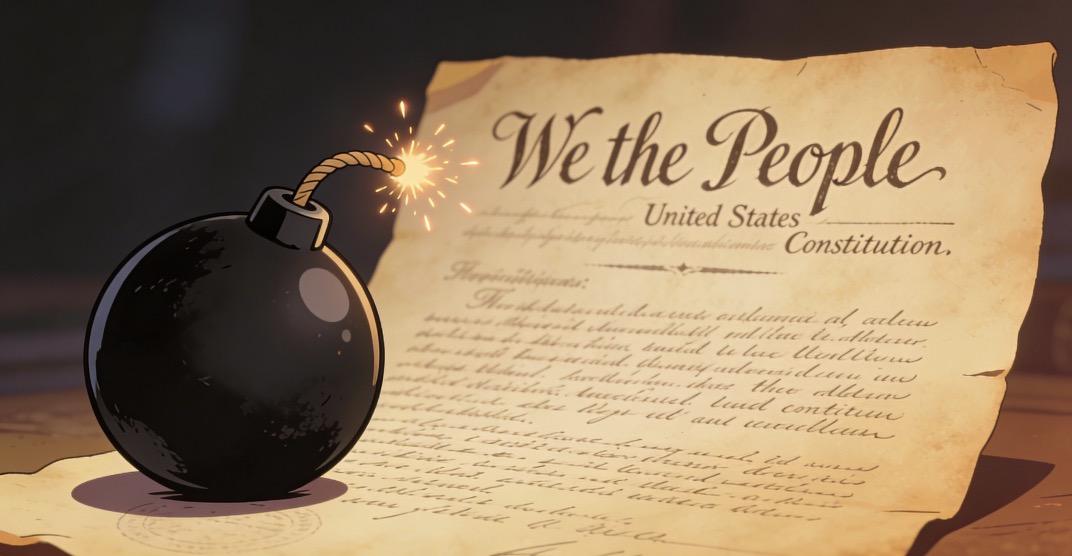
The combination of an inflexible U.S. constitutional structure and a shift to hyper‑presidentialism create big risks for the wider democratic world.
March 27, 2026
A Global Ideas Center, Strategic Intervention Paper (SIP) from the Global Ideas Center

You may quote from this text, provided you mention the name of the author and reference it as a new Global Ideas Center, Strategic Intervention Paper (SIP) published by the Global Ideas Center in Berlin on The Globalist.

The U.S. Constitution has always been risky business for the U.S. political economy domestically insofar as it imposes 18th century values onto the 21st century. These features include its de facto unamendability, the disproportional weight it assigns to rural populations, its implicit dislike of any elements of social policy as well as its checks on the will of the wider population.
By now, it is no exaggeration to speak of the U.S. Constitution as a global security risk. We live at a time when one man, literally by incessant strokes of the pen, has chosen to disregard virtually all checks and balances that are traditionally part of the U.S. political fabric.
To date, the efforts by the judicial branch to put strict and very necessary limits, if not a clear stop to many of these para-constitutional activities by the Trump administration are limited at best. In the end, they may even prove improbable as far as the often all-decisive dimension of the U.S. Supreme Court is concerned.
The global link-up
What has not been given proper attention in that process is that Donald Trump has created serious risks for the security, freedom and prosperity of people far beyond the United States itself.
This is a direct consequence of the fact that the U.S. government has long been preeminent among Western nations and, in many ways, served as a standard setter globally.
That the United States has reversed its stance as a global driver of democracy and shared prosperity globally is an unexpected development. Until now, this seemed to be a topic reserved for world of literature, in the segment of dark political novels featuring Trojan Horse presidents.
An imperial presidency and a toothless democracy
This global risk has obviously manifested itself in a very concrete fashion most dramatically with President Trump’s ability to launch a war of choice against Iran without any Congressional approval.
The often discussed War Powers Act, which Sees to shield the nation against a repeat of fundamental errors committed in the years of sliding into the Vietnam war, has proven toothless yet again.
The fact that Donald Trump even chose to pursue his endeavors in Iran completely counter to the firm promises to, and they clearly expressed continuous will of his MAGA movement, speaks further volumes about the flawed domestic mechanisms of American democracy.
The (real) EPA stunner
But the global risk dimension of American legal procedures also became clear for the entire world to see recently when the Trump administration rescinded the EPA’s 2009 “endangerment finding.” This administrative act provided the legal foundation that allowed the agency to regulate greenhouse gases like CO₂ as pollutants under the Clean Air Act.
With the U.S. thus effectively opting out of this crucial part of the global movement to promote the sustainability of our economies, the pressure on other countries with lesser economic means to stay the course becomes ever more pronounced.
Trump’s deplorable, but ultimately unsurprising move aside, what is truly stunning is that such an advanced nation bases key parts of its environmental policy on such a brittle – and, as we now see, easily revocable – legal basis.
This state of affairs is largely a consequence of U.S. Republicans’ longstanding insistence on altering next to nothing about the U.S. Founding Fathers’ constitutional determinations which to this day by and large reflect the political preferences of an agrarian and feudalist society.
A highly partisan Supreme Court
This general finding about the riskiness of the U.S.’s constitutional structure and provisions is even pronounced due to the U.S. Supreme Court’s highly partisan “jurisprudence” under the aegis of John Roberts.
Over the past 15 years, it has further maximized the U.S. Constitution’s already strong bias toward presidentialism and, implicitly, Republican rule.
Scholars increasingly describe the U.S. Constitution as one of the world’s most difficult to amend in practice, given the supermajority hurdles in Congress and three‑quarters of the states.
Utterly inflexible
Under the prevailing partisan and federal dynamics, no large‑scale reform project to provide a sensible update to 18th century provisions stands any realistic chance of ratification. These include the electoral college, a malapportioned Senate, lifetime Supreme Court tenure and presidential powers.
As a result, the process of democratic self‑correction must run through informal channels – norms, statutes and judicial interpretation – rather than through constitutional redesign.
The pathway to the latter is structurally blocked even though broad majorities of the American public perceive systemic failure.
From checks and balances to “checks only”
Traditionally, American politicians have reflexively referred to the importance and reliability of “check and balances” to safeguard the separation of powers in their nation.
Two problems stand out in this regard. First, ever since the Supreme Court altered U.S. campaign finance rules to remove any meaningful limits on corporate donations, it has been more appropriate to refer to “checks only” (i.e., money) as the predominant factor shaping the U.S. political economy.
Second, as Donald Trump’s complete disregard for checks and balances underscores vividly, those check and balances currently add up to little more than a house of cards.
At least with a politically submissive Supreme Court under the misleadership of John Roberts, it is crystal-clear that the U.S. system of government currently relies on a very brittle basis – good intentions and good will. Hopefully, that won’t prove fatal.
Presidentialism goes amok
The ultra-conservative legal movement in the United States has long pushed the cpuntry’s highest court to interpret the U.S. Constitution’s bare‑bones Article II to support a “unitary executive” view and to strengthen the model of a highly centralized presidency.
According to this script, the goal is not just for the president to control the entire executive branch, including so‑called independent agencies, but to implement what constitutional scholars describe as a clear drift toward authoritarianism.
This manifests itself in the political defiance or slow‑walking of court orders, the aggressive use of pardons and personnel purges, as well as systematic attacks on the media, universities and NGOs, which are often followed by limited or no institutional retaliation.
Worse, since the Supreme Court has turned itself into a branch of the U.S. government that is largely submissive to the current U.S. president, while the U.S. Congress is acquiescent, we are witnessing a near-complete reversal of the separation of powers.
Toward autocracy?
In Trump’s second term, this trend converges with the implementation of a political program (e.g., “Project 2025”) to purge the civil service, politicize prosecution, neutralize independent oversight and treat agencies as direct instruments of presidential will.
At the same time, the Supreme Court’s ruling in Trump v. United States extending broad immunity for “official acts” significantly weakens the ability of Congress and the courts to hold a president criminally accountable while in office, and arguably even afterward, for a wide range of abuses.
These developments greatly widen the zone in which an ambitious president can stretch or violate norms without fear of effective sanctions, bringing the system closer to an “imperial presidency.”
A significant loss in the midterms elections scheduled for this coming November may reduce the imperial element of the Trump presidency somewhat, but certainly not sufficiently.
Spillover risks for the wider “free world”: A close-up
Because of the U.S.’s traditionally predominant role in economic, military and regulatory affairs, an authoritarian drift in Washington – against which the provisions of the U.S. Constitution evidently prove powerless – has immediate international consequences.
1. Security
An unconstrained U.S. president can abruptly reorient alliances, nuclear posture and commitments to NATO or Asian partners, forcing other democracies into potentially destabilizing arms races or risky hedging strategies virtually overnight.
2. Race to the bottom
When the flagship democracy and technologically most advanced nation due to a President’s whim opts out of the Paris Treaty, the WHO, the provisions of the multilateral global trading system as well as the UN, this has a significant downdrift effect.
It immediately reduces the willingness and ability of many other nations to tackle global problems in a cooperative, goal-oriented manner.
3. Global enabler of autocracy
Due to the defiance of judicial orders, highly politicized law enforcement, attacks on independent media and universities, as well as on science per se, the United States under current management offers a ready‑made template and rhetorical cover for would‑be autocrats in Europe and beyond.
In that sense, the particular U.S. combination of a virtually unamendable constitutional structure, a shift to hyper‑presidentialism thanks to the Roberts Supreme Court as well as a shift to from benevolent to imperial global power projection do create a distinctive risk profile for the wider democratic world.
Of course, beyond the Constitution, there are other great risk factors in play in the United States that have global readiating effects. Extra‑constitutional factors include the degeneration (as well as immobility) of the party system, media echo chambers, social polarization and an unrestrained rule of the U.S. corporations that dominate the U.S. and entire Western digital economy landscape.
Conclusion
The U.S. Constitution is a critical risk multiplier in the sense that its rigidity and inherent presidentialism do not by themselves create authoritarianism. However, they sharply magnify the danger when a populist leader and a radicalized party decide to weaponize the system from within.
Takeaways
The U.S. Constitution has always been risky business for the U.S. political economy domestically insofar as it imposes 18th century values onto the 21st century.
The U.S. combination of a virtually unamendable constitutional structure and a shift to hyper‑presidentialism create a distinctive risk profile for the wider democratic world.
Bevor Trump, global risk factors emanating from the U.S. include the corrosive media echo chambers, social polarization and U.S. corporations dominating the entire Western digital economy landscape.
What has not been given proper attention to date is that Donald Trump, far beyond his wall mongering in Iran, has created serious risks for the security, freedom and prosperity of people far beyond the United States itself.
The U.S. Constitution is a critical risk multiplier inside the U.S. and globally. It has proven toothless to stand in the way of a populist leader hell-bent on his "kingdom".
A Global Ideas Center, Strategic Intervention Paper (SIP) from the Global Ideas Center
You may quote from this text, provided you mention the name of the author and reference it as a new Global Ideas Center, Strategic Intervention Paper (SIP) published by the Global Ideas Center in Berlin on The Globalist.