U.S. Global Strategy: A Record of Turning Natural Allies Into Enemies?
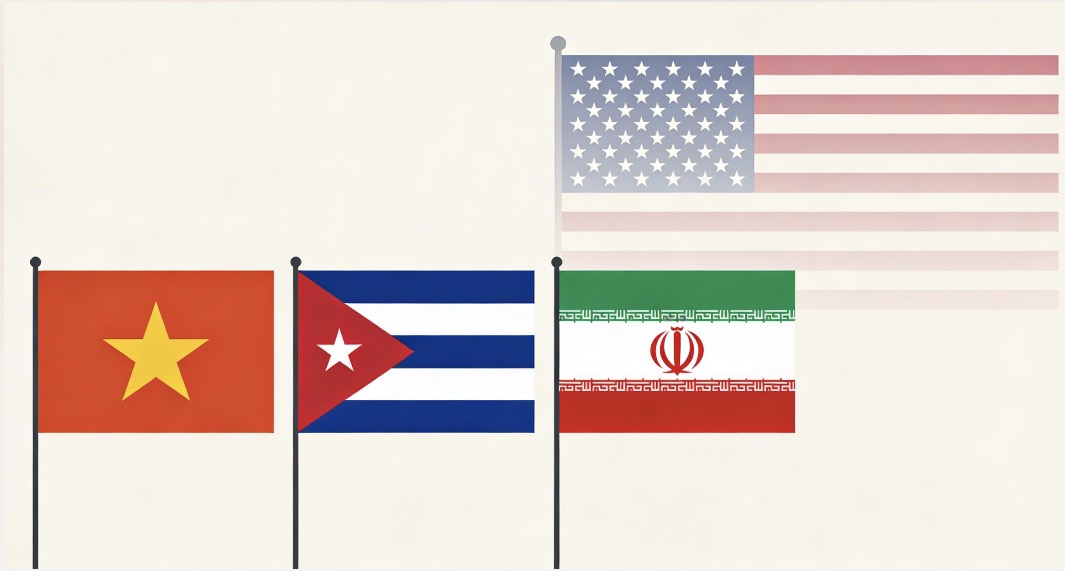
Reflections on which nations should be the U.S.’s natural allies but somehow became mortal enemies: Iran, Cuba, Vietnam.
March 16, 2026
A Global Ideas Center, Strategic Assessment Memo (SAM) from the Global Ideas Center

You may quote from this text, provided you mention the name of the author and reference it as a new Global Ideas Center, Strategic Assessment Memo (SAM) published by the Global Ideas Center in Berlin on The Globalist.


Let’s go back to the 1950s and reexamine spheres of potential U.S. influence of the time.
And let us ask, even without the benefit of hindsight, which political miscalculations of that era on the part of the United States have significant repercussions well into 2026?
Rethinking decisions made by the U.S. in the 1950s
These miscalculations manifest themselves in two dimensions. The first is the impact on global security today and the second concerns the ability of the United States to build strong alliances in key regions.
Three countries and three respective decisions come to mind:
1. The U.S.-recognized military coup by Fulgencio Batista in Cuba which overthrew the then-elected President Carlos Prío Socarrás in 1952.
2. The U.S./U.K.- financed and orchestrated overthrow of the democratically elected Prime Minister of Iran, Mohammad Mossadegh, in 1953.
3. The U.S. failure to negotiate a better deal than the Geneva Accords (and sign it!), which ended the French colonial war in Vietnam and formalized the country’s division at the 17th parallel in 1954.
These three incidences set the stage in three different but important spheres of potential U.S. influence which very immediate repercussions in 2026.
1. The U.S.’s best natural friend in Latin America
Looking at Latin America, U.S. governments of various political stripes, always eager to fight communism, have a tradition of sidling up to the military dictators in just about every Latin American country.
But those countries, whether in Central America or South America, shared next to none of the positive attributes of the United States, such as openness, flexibility, pragmatism and gender equality.
Cuba is different. Fidel Castro had very good reasons to rise up against the dirty cabal of the American mafia and Cuba’s feudal landlords that had established a crime-ridden chokehold over the country and its population under Batista’s regime.
Why the early Castro liked the U.S.
Fidel Castro’s natural inclination was to turn to the first nation in the Americas that, in modern time, had managed to shake off the bonds of oppression by a foreign power — i.e., the United States.
Only when Castro found himself not just cold-shouldered did he turn in earnest to the Soviet Union, as a kind of substitute pal. The consequences of that turn are well-known.
Sadly, the dark part of the U.S. power structure — intelligence agencies collaborating with criminal elements and shady business people — simply proved too tight-knit a network for the U.S. government to choose an enlightened course of action.
2. The U.S.’s best natural friend in the Muslim world
For all the closeness of business and official ties, the country whose people in the Muslim world in many ways most resemble those of the United States surely isn’t Saudi Arabia.
And it surely isn’t Iraq or Afghanistan either, even though the United States has gone to great lengths – in terms of blood and treasure.
It was Iran in the 1970s that the United States clung to the deep flaws of its original sin by supporting the brutal dictatorship of Shah Reza Pahlavi until the very end, basically until after all reasonable more democratic alternatives to the Shah had been eliminated.
Unfortunately, that drove many of Iranians right into the open arms of a brutal theocracy that, at the time, had become the only viable outlet of opposition against the Shah.
A long tradition of brutalizing the Iranian people
Perversely, the mullahs took their oppressive cues from the regime of the Shah and then, over time, brutalized itself ever more.
The failure to recognize the Shah’s brutality prevented the United States from harvesting the benefits of a more mature relationship with what basically is the oldest continuing culture in the region.
As everybody is aware by now, this Muslim, non-Arab country also has a large pool of well-educated, civic-minded young people, notably including young women.
Secular Iranians – that is, most of them, resemble U.S.-style preferences, priorities and practices.
How different the region might have turned out
How different the region might have turned out, had the United States supported democratic and secular replacements for the dictator Pahlavi and not waited until only the ayatollahs had become an alternative to many Iranians.
Just ask yourself what had been Mossadegh’s chief vice before he was replaced by the Shah? He had wanted to make sure his country would get its fair share from the oil revenues being extracted by Western companies. It was his peaceful Boston Tea Party.
Small wonder then that the Iranian people should react badly when they finally reached what they expected to be the moment of self-determination in 1979.
The real tragedy, of course, lies in the fact that the mullah regime in Iran has long acted in a despotic fashion against its own people.
3. The U.S.’s best natural friend in Asia
In Asia, which nation there, in terms of the entrepreneurialism, dynamism, openness and general friendliness of its people, seems most like the United States today?
Anybody who travels to Vietnam these days is almost instantaneously taken in by the vibrancy as well as the hustle and bustle that shapes this Asian society. “Always friendly, always busy” – that could be the national motto of Vietnam.
Beyond this shared hard-working, can-do attitude, Vietnam also has a long history of resisting outside domination.
Ho Chi Minh and the American Founders
Note that even Ho Chi Minh, the country’s revolutionary leader, drew great inspiration from the American Founders – perhaps equal to the inspiration he took from Marx.
In his fight for national liberation, Ho sought, unsuccessfully as we now know, to build ties with the Americans during and just after World War II. He saw common ground in the story of U.S. independence.
And yet, the era of a heating up Cold War caused the U.S. to fail in mediating a better agreement than the Geneva Accord between France and North Vietnam under President Eisenhower in 1954.
It first drew President Kennedy into sending “military advisors” to support the government of an oppressive regime in South Vietnam.
Then, it forced President Johnson’s hand to formalize U.S. military presence in the country. And it led to a military escalation under President Nixon, only to end in a quasi-surrender by the U.S. in the Paris Peace Accords of 1973.
The way to move forward
Forging alliances takes thoughtfulness. It requires recognition on all sides that differences always remain.
It means that the United States finally recognizes that its belief in nation-building is probably the most ill-advised misjudgment in the history of the U.S.’s pursuit of global influence.
But alliances with Cuba, Iran and Vietnam are in the utmost interest of the United States, especially from a political and geopolitical perspective.
Invade Cuba?
In Cuba, non-intervention in the affairs of the existing Cuban regime would be preferable.
However, given the interventionist actions by the current administration, an invasion is to be expected.
Should the Trump administration choose to remove the Cuban regime, it would be well-advised not to replace it with the descendants of the oppressors that led to the rise of Fidel Castro in the first place.
What about Iran and Vietnam?
In Iran, the case is similar, although a full-fledged military intervention is already in place with uncertain outcome.
Should the U.S. war against Iran, against long odds, lead to the removal of the Islamic regime, here too it would be in the best long-term interest of the United States not to encourage the son of the despised Shah Pahlavi to step into the vacuum. Such action would only further harm a country in need of peaceful reconciliation.
Finally, in case of Vietnam the case is much simpler. It would be strategically best to accept Vietnam as an equal trading partner, remove all tariff barriers and encourage direct investment in this industrious nation.
Conclusion
Unfortunately, if history is any guide and if the actions of the current U.S. Administration tell us anything, President Trump will do the exact opposite.
This would mean another lengthy period for the United States without like-minded partners in key places. History does sometimes repeat itself.
Takeaways
The US often finds itself opposite the nation that should be its most natural ally in any given region.
Vietnam, Cuba, Iran all might have shored the U.S. up had it played its cards differently.
The disastrous legacy of Cold War foreign policy decisions remain with the United States to this very day.
Nation-building is probably the most ill-advised misjudgment in the history of the U.S.’s pursuit of global influence.
A Global Ideas Center, Strategic Assessment Memo (SAM) from the Global Ideas Center
You may quote from this text, provided you mention the name of the author and reference it as a new Global Ideas Center, Strategic Assessment Memo (SAM) published by the Global Ideas Center in Berlin on The Globalist.