Donald Trump’s “Rascality” and Its Global Consequences
What happens if one leader betrays America’s proudest traditions?
April 18, 2026

Note to journalists: You may quote from this text, provided you mention the name of the author and reference it as a new Strategic Intervention Paper (SIP) published by the Global Ideas Center in Berlin on The Globalist.
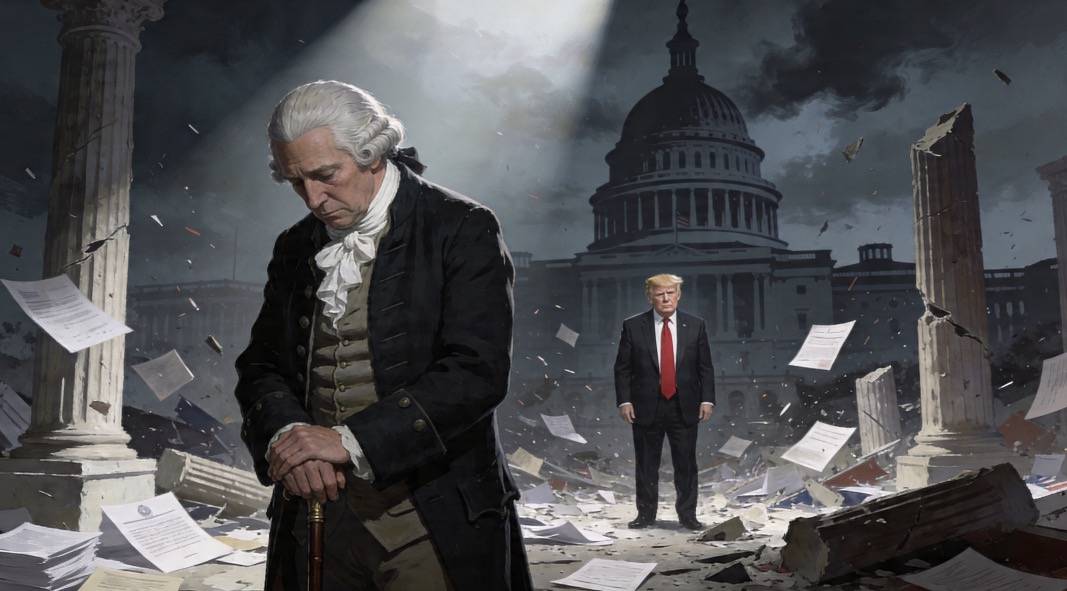
In early 1776, John Adams wrote that there was already “so much Rascality, so much Venality and Corruption, so much Avarice and Atheism, in all states, and especially in the most commercial” that he doubted whether there was “public Virtue enough to support a Republic.”
Adams warned that the form of government “gives the decisive color to the manners of the people”. By that, he meant that, if public life is dominated by corruption and bullying rather than restraint and law, the people themselves will be reshaped in that image.
Absolute power intoxicates
Again and again in his letters and essays, Adams returned to a simple insight: Any leader who escapes accountability will come to believe that his will should stand above law, custom and morality.
This is a lesson that is stunningly lost on the present U.S. Supreme Court. If any institution in the history of the United States should have known better, it is the country’s highest court.
That the use of power without restraint at the top seeps into the culture and teaches citizens to admire impunity rather than integrity is a lesson that has essentially been known since Roman times.
Two hundred and fifty years later, as the United States marks its semiquincentennial, Donald Trump’s second term has become a case study in the very “rascality” Adams feared.
The great betrayal of America’s proudest traditions
The great betrayal of America’s proudest traditions is not only that a president openly treats the U.S. Constitution as an obstacle rather than a guide.
It is that an entire political ecosystem has normalized the idea that the president’s personal grievances, financial interests and hunger for impunity can legitimately override the rule of law at home and the defense of democracy abroad.
The rule of law is endangered when the U.S. Department of Justice is deployed to extort potential critics, intimidate political opponents and censor the media.
One half of that ecosystem, the Republican side, has shown no qualms to embrace this, while the other half, the Democratic side, has not found effective means to stop it.
Adams’s republic versus Trump’s personal rule
Adams understood the temptation to vest power in a single “clever fellow” who promises protection and revenge in times of fear and confusion. He worried that citizens would rally behind such a man, “though they distrust him, hate him and fear him,” because they believe that only a strong hand can impose order.
His answer was not blind faith in virtue but the deliberate construction of institutions that check power, bind rulers to law and make even the most popular leader answerable to independent courts, legislatures and a free press.
How True defies Adams
Trump’s second term has unfolded in open defiance of that architecture. He behaves less like the head of a constitutional republic and more like the proprietor of a personal monarchy.
He not only asserts the right to deploy overwhelming military force abroad on his own authority. He also turns the machinery of the state into a weapon against whoever he regards as his domestic enemies, real or imagined.
He has established a rich target list: prosecutors he dislikes, media outlets that scrutinize him, companies that cross him, civil servants who refuse unlawful orders.
The tests ahead
American democracy faces crucial tests. Trump is likely to deploy a barrage of schemes to subvert the Congressional elections in November and ensure Republican victories.
Should he fail, and should the Democrats form the majorities in both houses of Congress, then will Trump strive to find ways to rule as if Congress is no more than an irritant?
The Democrats are acutely aware of the dangers, yet stunned by Trump’s audacity, and floundering in search of fresh leadership and effective responses.
The Oval Office as a platform for self‑enrichment and revenge
In Trump’s view, the presidency is a suite of private prerogatives – the power to bomb, pardon, sue, threaten and reward. Worse, it should not be second‑guessed by courts or Congress.
Where Adams demanded that public office be conducted in a spirit of restraint and sacrifice, Trump has converted the office into a platform for self‑enrichment and revenge.
In the age of Trump, ethics norms are treated as jokes. Conflicts of interest become badges of honor among his officials, while Congressional oversight is regarded as partisan harassment. The fact that U.S. senators not so long ago were concerned about even avoiding the mere appearance(!) of any improprieties now seems light years away.
Unsurprisingly, the idea that a president should model civic virtue – even imperfectly – has been replaced by the message that only suckers submit to rules.
In that sense, Trump does not simply ignore Adams’s warning about “rascality”. He has elevated it into a governing philosophy.
From beacon of transparency to blueprint for evasion
The institutional consequences are visible across the globe. For generations, the United States derived immense soft power from the claim that, whatever its flaws, it aspired to transparent, accountable government.
Freedom of information laws, relatively robust oversight institutions, an adversarial press and the prosecution of high‑level wrongdoing sent an unmistakable signal that no official, not even a president, stood entirely above the law.
That moral capital underpinned U.S. advocacy for democracy and human rights abroad. Washington’s ability to press others on corruption, free elections, and independent courts rested on a minimum of credibility at home.
Debasing the positive power of the U.S.>
Trump’s second term has inverted that relationship. Instead of exemplifying transparency, the United States now shows how to dismantle it. Freedom‑of‑information processes are delayed or ignored.
Statistical agencies are pressured to massage data. The line between government communication and partisan propaganda is erased.
Providing cover for autocrats around the world
Authoritarians and illiberal populists around the world are thrilled. They now have great “cover” for their misdeeds.
Where they once had to move artfully to disguise their tactics, they can now point to Washington for validation.
Want to discredit inconvenient journalism? Label it “the enemy of the people” and flood the information space with conspiracies.
Want to neuter anti‑corruption bodies? Accuse them of bias, purge their leadership and then claim your own “victimhood” when challenged.
Want to evade accountability for attempts to subvert an election? Call it legitimate “questioning” and lean on allies in parliament and the courts to forestall consequences.
Populism’s global wave meets America’s fall
The world’s most powerful democracy has become a laboratory for such evasion strategies.
The Trump administration, with JD Vance’s strong assist, has positioned itself as the vanguard of a wider authoritarian‑populist wave which has already swept through advanced and emerging democracies alike.
Spotlight on Hungary
Viktor Orban ran Hungary for 16 years, securing control over the courts, the media, the universities and securing the accolade in Transparency International’s annual survey as the most corrupt government in the European Union.
Orban might have gone further to capture the state had Hungary not been in the EU and bound to adhere to most of its rules and standards. It had become what the Economist Intelligence Unit calls a flawed democracy. The corruption, economic mismanagement and exceptional opposition campaigning led to Orban’s ouster.
Spotlight on India
In India, Narendra Modi’s strongman rule has combined economic promises with Hindu nationalist mobilization, majoritarian rhetoric and a systematic narrowing of space for critics. Journalists, NGOs and opposition figures face legal harassment and surveillance.
Religious minorities are exposed to inflammatory discourse and discriminatory policies. Formal institutions remain, but they are increasingly aligned with the ruling party’s ideological project.
Spotlight on Brazil
Although Brazil pulled back from the brink with Bolsonaro’s electoral defeat and institutional pushback against coup‑curious violence, the episode underscored how quickly a large democracy can be driven toward rupture once a leader convinces followers that only he represents the “real people.”
Is pluralism decadence?
These countries share a script. They attack pluralism as decadence, frame independent institutions as corrupt conspiracies and present themselves as the lone authentic voice of the nation.
That is no surprise when a U.S. president behaves like a caricature of the very populists Washington once condemned.
Improbable though it is, Trump confirms their central claim that liberal democracy is merely a mask for power, that legal and ethical restraints are optional and that “winners” should never have to submit to rules written by “losers.”
Europe’s half‑fulfilled ambition to replace the beacon
Faced with U.S. democratic backsliding, many in Europe speak of a turning point in which the EU must become a more autonomous beacon of democracy and rule of law.
But while the European Union always presents itself as a community built on law, human rights and constitutionalism, its own record in the defense against clear-cut abuses is mixed.
Brussels has eventually moved to freeze funds and launch procedures against Hungary, but those actions came only after years of internal dithering and mutual protection among governments.
As to a principled application of EU foreign policy, the sad reality remains that one or two illiberal member states can block strong joint positions on democracy and human rights toward external partners.
A dangerous feedback loop for democracy
At the international level, American backsliding from democracy affects both elites and publics.
What is especially unfortunate is that ordinary citizens, exposed to economic uncertainty and cultural polarization, become more receptive to leaders who promise decisive action unconstrained by “obstructionist” checks and balances.
The damage is not only to America’s image. It is to the global reputation of democracy as a workable, self‑correcting system.
In that sense, Trump’s great betrayal is double. Domestically, he has trampled the ethic of public virtue that Adams saw as essential to republican survival, replacing it with a cult of impunity and self‑interest.
Internationally, he has squandered the moral capital that allowed the United States to champion transparency, accountability and human rights. While the American Revolution sought to restrain kingly impulses, Trump has turned the U.S. presidency into a megaphone for those very impulses.
Recovering Adams’s republic – if we can
Trump’s second term, with its systematic assault on those tools, has vindicated Adams’s darkest suspicions about how easily “rascality” can capture a commercial, polarized, spectacle‑driven society.
The question for Americans – and for the global policy community – is whether that spirit can be revived in time. Will Congress reassert its prerogatives? Will courts enforce legal limits without flinching?
Will ever more major U.S. media brands become willful tools in the hands of plutocratic populists? And will civil servants, journalists and citizens refuse to accept the normalization of corruption, cruelty and impunity at the top?
The fate of American democracy has never been a purely domestic affair. Whenever the United States honors its better traditions, it has helped raise the global baseline for what citizens expect and what rulers believe they can get away with.
Trump’s great betrayal of America’s proudest traditions is not only that he has acted as if he were unshackled from the Constitution. It is that he has established a live-wire case study for the world’s other democratic despots on how to turn a republic against itself.
Takeaways
In early 1776, John Adams wrote that there was already “so much Rascality, so much Venality and Corruption, so much Avarice and Atheism, in all states, and especially in the most commercial” that he doubted whether there was “public Virtue enough to support a Republic.”
It is eerie to read that words of one of America's founders from 250 years ago. John Adams might have described Trump's America.
That the use of power without restraint at the top seeps into the culture and teaches citizens to admire impunity rather than integrity is a lesson that has essentially been known since Roman times.
American democracy faces crucial tests. Trump is likely to deploy a barrage of schemes to subvert the Congressional elections in November and ensure Republican victories.
The damage from the Trump era is not only to America’s image. It is to the global reputation of democracy as a workable, self‑correcting system.
In Trump's shadow, autocrats elsewhere attack pluralism as decadence, frame independent institutions as corrupt conspiracies and present themselves as the lone authentic voice of the nation.
Note to journalists: You may quote from this text, provided you mention the name of the author and reference it as a new Strategic Intervention Paper (SIP) published by the Global Ideas Center in Berlin on The Globalist.
Authors

Stephan Richter
Founder and Editor-in-Chief of The Globalist and Director of the Global Ideas Center, a global network of authors and analysts.

Frank Vogl
Frank Vogl is co-founder of Transparency International and author of “The Enablers: How the West Supports Kleptocrats and Corruption — Endangering Our Democracy”