
From Organic to Regenerative
For the sake of food security, the adoption of home-grown regenerative farming should not be viewed as a passing fad but an urgent necessity.
April 25, 2026

Note to journalists: You may quote from this text, provided you mention the name of the author and reference it as a new Strategic Assessment Memo (SAM) published by the Global Ideas Center in Berlin on The Globalist.

“Organic” became the buzz word in supermarkets some decades ago. An important purpose of introducing that label was to generate higher prices as well as a sense of security among those who could afford to buy it. Even Walmart expanded to include lower-priced organic foods.
A new buzz word
Now a new buzz word is nudging “organic” aside. Meet “regenerative”, as in farming. This farming system aims to restore today’s widely depleted soil and wants to encourage the production of more nutrient-dense food, capture carbon and improve water retention, as well as reduce reliance on modern fertilizers and pesticides.
It is a far from new idea. The British agriculturist Charles “Turnip” Townshend (1674–1738) and American agricultural scientist George Washington Carver (1864-1943) each promoted crop rotation, a system focusing on similar goals.
Also worthy of mention in this context is a man who helped to bring about Britain’s Agricultural Revolution in the 18th century, Jethro Tull (no, not the late-60s rock band),
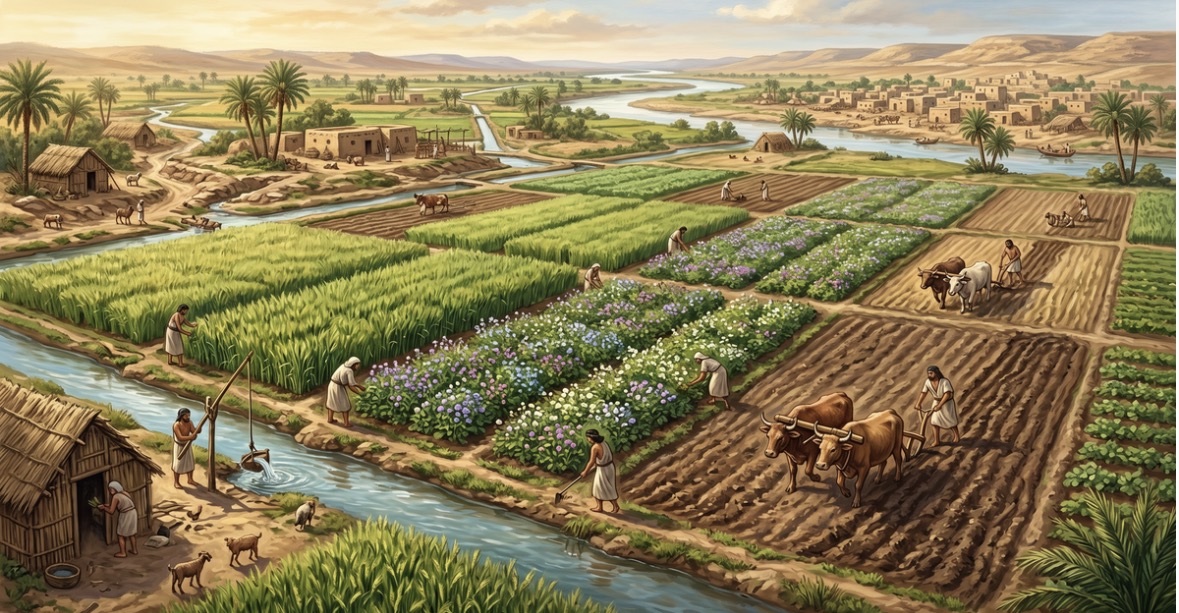
In use in the Middle East as early as 6000 BC
Very much further back, there is evidence rotation was in use in the Middle East as early as 6000 BC and of simple rotation being applied by the early Greeks, Romans and Chinese to maintain soil health.
During the Middle Ages, from 476 AD to the late 15th century, it developed into a three-field system; then Viscount Townshend popularized a four-crop rotation of wheat, turnips, barley and clover.
In the Southern States in the early 1900s, George Washington Carver promoted the rotation of peanuts, peas and soybeans with cotton to replenish nitrogen in the soil.
Growth more in media coverage more than in farm acreage?
The practice is growing in popularity in the United Kingdom and the United States – in the latter in media coverage more than in farm acreage.
The U.S. Department of Agriculture is investing billions in “climate-smart” agriculture and Big Food Biz corporations like General Mills, Nestlé and PepsiCo have also pledged their support.
However, so far only 1.5% of U.S. arable land has been turned over to it entirely, although 15% of farmers have committed some of their land to regenerative practices.
In Britain, a 2022 survey found 65% of farmers are already using regenerative techniques. But because they rely on soil health outcomes rather than the kind of strict certification governing British organic farming, it is hard to calculate the number of farms practising the method rigorously.
The Hormuz booster
With the blockade of the Strait of Hormuz, regenerative farming takes on a new significance. The United Nations’ Food and Agriculture Organization estimates 20 to 45% of agricultural and food production depends on free access to that sea passage.
If the conflict in the Middle East lasts beyond June 2026, the UN’s World Food Programme calculates around 45 million people will be added to the 318 million individuals already suffering acute food insecurity. Add diminishing supplies to the effects of climate change on farmers’ yields, and soaring food prices globally are on their way.
Are we ready?
But are we ready? In Britain, the Business and Trade Secretary Peter Kyle declared: “If [food or CO₂ shortages are likely], I will be upfront with the public about it in advance so we can prepare. But right now, people should go on as they are enjoying beer, enjoying meats and enjoying their salads.”
Really? Shouldn’t we already have begun preparing?
How food secure is the U.S.?
The U.S. is generally considered food secure, producing far more food than it consumes although it is heavily dependent on fertilizers.
Eighteen percent of the U.S. demand for vital nitrogen and 25% of its total fertilizers pass through the Strait of Hormuz. A permanent impact on the cost of food is assumed.
“The good old days are gone,” says Christopher Tang, a professor of global supply chain management at the UCLA Anderson School of Management. “When the prices go up, they rarely come back down.”
Spreading systemic risk
With increasing alarm over the risk to financial stability from not only AI and private credit lending but the U.S.-Israel war on Iran, the leaders of the U.S. Federal Reserve, the European Central Bank and the Bank of England met on Saturday behind closed doors in Washington to war-game how they would handle the collapse of a globally significant bank.
For the sake of food security, the adoption by every nation of home-grown regenerative farming should not be viewed as a passing fad but an urgent necessity.
Takeaways
For the sake of food security, the adoption of home-grown regenerative farming should not be viewed as a passing fad but an urgent necessity.
Far from being a new idea, there is evidence that early forms of regenerative farming were in use in the Middle East as early as 6000 BC, withsimple rotation being applied by the early Greeks, Romans and Chinese to maintain soil health.
With the blockade of the Strait of Hormuz, regenerative farming takes on a new significance. It is estimated that 20 to 45% of global agricultural and food production depends on free access to that sea passage.
The U.S. is generally considered food secure, producing far more food than it consumes although it is heavily dependent on fertilizers.
Note to journalists: You may quote from this text, provided you mention the name of the author and reference it as a new Strategic Assessment Memo (SAM) published by the Global Ideas Center in Berlin on The Globalist.