Is Syria’s New Leader Working with a Turkish Toolkit?
Syria’s new government draws on the development and control model which Erdogan has long used in Turkey. Will this work? And what about democracy?
December 1, 2025
Contrary to the perception of many outside observers, the Syrian state’s core bureaucratic and administrative institutions are not run by men with long beards in military khakis, but by technocrats who returned from exile and know what they are doing.
Technocrats at the helm
Just consider the case of Syria’s 47-year-old minister of communications and information technology, Abdesselam Haykal. He fled the country in 2012 because he saw himself on the Assad regime’s arrest list, did his master’s degree at SOAS London and then took over his family’s shipping and logistics business headquartered in Abu Dhabi.
He now moves across the region seeking investors for his ambitious public and private ventures, including a plan to position Syria as “a digital Silk Road” that would need 4,500 km of fiberoptic lines and new submarine cables. He says thousands of other exiles with backgrounds in technology are preparing to return as he did.
He recently said this:
“The other thing is, from a security point of view, whether the country is safe for people to operate in, to live in, to thrive in? Probably Damascus today is safer than New York or Chicago. Are there concerns? Of course. Not every part of Syria is Damascus. But that’s a work in progress.
I do not really anticipate anything that could derail us from a security point of view, unless something dramatic happens, which I do not see on the horizon. We are on track to increase the level of safety and security in the country.
It might seem to an outsider as Mission Impossible. That’s why you need the will, because it is a complex situation. So we have the intent and we have the will. What we need more of are the tools. Technology is a tool. Money is a tool. Experience is a tool. Expertise is a tool. And we’re building that tool kit.”
You may hang on his hyperbolic claim about Damascus being safer than New York or Chicago. Yet, his words on experience, expertise and the toolkit matter more. At least for me, because those words echo something I have heard many times before.
Echoes of the AKP in Turkey
That vocabulary is foundational in the “big brother role” (you can call it mentorship) that the AKP used to create a success story out of the Muslim Brotherhood (Ikhwan) in Egypt after the fall of Mubarak and simultaneously Ennahda in Tunisia.
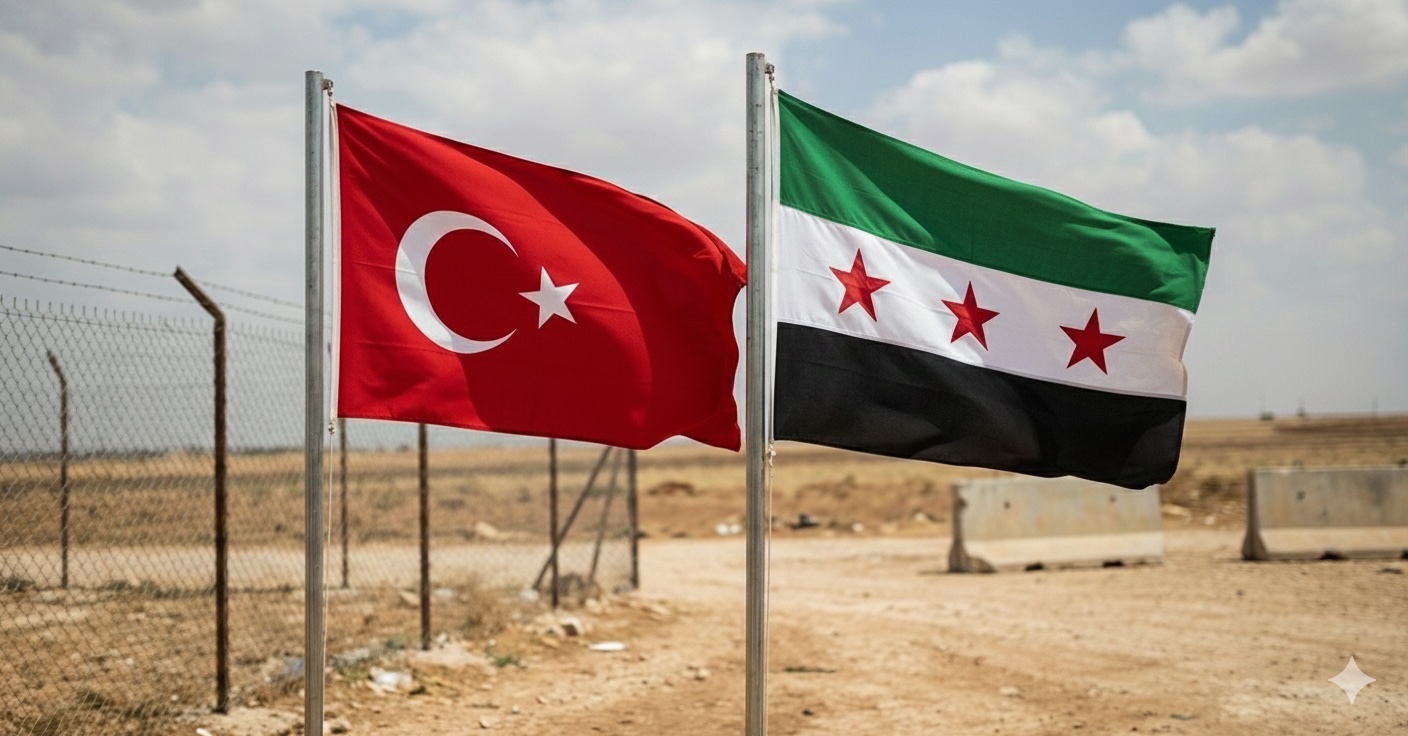
In a very similar quest to become legitimate actors that can govern, al-Sharaa and al-Shaibani now also rely a lot on “the tool kit” based on AKP’s “experience and expertise” in governance and development.
The relationship of HTS, the group which al-Sharaa used to lead, and the Turkish state goes back almost a decade. The meetings with the civil AKP teams, on the other hand, only began with the fall of the Assad regime.
Turkish mentorship and diplomatic support
Two points matter here. First, Turkish mentorship and diplomatic support have been central to al-Sharaa’s international legitimacy. Neither side likes to acknowledge this because it would strengthen Israel’s argument that Syria has become a Turkish mandate, yet President Trump speaks openly about this diffusion across different settings.
Second, the mindset of service and development remains the ABC of Erdogan’s politics, and al-Sharaa repeats it in his own interactions with Syrians.
Political legitimacy begins with basic services
Last week Syria saw twenty-four hours of uninterrupted electricity for the first time in two decades. Even the fiercest critics will pause if basic services improve. Legitimacy begins there.
Even the most secular Syrians will adjust to the idea that a former jihadist governs Damascus if the lights stay on and the signal stays strong. Transitional periods have their own logic and cycle and recycle.
Furthermore, al-Sharaa has been working with U.S. and Turkish intelligence since 2016. The recent formal inclusion of the new government in the anti-ISIS alliance, as well as the fruits of U.S. intel sharing with the Sharaa government, have brought remarkable successes in raids that led to the capture of current top leadership of ISIS in Syria.
Happy Turks
Now al-Sharaa and his closest teammate, foreign minister al-Shaibani, are using a toolbox shaped by the AKP’s self-proclaimed success formula. The Turkish government is very happy with the current outlook.
The half-serious joke in Ankara nowadays is that Sharaa and his public-facing team (particularly al-Shaibani who had done his graduate studies in Istanbul) have adapted to Western settings so quickly that they may soon discover LGBTQ rights.
Overstatement aside, it is only a matter of time before al-Sharaa begins to echo Erdogan’s favorite motto that “service to the people is a form of prayer (Halka hizmet, Hakk’a hizmettir),” using it to consolidate both his elite entourage of former jihadis and the wider population.
Al-Sharaa: Fighting extremism
No one wants Syria to succumb back into the abyss and all sincerely hope for stability and peace for the war-torn country and its people. However, stability or al-Sharaa being perfectly adaptable or no longer a jihadist does not mean democracy or free speech for the Syrian people.
However, if anyone, especially within the U.S. and European security apparatus, still worries that Sharaa will return to the jihadism of his late twenties or act in complicity with ISIS while presenting another face to the world, they can brethe a sigh of relief. There is no recorded road from the presidential palace down to jihadi bunkers.
He will fight all extremist factions beyond his control and all Iranian influence and Hezbollah with full force. Not because he hates extremists or jihadists for the sake of Islam, but to maintain his power, an aspiration he has demonstrated throughout his whole adult life.
Much like Erdogan
In this sense, al-Sharaa is much like Erdogan. The motive is power. He seeks it and will try to maintain it with the same tenacity that Erdoğan has displayed for two and a half decades.
In keeping with his steps following Erdogan, there may, and most probably will, come a point where his rule begins to harden into an authoritarian form unless something dramatic such as an assassination or countercoup intervenes (which looks unlikely at the moment).
Not because al-Sharaa was a jihadist or not because he is an Islamist. But because his rule in Idlib had been quite authoritarian. Brutal, authoritarian, yet more efficient compared to other places in Syria.
The authoritarian triad of submission, aggression and conventionalism
Islamism is a (thin-centered) right-wing ideology, and as with all right-wing ideologies we see around the world, its center gravitates toward an authoritarian triad marked by a close co-variance of three features: submission, aggression and conventionalism. From there come the familiar shades of ethnocentrism and intolerance toward plurality.
But as long as al-Sharaa keeps the market open, few will object. If he is as lucky as Erdogan, the rest can be waved away after a certain point as vulgar parlance or as “domestic matters” in the boulevard of international politics.
Takeaways
Syria’s new leadership relies a lot on the tool kit developed by Turkey’s AKP and its focus on “experience and expertise” in governance and development.
The Syrian state’s core bureaucratic and administrative institutions are not run by men with long beards in military khakis. They are run by technocrats who returned from exile and know what they are doing.
Syria’s al-Sharaa is much like Erdogan. The motive is power. He seeks it and will try to maintain it with the same tenacity that Erdogan has displayed for two and a half decades.
Syria just had twenty-four hours of uninterrupted electricity for the first time in two decades. Even the fiercest critics will pause if basic services improve. Political legitimacy begins there.
Syria’s new minister of communications and information says: “Probably Damascus today is safer than New York or Chicago. Are there concerns? Of course. Not every part of Syria is Damascus. But that’s a work in progress.”
The minister adds: “Technology is a tool. Money is a tool. Experience is a tool. Expertise is a tool. And we’re building that tool kit.”
Islamism is a thin-centered right-wing ideology. As with all right-wing ideologies, its center gravitates toward an authoritarian triad — submission, aggression and conventionalism.