From Martin Luther to Björn Höcke: The Centuries-Old Saga of German Anti-Americanism
There is a deplorable German tradition of casting capitalism, cosmopolitanism and modernity as suspect forces, from Luther to the AfD today.
June 15, 2026

Note to journalists: You may quote from this text, provided you mention the name of the author and reference it as a new Strategic Assessment Memo (SAM) published by the Global Ideas Center in Berlin on The Globalist.
Fortunately for Germany’s other political parties, the irrepressible instinct of the far-right Alternative for Germany (AfD) is to act as a kind of self-sabotaging communications machine.
It keeps making mistakes that France’s hard-right Rassemblement National, which is very disciplined in its political messaging, is most unlikely to commit.
The art of insulting voters
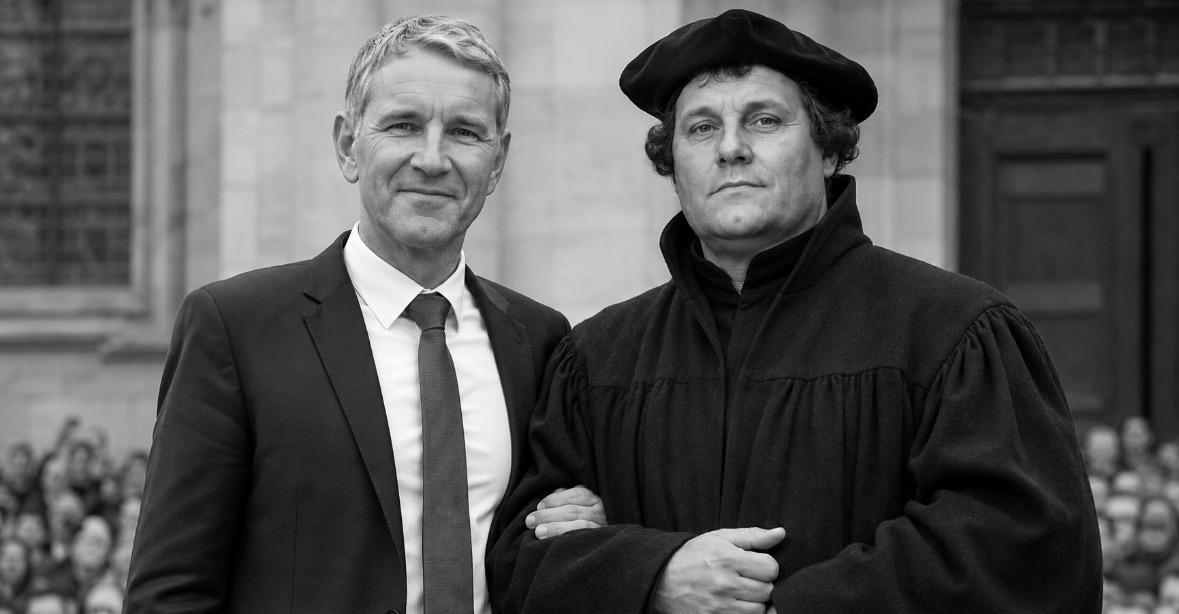
Just consider the latest outburst by Björn Höcke, the demagogic leader of the German hard-right party’s ethno-nationalist wing. Echoing, if not copying Russian propaganda, he described his fellow West Germans as “German-speaking Americans.”
Given that this group makes up roughly 85 percent of Germany’s electorate and perplexingly includes the West Germany-born Mr. Höcke himself, his latest round of insulting potential voters amounts to a significant political own goal.
Beyond the contemporary provocation
Yet Höcke’s outburst is far more than a contemporary provocation. It reflects a much older and distinctly German intellectual tradition in which “the German” is repeatedly defined in contrast to a supposedly corrupt (or merely alien) “Other.”
Whether eons ago the target of denigration was Rome, “the Jew,” or now “the American,” the underlying target of presumable moral rejection remains the same. It is capitalism, cosmopolitanism and modernity that are cast as suspect forces.
Before Washington, there was Wittenberg
Of course, Martin Luther, the 16th century religious reformer and seminal figure of the Protestant Reformation who posted his 95 Theses in 1517 in the town of Wittenberg, in this time could not have been labeled as an anti-American, since the United States did not yet exist. It is now only moving toward its own 250th anniversary.
But Luther’s writings shaped a worldview that considered itself misleadingly as profoundly cultivated. It continues to resonate in both right- and left-wing critiques today.
Luther’s attacks on usury, interest and the mercantile spirit constructed “the Jew” less as a biological enemy than as a symbolic figure of unrestrained, rootless capital, as focused on money, while being detached from land, status and traditional social ties. And hence, in Luther’s telling, cast as profoundly un-German.
Cultural close-mindedness as a driver
Luther articulated and amplified a deep mistrust of a world in which financial calculation began to unduly outweigh the importance of religious faith.
His personal anti-Judaism helped establish a cultural grammar in German culture that had disastrous historical consequences. It pitted on one side a rooted, organic community, facing the nation-eating force of global finance on the other.
In the 19th century, this insecurity- and ignorance-driven opposition to recognizing different sources of national culture led Germany’s educated middle class to establish a worldview that distinguished between “culture” (Kultur) and “civilization” (Zivilisation).
These pairs were meant to contrast depth and surface, seeking to protect the pursuit and individual and collective honor and high-minded spirit from the moral lowlands of commerce.
Germans’ longstanding, perverse cultural allegiance to Russia
Needless to say that Germany was consistently assigned to what Germans of the time considered the higher road, while Western countries—France, Britain and increasingly the United States—were relegated to the latter.
Those nations were viewed perhaps as technologically advanced and economically dynamic, but as spiritually shallow. Even more perversely, Russia was perceived as more rooted in cultural depth and honesty. Since it was also viewed as less financially driven, it was often seen as a kindred civilization to Germany’s.
Anti-modernity as a constant source of German “culture”
From this intellectual framework emerged one of the central tragedies of German history. Following on the long track of Martin Luther’s lead, “the Jew” came to symbolize more than just religious difference.
“The Jew” was also deliberately miscast as “un-German”, if not as anti-German. It was considered the source of various transformative manifestations of modern culture, be they the stock exchange, the metropolis, the media or a life governed by the cold rigors of capital rather than tradition.
Still stuck in the late 19th century?
What went largely unrecognized was that in attacking the figure of “The Jew”, critics were in fact rejecting modernity itself. That explains part of why contemporary Germany has such a hard time coming to grips with modernity-oriented reforms. Its reform spirit seems still stuck in the precepts of the late 19th century.
The German discomfort was never simply with industrialization, but with what it implied for a changing national identity, the sense of belonging and rootedness in the local. “Capitalism” became a shorthand for a deeper unease with a world in which heritage and soil no longer determined one’s place.
Uncomfortable with capitalism to this day
After 1945, this unease did not disappear, but its language changed. The moral collapse of Nazism discredited open antisemitism. Yet the underlying structure of resentment persisted and found a new target in the United States.
The U.S. presented an ideal surface for projecting what was to be rejected. It did not help that the U.S. was both victor and occupying power in postwar Germany.
“The Jew” was replaced by “the American”
Long before Donald Trump, who does indeed project not just the image but the gruesome reality of a morally debased, narcissistic United States, the U.S. came to embody the same feared modernity.
What is notable is how broadly this anti-Americanism had spread in Germany even before the advent of Trump as the political master of the United States.
On the German right, the United States is seen as a consumerist society in which tradition and identity dissolve in a culture driven by shallow advertising. On the German left, it appears solely as the engine of the crudest form of capitalism.
The vocabulary of rejection differs, but the structure is nearly identical: America represents a dislocating global force that offends a specifically German sense of depth, history and good morals.
Germany as the in-between power
At the same time, a geopolitical narrative has resurfaced on both the German left and the hard right that seeks to cast Germany as a mediator between the United States and Russia.
In an ideologically bewildering political formation, this bizarre ambition captures both the SPD, which is part of the current German government, as well as the hard-right AfD party.
This impulse for bridge-building to a Russia that has come completely unhinged reflects the lingering effects in our time of the old contrast between German “culture” and Western “civilization.”
It also forms the backdrop for the right-wing agitator Björn Höcke’s rhetoric today. When he dismisses West Germans as “German-speaking Americans,” he implies that the “real Germany” lies elsewhere.
In that view, Germany’s anchor cannot be found in the liberal, transatlantic minded Federal Republic, but in an imagined core where people, their history and their aspirations remain rooted in the soil – and, if anything, have an inexplicable eastward affinity.
In Höcke’s worldview, speaking German signals, at best, a superficial form of belonging—it merely reflects “civilization,” not “culture.”
When the AfD is selling out West Germany
Höcke’s tone may be radical, but the structure underlying his deviance is not new. By effectively casting 85 per cent of Germany’s own population as an internal quasi-foreign body, he associates it with a force he sees as an external enemy.
In Höcke’s and the far-right’s world, West Germany appears as a colonized space—this even though, in a related philo-Russian move undertaken by Donald Trump, American troops are at present withdrawing from German soil.
The AfD: Tool of Russian political and cultural interference in Germany
That Russian propaganda has long promoted precisely this image—a decadent West controlled by the United States—adds little originality.
Höcke’s phrase “German-speaking Americans” is, in effect, a German nationalist translation of the Russian/Putinist clique’s term for Europa, “Gayropa.”
Seen against its long arc of intellectual history, Höcke’s statement is not an isolated provocation. The labeling on the rhetorical figures of speech may change—from “the Jew” to “the American” to the “Americanized German”—but the underlying narrative remains remarkably stable.
Conclusion
The novel factor in the anti-Americanism of Höcke no longer targets a distant country. Rather, he transforms German society itself into a battleground between “real” Germans and those he deems merely “German-speaking.”
The old-time German impulse to preserve a fading sense of identity through contempt for the “other” has thus turned inward. While the United States of America in this view serves as a projection screen, the real dividing line now runs through Germany itself.
The only positive news in Höcke’s latest utterance is that he targets his fellow West Germans (Höcke was born and later worked as a teacher in the West German state of Hesse) – and, for once, not various immigrants.
Takeaways
Echoing Russian propaganda, the leader of the German hard-right party’s ethno-nationalist wing just summarily described his fellow West Germans as “German-speaking Americans.”
Höcke’s outburst reflects an old and distinctly German intellectual tradition in which “the German” is repeatedly defined in contrast to a supposedly corrupt (or merely alien) “Other.”
Luther’s attacks on usury, interest and the mercantile spirit constructed “the Jew” less as a biological enemy than as a symbolic figure of unrestrained, rootless capital.
On the German right, the U.S. is seen as a consumerist society in which tradition and identity dissolve. On the German left, as the engine of the crudest form of capitalism.
Casting Germany as a mediator between the U.S. and Russia is a political goal bizarrely shared by the SPD, which is part of the current German government, as well as the hard-right AfD party.
Note to journalists: You may quote from this text, provided you mention the name of the author and reference it as a new Strategic Assessment Memo (SAM) published by the Global Ideas Center in Berlin on The Globalist.