
Mushrooms: From Ancient Foraging to Modern Obsession
A short cultural history of fungi — and a case for the humble king oyster.
June 12, 2026

Russians cook nearly every variety of mushroom with smetana (sour cream), often with fresh dill, into a thick stew. It is mopped up with copious slices of dark bread.
Yet Russians, along with Eastern Europeans, the French, and Italians, were far from the earliest mushroom foragers. Archaeological evidence shows fungi were gathered for both food and medicine long before written history. Some species — hard, shelf-like growths on tree trunks — were even used as fire starters.
Tyrolean iceman Ötzi, who lived between 3350 and 3105 BC, was carrying tree fungus when he died, possibly as tinder. The detail is a reminder of how much can be reconstructed from fragments of the distant past.
Fungi were among humanity’s earliest multi-purpose tools — food, medicine, and fire all in one.
The sacred, the medicinal and the mythic
In ancient Egypt, mushrooms were reserved for pharaohs. They were believed to confer immortality.
The Greeks and Romans prized porcini and truffles. Greek warriors were even fed mushrooms to enhance physical strength before battle.
Across the Atlantic, Mesoamerican cultures used psychedelic mushrooms in religious ceremonies. The Aztecs and Mayans treated them as sacred instruments of spiritual experience.
Meanwhile, in China, wild mushrooms were used for food and medicine long before 600 BC. Formal cultivation began during the Tang Dynasty, when wood ear fungus was grown on logs.
Across civilizations, mushrooms have been seen not just as food, but as power — culinary, physical, and spiritual.
From forest floor to farm
Mushrooms were first described explicitly as a crop in 1600 by French agriculturist Olivier de Serres.
More striking, however, is how early their biology was partly understood. In 1678, botanist Nicolas Marchant demonstrated that the white filaments beneath mushrooms — what we now call mycelium — could generate new growth if transferred to suitable soil.
This insight helped spark mushroom cultivation in France. By the 16th century, Parisian market gardeners were growing button mushrooms in caves and quarries. These became known as “Paris mushrooms.”
From there, mushrooms spread into elite kitchens. London gardeners soon followed, and fungi entered fashionable cuisine.
The modern mushroom industry rests on a 17th-century insight: the real organism lives underground.
The accidental supermarket staple
The ubiquitous white button mushroom did not emerge from careful planning. It was a mutation.
In 1925, a light brown variety growing on a farm in Coatesville, Pennsylvania, naturally shifted to white. That variant was cultivated and commercialized. It is now the default mushroom across much of the world.
At the same time, contemporary science has returned attention to fungal networks. Mycelium — the threadlike structure beneath the soil—connects plant roots and enables the exchange of water, carbon, and nutrients. It plays a crucial role in ecosystem resilience.
What looks like a simple mushroom is the visible tip of a vast underground network.
A personal favorite: The King Oyster
As for modern varieties, not all live up to their reputation. Porcini can feel overrated. Truffles, while occasionally compelling, rarely justify their mystique — though white truffles over tagliatelle remain an exception.
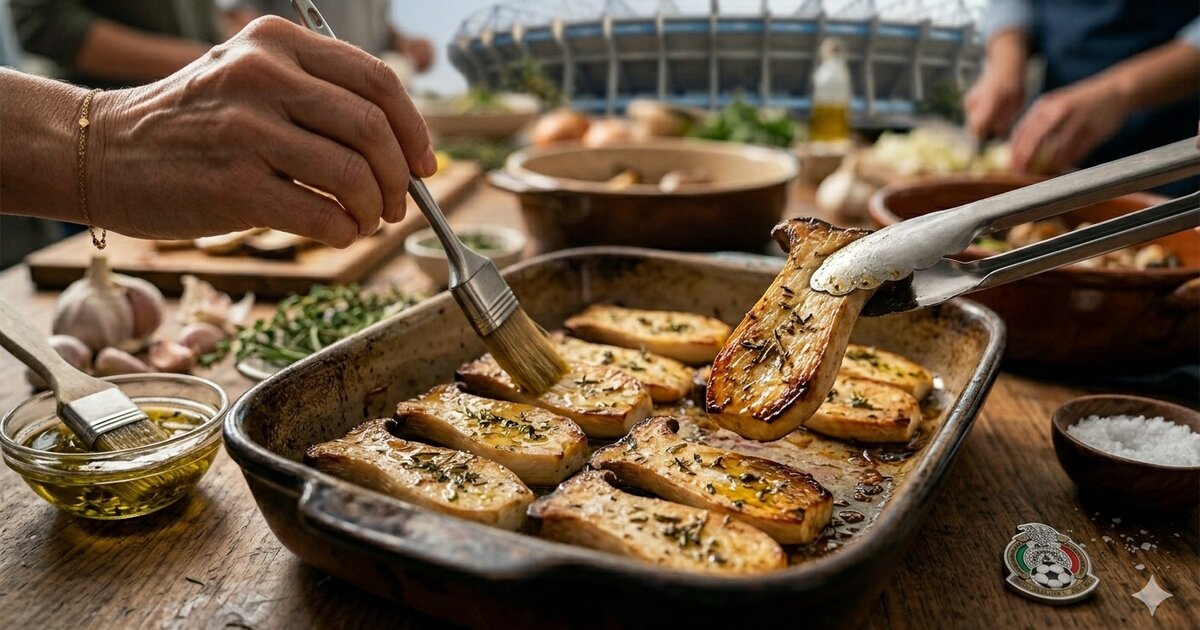
King oyster mushrooms are different. They offer a deeply savory, almost meaty flavor and a firm, chewy texture. For those reducing meat consumption, they provide a convincing substitute.
Adapted from an Ottolenghi recipe, the following preparation produces a substantial dish. It works equally well with sticky rice or alongside roast pork or chicken.
Roasted King Oyster Mushrooms
Ingredients:
500 g (1 lb) king oyster mushrooms, sliced lengthwise
Salt and freshly ground black pepper
90 ml (3 fl oz) soy sauce
120 ml (4 fl oz) olive oil
3 tablespoons tomato paste
60 ml (2 fl oz) maple syrup
4 garlic cloves, crushed
1 teaspoon ground cinnamon
1 teaspoon five-spice powder
1/2 teaspoon toasted, ground cumin
1/2 teaspoon ground fennel seeds
Method:
Preheat the oven to 240°C (475°F).
Pack the mushrooms tightly into a baking dish.
Season with salt and a generous amount of black pepper (around 20–30 grinds).
Add all remaining ingredients and toss thoroughly to coat.
Roast for 15 minutes.
Stir well, then return to the oven for 15–20 minutes more, until golden brown.
Takeaways
Fungi were among humanity’s earliest multi-purpose tools — food, medicine, and fire all in one.
Across civilizations, mushrooms have been seen not just as food, but as power — culinary, physical, and spiritual.
The modern mushroom industry rests on a 17th-century insight: the real organism lives underground.
What looks like a simple mushroom is the visible tip of a vast underground network.