
Switzerland: An Immigration Superpower
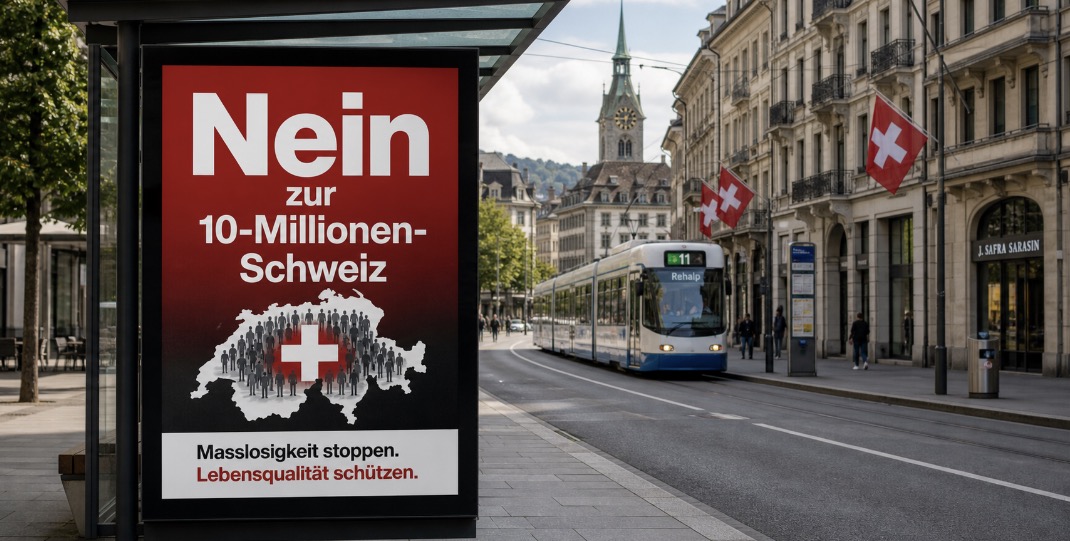
The “No to 10 Million” initiative deliberately overlooks that, without immigration, Switzerland would be an economically and structurally weaker country.
June 12, 2026

Note to journalists: You may quote from this text, provided you mention the name of the author and reference it as a new Strategic Assessment Memo (SAM) published by the Global Ideas Center in Berlin on The Globalist.

For a country of just under nine million people, Switzerland occupies a uniquely privileged position in the global competition for talent.
Global talent magnet
It sits at the center of Europe, embedded in a labor market of more than 300 million people. Beyond its bilateral agreements with the European Union, it is globally attractive to high-skilled migrants from beyond the continent.
That combination is extraordinarily rare. As a result, Switzerland can recruit, at scale, from one of the deepest and most highly educated talent pools in the world.
The best engineers from Germany, doctors from Italy, scientists from France, data scientists from India, software developers from across Eastern Europe and entrepreneurs from far beyond can all realistically build careers here.
Big advantage compared to Germany
For a small country, this is a structural advantage that most other countries are envious of. The comparison to Germany is especially telling.
Its neighbor to the north has talked about the need to attract skilled professionals from abroad for some decades but has largely failed in that mission. Instead, it has absorbed many low-skilled people.
And even to the extent that it has managed to attract high-skilled migrants, it struggles to retain at the scale its economy requires. But it isn’t just bureaucratic hurdles, overly tightly applied language barriers and a less flexible labor market that limit its ability to compete globally for talent.
The particular reason why Germany often loses out to more agile systems even within the EU is that those high-skilled migrants have a correct sense that they receive little for all the taxes and social contributions they are charged. Switzerland, in particular, delivers more public sector “bang” for the money paid to the state.
The benefits of immigration
The numbers are clear. Switzerland’s population has doubled since 1950, from 4.3 million to more than 8.7 million today, with immigration as the decisive driver.
The expansion of Switzerland’s population is one of the principal causes of its long-lasting economic success. Roughly half of Switzerland’s long-term economic growth—around 1% annually can be attributed to the expansion of the workforce. The other half comes from productivity gains that are high by international standards.
High productivity and immigration go hand in hand
In the Swiss case, these two engines are deeply interconnected. A growing, highly skilled workforce sustains Switzerland’s core industries, be it pharmaceuticals in Basel, finance in Zurich, precision manufacturing across the country, world-class research institutions like ETH, as well as a healthcare system that depends heavily on foreign-trained professionals.
Without immigration, Switzerland would not simply be smaller—it would be structurally weaker.
The troubles of other advanced economies
Switzerland has developed a system that skillfully combines high wages, relatively light bureaucracy and a pragmatic approach to labor market integration. Skilled migrants can enter quickly, find employment efficiently and contribute to the national economy immediately.
The result is a structural gap in talent attraction that Switzerland has quietly turned into a competitive edge over other advanced economies.
Japan, for example, remains quite restrictive on immigration – a practice which only worsens its severe demographic decline. Italy and Spain struggle with weaker labor markets and lower wages, making them less attractive to top talent.
Even the United Kingdom, post-Brexit, has introduced new frictions that complicate access to European workers, particularly in sectors like healthcare and research.
Why change a winning formula?
Switzerland stands out globally not because it has avoided immigration, but because it has embraced it strategically. It has built a system that channels talent into high-value sectors while maintaining strong economic performance and social stability. That balance is difficult to achieve — and easy to disrupt.
That is why the “No to 10 Million” initiative is so misplaced and, more accurately put, detrimental to Switzerland’s own national economic interests.
It fancifully suggests that population growth is a problem, rather than the outcome of a successful economic model.
“No to 10 Million”: Eager to score an own goal?
A hard population cap would not simply slow economic growth. It would force Switzerland to ration access to its labor market. In practice, that means turning away precisely the people who sustain its most productive industries.
For a country whose prosperity depends on human capital, that is a risky proposition. Talent is mobile.
If Switzerland becomes less accessible, highly skilled workers will go elsewhere—to the United States, to Singapore or increasingly to other European countries that are busy reforming their immigration systems to compete more effectively.
Yes to sensible limits, but they are largely in place already
None of this means that immigration policy should be unbounded. On the contrary, the debate over scale, composition and integration is both legitimate and necessary.
Infrastructure, housing and social cohesion are real constraints in a small country. But the appropriate response is not to abandon a winning model. It just needs to be managed even more intelligently.
That means being selective where it matters, investing in infrastructure and housing supply, and ensuring that immigration remains aligned with economic needs. It also means recognizing that Switzerland’s openness is not a liability to be curtailed, but an asset to be leveraged.
Conclusion
Very few countries have the ability to combine small size with global reach in the way Switzerland does. Fewer still have built an economy so dependent on — and so economically advantaged by — the continuous inflow of talent.
This is what allows Switzerland to punch far above its weight in innovation, productivity and wealth creation.
To cap that smoothly functioning economic model at an arbitrary population threshold would be to misunderstand its foundations.
Despite the efforts of the “No to 10 Million” popular initiative, nobody should be under any illusion: Switzerland is not succeeding despite immigration. It is succeeding because of it.
And that is precisely what makes it an immigration superpower.
Takeaways
Despite the efforts of the “No to 10 Million” popular initiative, nobody should be under any illusion: Switzerland is not succeeding despite immigration. It is succeeding because of it.
What allows Switzerland to punch far above its weight in innovation, productivity and wealth creation is that it channels global talent into high-value sectors while maintaining strong economic performance and social stability.
Roughly half of Switzerland’s long-term economic growth — around 1% annually — can be attributed to the expansion of the workforce. The other half comes from productivity gains that are high by international standards.
While Germany has talked about the need to attract skilled professionals from abroad for decades, Switzerland has succeeded in that task.
Switzerland stands out globally not because it has avoided immigration, but because it has embraced it strategically.
The debate over scale, composition and integration of immigrants is both legitimate and necessary. Infrastructure, housing and social cohesion are real constraints in a small country.
Note to journalists: You may quote from this text, provided you mention the name of the author and reference it as a new Strategic Assessment Memo (SAM) published by the Global Ideas Center in Berlin on The Globalist.