Sheinbaum, von der Leyen and the Reordering of Atlantic Relations
How two technocratic leaders, facing a heavy dose of antagonism from Washington, try to rewire transatlantic commercial and political ties.
June 11, 2026

Note to journalists: You may quote from this text, provided you mention the name of the author and reference it as a new Strategic Intervention Paper (SIP) published by the Global Ideas Center in Berlin on The Globalist.

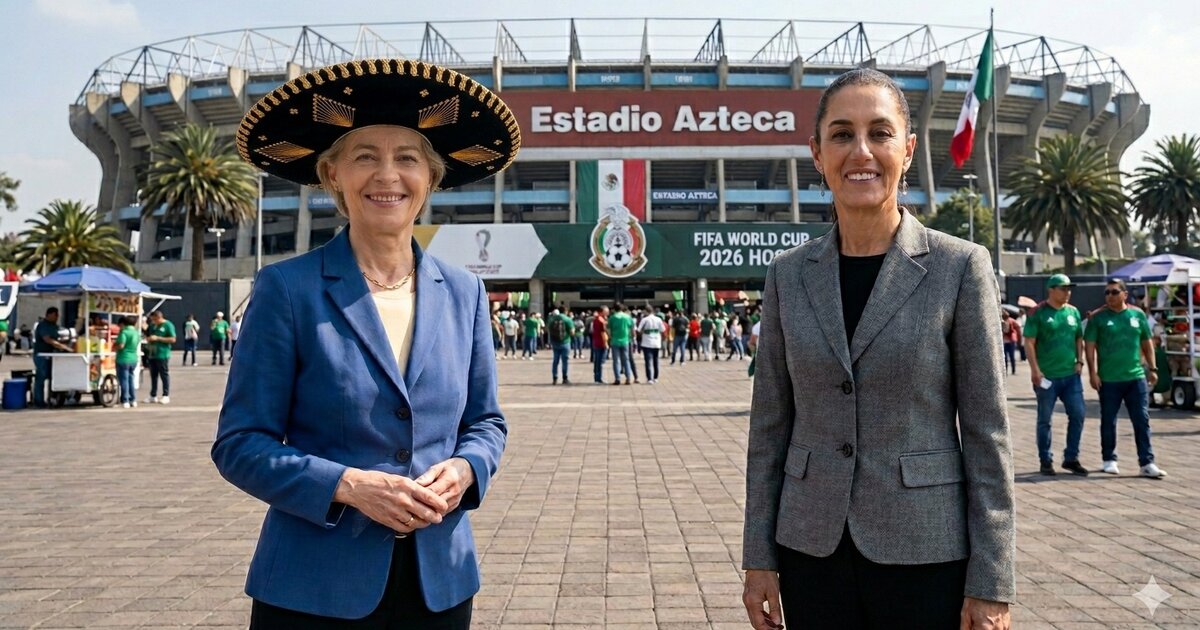
When Claudia Sheinbaum and Ursula von der Leyen stood together in Mexico City in late May to sign the Modernized Global Agreement between Mexico and the European Union, the symbolism was unmistakable.
More than diplomatic signaling?
Two of the world’s most powerful female leaders were formalizing a strategic partnership at a moment when geopolitical uncertainty, economic fragmentation and especially trouble-laden relations with an imperially acting U.S. administration are forcing governments the world over to rethink their alliances.
Yet symbolism should not be mistaken for substance. So far, we know very little about whether the agreement will achieve its stated objectives or who will ultimately benefit from it.
Questions abound: How will its commitments be implemented and enforced? To what extent do the political records of Sheinbaum and von der Leyen support the ambitious values contained in the text of the Modernized Global Agreement?
Two careers, one technocratic promise
Claudia Sheinbaum is an environmental engineer and the first woman and first Jewish person to be elected president of Mexico. Before entering politics, she established herself as a respected academic, earning a doctorate in energy engineering from the National Autonomous University of Mexico.
Her scientific credentials have become central to her political identity. Known as “la Doctora,” she presents herself as a leader guided by evidence, expertise and rational problem‑solving.
Still beholden to her predecessor
Yet the image of the scientist‑president sits uneasily alongside aspects of her political record. As mayor of Mexico City and later as president, Sheinbaum has often demonstrated loyalty to the political project of her predecessor, Andrés Manuel López Obrador.
She did so even when the project in question was criticized for weakening institutional checks and balances, concentrating power in the executive and privileging political considerations over technical evidence.
While Sheinbaum’s supporters portray her as a pragmatic modernizer, her presidency represents less a departure from López Obrador’s populism than its technocratic refinement of his approach to politics.
She leads a government that speaks the language of science while pursuing many of the her predecessor’s centralizing political objectives.
Von der Leyen’s Brussels power project
Ursula von der Leyen’s trajectory differs substantially. Born in Brussels and trained as a physician, she entered politics after a professional career in medicine and rose through the ranks of the German federal government under Angela Merkel.
After ministerial roles in Family Affairs, Labor and Defense, she became the first woman President of the European Commission in 2019 and secured a second term in 2024. She is often portrayed as a defender of liberal democracy, European integration and multilateral cooperation.
A president in Brussels…
Yet her leadership has also generated criticism. Detractors point to increasing presidentialization within the European Commission, which includes a notable tendency to centralize decision‑making around a small circle of advisers.
Critics argue that under von der Leyen, the European Commission has become more political, more strategic and at times less accountable than the technocratic institution it claims to be.
Lots of similarities between the two?
Even so, the similarities between the two leaders are therefore less straightforward than they initially appear. Both Sheinbaum and von der Leyen cultivate an image of competence, expertise and evidence‑based governance at a moment when many democracies are experiencing growing distrust of institutions.
Yet in both cases, the language of technocracy can obscure the inherently political nature of the decisions they take.
Technocratic resumes can double as political armor, inviting voters to trust a leader’s expertise even as he or she sidesteps traditional checks.
Technocratic expertise as political capital
Expertise provides legitimacy, to be sure, but it does not eliminate ideology, nor does it guarantee democratic accountability.
In Sheinbaum’s case, scientific credentials have frequently been invoked as evidence of good governance, as if to wipe away persistent concerns over security, judicial independence and institutional concentration.
In von der Leyen’s case, the rhetoric of European values and rules‑based governance has not prevented questions about transparency, executive power, and democratic oversight.
What ultimately links the two women is that they illustrate a broader lesson of contemporary politics – using technocracy as one of the most effective ways of exercising it.
If a leader positions expertise as neutral, the contesting of decisions starts to look irrational, which quietly attempts to move real political conflict out of view and out of reach.
A deal born of pressure, not goodwill
The Modernized Global Agreement reflects a specific geopolitical configuration. Mexico sends roughly 80 percent of its exports to the United States and is renegotiating its existing USMCA under considerable pressure.
The EU has watched the transatlantic relationship shift markedly since the return of Donald Trump to the White House, with Washington imposing tariffs at liberty and undermining the multilateral frameworks that European trade strategy depends on.
Seeking options beyond Trump
The EU-Mexico deal reflects efforts on both sides to reduce their dependence on the United States and on China, for which Mexico has become a significant hub for electric‑vehicle production.
Viewed from Mexico City, the EU partnership has never looked more strategically necessary. Deepening ties with Brussels is one of the clearest available levers to diversify export markets and reduce the structural vulnerability of having a single dominant trading partner.
For von der Leyen, Mexico is a key gateway to deepen the EU’s realignment with Latin America that the EU has been working to consolidate for some time.
Trade architecture as governance
EU–Mexico trade was valued at over €86 billion in 2025, with the EU as Mexico’s third‑largest trading partner and second‑largest export market.
The new agreement expands the original accord, which covered only industrial goods, to include services, government procurement, digital trade, and investment. It also contains enforceable commitments on climate, intellectual property and circular‑economy principles.
About more than commerce
The Modernized Global Agreement between Mexico and the EU is a governance document as much as a commercial one. That dual character is crucial for both sides.
Governance provisions create new arenas for regulatory convergence and they also entrench certain policy preferences in binding international commitments.
This mechanism also shifts key decisions away from domestic legislatures into joint committees, dispute‑settlement panels and transnational regulatory dialogues.
Gender a focus in the headlines, but how much in reality?
The narrative of having two women leaders in von der Leyen and Sheinbaum shaping a more inclusive trade agenda surely makes for compelling symbolism. But it is also a convenient distraction from a more important question: what, exactly, changes as a result?
True, the agreement includes commitments on gender equality, monitoring mechanisms and support for women’s economic participation. Yet such provisions have become standard features of modern trade agreements, while evidence of their transformative impact remains limited.
Meanwhile, in Mexico, femicide, informal employment, unpaid care burdens and unequal access to economic opportunities remain deeply entrenched.
Caution is warranted
These are structural problems that trade agreements are poorly equipped to solve. The presence of gender chapters and declarations does not automatically translate into greater security, higher incomes or expanded opportunities for the women most affected by these inequalities.
While von der Leyen has championed gender equality as a European value, significant disparities persist across the European Union and the European Commission’s lofty rhetoric has often outpaced results.
The real test is not whether two women signed an agreement containing gender provisions. It is whether the monitoring mechanisms prove independent, whether civil society can genuinely hold governments to account and whether either side is willing to enforce these commitments when doing so becomes politically inconvenient.
Until then, the symbolism deserves far less attention than the implementation.
The hard road to ratification
The agreement still faces ratification on both sides, and the history of trade deals delayed, weakened or reshaped during that process is extensive.
However, signing ceremonies generate headlines. Actual implementation is where trade agreements especially receive their first real-world test.
Conclusion
The EU-Mexico summit was presented as a reaffirmation of shared values, institutional cooperation and reliance on evidence‑based policymaking.
Yet neither the rhetoric nor any symbolism guarantees the intended positive outcomes. While it may help that both leaders have cultivated reputations for competence and technocratic governance, both also operate within political systems where narrower interests routinely outweigh broadly stated principles.
The hope is that, years from now, the commitments now made will survive political realities and produce tangible results for the people they claim to serve.
Takeaways
The EU-Mexico deal reflects efforts on both sides to reduce their dependence on the United States and on China.
Viewed from Mexico City, the EU partnership has never looked more strategically necessary. It is the clearest available lever to reduce the structural vulnerability of having a single dominant trading partner.
Both Sheinbaum and von der Leyen cultivate an image of competence, expertise and evidence‑based governance at a moment when many democracies are experiencing growing distrust of institutions.
Von der Leyen’s rhetoric of European values and rules‑based governance has not prevented questions about transparency, executive power, and democratic oversight.
Sheinbaum’s scientific credentials have frequently been invoked as evidence of good governance, as if to wipe away persistent concerns over security, judicial independence and institutional concentration.
If a leader positions expertise as neutral, the contesting of decisions starts to look irrational, which quietly attempts to move real political conflict out of view and out of reach.
Note to journalists: You may quote from this text, provided you mention the name of the author and reference it as a new Strategic Intervention Paper (SIP) published by the Global Ideas Center in Berlin on The Globalist.