
What Orban’s Defeat Tells Us About Erdogan’s Future
The Hungarian opposition lost in 2022 not because it was not sufficiently united. It won in 2026 because Orban’s economic base had finally cracked.
April 29, 2026

Note to journalists: You may quote from this text, provided you mention the name of the author and reference it as a new Strategic Intervention Paper (SIP) published by the Global Ideas Center in Berlin on The Globalist.

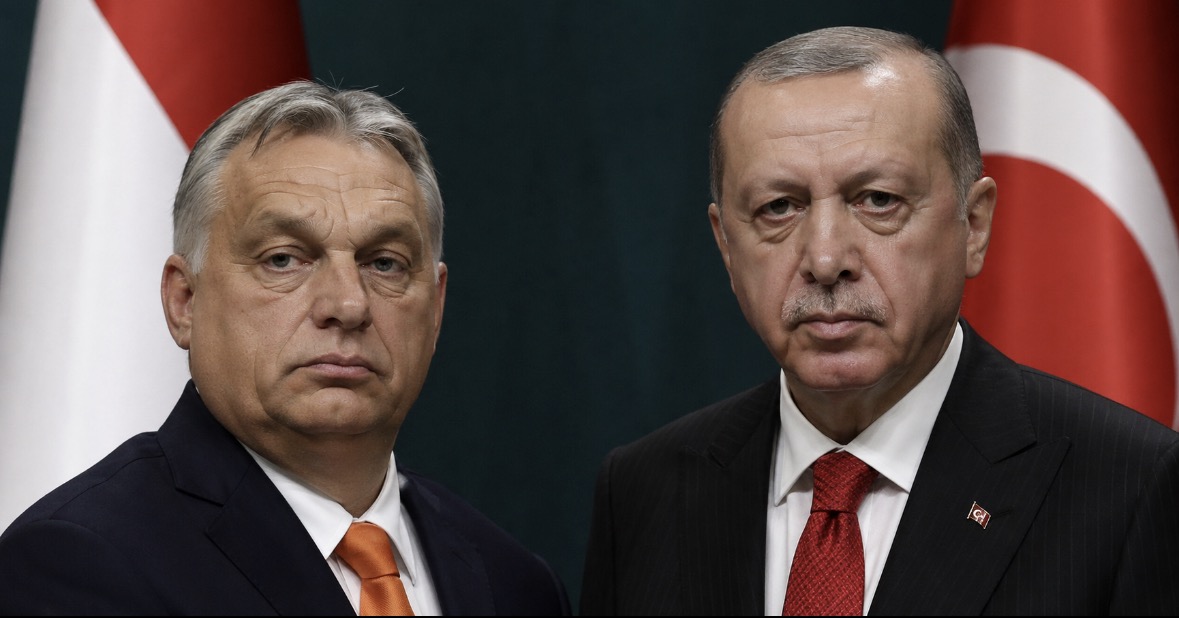
Many celebrated Hungary’s strongman Vikt Orbán’s fall via electoral defeat at the beginning of April. What does his fall possibly portend for his fellow autocrat Recep Tayyib Erdogan’s political future in Turkey?
Two cases of competitive authoritarianism
After all, the authoritarian styles of Orbán and Erdoğan have been likened for quite some time. Even though Orbán is an Islamophobe and Erdoğan a proud Muslim, they seem to get along well for the exact reason that they epitomize authoritarian populism.
Little wonder then that Orban’s defeat has been part of a lively debate in Turkey’s media.
The lens of the Turkish media
The pro-government media, filled with sycophants who claim to be good Muslims, have been largely silent on Orbán’s fall. They are silent because they fear that Orbán’s fall means that Erdoğan could also go, and that the crony system he established would crumble.
Other commentators note that Viktor Orbán was not unseated by the left, but by a conservative challenger. Indeed, Peter Magyar had belonged to Orbán’s inner circle until their break.
How did Magyar manage to shed the burden of that association and present himself anew to the electorate? The answer is obviously rife with speculation.
Sensing the inevitability of one’s own decline?
Smart leaders who sense the inevitability of their own decline, the implication goes, may quietly want to facilitate transition.
Magyar belonged to Orbán’s inner circle until 2024 and broke with it on substance – over a child abuse pardon scandal, over Orban’s family-and-friends focused style of managing the national economy, as well as over the direction of Hungary’s relationship with Europe.
In the Turkish context, there is an apt parallel. At some point during his rein, Atatürk, modern Turkey’s founder, recognized shifting political conditions and he prepared the ground for political change rather than resisting it outright.
Adapted to contemporary Turkey, this would suggest that both former pillars of the AKP, such as Ali Babacan, the former economic czar, or Ahmet Davutoğlu, a former prime minister, could emerge as credible challengers.
What unites these readings is a quiet conviction that the Hungarian result was a transfer of personnel rather than a rupture in a system.
The Orban regime’s architecture is left intact in this telling. Only the face on top has changed, and the lesson for Turkey is reduced to a casting question: Which member of the old inner circle might credibly play the role of Peter Magyar?
This line of thinking undoubtedly flatters Erdoğan because it leaves his approach to Turkey’s political economy and his ideological project untouched. It also serves the interests of the AKP by suggesting that all it needs to do is prepare the transition to another politician with a conservative vision without having to concede that the vision itself has failed.
But is that interpretation of the Hungarian election result more or less as a well-crafted handover correct?
Orbán and Erdoğan’s ideology
To a considerable extent, the answer to this question rests on whether or not Orbán and Erdoğan actually share an ideology. And if so, is it one we can usefully call right-wing?
Across much of the democratic world, a right-wing ideology today tends to rest on three core elements: First, a determined defense of national sovereignty against supranational and cosmopolitan claims. Second, a traditionalist account of family and cultural order against liberal pluralism. And third, the pursuit of a market economy that is treated as the natural expression of freedom.
But there is one dimension in which both Orban’s and Erdogan’s regimes go well beyond that model. Both assume that the national majority is not a matter depending on election results, but the consequence of an permanent ethno-religious base whose authentic voice is the leader.
This concept is then made operational by relying on pure majoritarianism. The leading party that is in line with the preferred and pre-assumed ethno-religious base cannot be checked by a constitution, the courts, central banks, never mind the media. All of these institutions solely exist to serve that majoritarian ethno-religious will rather than constrain it.
Where Magyar’s Hungary departs from the Erdogan/AKP playbook
What Magyar’s Tisza platform proposes to remove is this effectively autocratic foundation. He accordingly plans to restore the rule of law, reinstate EU-aligned constitutionalism, reintroduce media pluralism and base political majorities on a truthful rendition by an untainted count of electoral votes.
In short, a great deal is bound to change in Hungary. But it does not just apply to its completely revised governance model.
A governance problem, or the failure of a national economic model?
It would be short-sighted, however, to assume that Hungary’s path to recovery is merely a matter of fixing its governance problem. The much bigger question is whether the end of Orban also reflects the failure of the country’s national economic model.
And this is precisely where matters become relevant with regard to a post-Erdogan future for Turkey.
Let’s consider the evidence. Both countries, whether under Orban or Erdogan, depended on foreign investment to finance big projects at the same time as the two leaders promised complete national sovereignty.
That was ultimately mostly a rhetorical act, since investments provided by foreign sources was critical to finance each regime via construction rents and a central bank subordinated to the presidency.
What has caused Orban’s failure in Hungary – and will cause failure in Turkey – is therefore not simply corruption or leadership fatigue. It is the system itself.
Economic strategies closely shadowing one another
Both Hungary and Turkey relied on an approach that brought their respective central banks under political control, enabling interest rates to be cut when elections approached, regardless of inflationary cost.
Both built state investment funds, large pools of public capital outside normal budgetary scrutiny, deployed to rescue friendly firms and finance megaprojects when foreign credit tightened.
Both designated national champions in strategic sectors, construction, energy, banking, defense and telecoms. Both channeled state contracts, subsidized loans and regulatory advantage towards them, producing the patronage economy on which the regime rests.
Above all, both steered a construction boom directed from the presidency, using public housing authorities, infrastructure megaprojects and urban transformation to generate employment at scale, visible monuments the leader could inaugurate, as well as rents that were distributed to loyal contractors.
All of this was designed to keep the electoral coalition solvent when global conditions turned. Which worked, until it did not.
The deterioration in Hungary
Inflation peaked above 25%, the highest cumulative figure in the European Union since 2020. Household consumption per capita is the lowest in the EU. The economy has entered technical recession twice in two years.
The fertility allowances that were meant to anchor the Christian nationalist project failed on their own terms, with births falling back to where they stood before the policy began.
Why the Hungarian election result in 2026 differed from that in 2022
It is widely assumed that Hungary’s center-left coalition lost in 2022 because it was not sufficiently united, thus presenting openings inside the electoral coalition that Orban knew to exploit to his advantage.
The cohesion inside an opposition coalition certainly does play an important role. But is it the key determinant?
From an economic policy perspective, one could argue that the opposition to Orban did not lose in 2002 due to the fact that it was led by someone from well outside the Orban regime.
Instead, it stands to reason that the Hungarian opposition lost in 2022 because the country’s economic base had not yet cracked. Accordingly, Orban’s well-oiled (and well-funded) electoral machinery was still able to absorb discontent.
However, by 2026, Orban’s economic base had definitely cracked. Inflation had done its work on household spending over four years and even his very determined machinery could no longer hold him in power.
Magyar thus won because conditions changed, not because his past was acceptable to Fidesz voters.
His victory thus represents a structural rupture more than merely a personnel change.
The deterioration in Turkey
With all of that in mind, it is worth looking at the parallel’s in Turkey’s economic – and ultimately – political path.
Erdoğan’s regime was built on the same three legs as Orban’s: a patronage-based construction economy, a subordinated central bank and a politically mobilized (in his case Islamist) voter base.
The trajectory of the Turkish lira since 2018, the continuously high inflation level in Turkey that has eroded wages, the dependence on Gulf state money and now Chinese short-term capital, are not Erdoğan’s personal errors.
They are the inevitable consequences of what happens when an economic regime based on a very shallow base exhausts the conditions that made it possible.
The Imamoglu phenomenon
Just like Orban, Erdogan has arrived at the end of his economic “rainbow.” The level of economic dissatisfaction in the country is rising constantly.
The rise of Ekrem İmamoğlu, first in Istanbul and then nationally, has driven Erdogan to resort to extreme legal measures that are entirely driven by political considerations.
However, what the Imamoglu phenomenon has already shown, albeit at the municipal level so far, is that cracks along economic contradictions appear long before they appear along ideological ones.
A dynastic succession in Turkey?
The succession issue within the AKP is seen by many around Erdoğan as a dynastic question. Literally. Would it be one of the sons-in-law, or Bilal Erdoğan?
In recent time, other possible contenders such as İbrahim Kalın and Hakan Fidan have slipped down the list. Those who frame Erdoğan’s eventual departure as dynastic may have a point.
As CHP leader Özgür Özel once said, Erdoğan does not allow a popular candidate to survive politically, as İmamoğlu’s imprisonment vividly illustrates.
The electoral structure, the very uneven political playing field and gerrymandering tactics may be similar in Orbán’s Hungary and Erdoğan’s Turkey, but Erdoğan has gone further and simply jailed the main challenger.
The Erdogan model for Turkey is economically – and politically – exhausted
Still, even if a former AKP insider were to emerge as a future opposition figure, that would not vindicate the project they once helped build. It would rather confirm its exhaustion.
Atatürk’s example is a weak analogy here. It was a transition managed from above. What happened in Budapest was a shift under pressure from below, by voters who could no longer condone the arrangement.
Meanwhile, hardly anybody assumes that Erdoğan possesses anything like Atatürk’s sense of patriotic restraint or long-term vision.
Takeaways
Even though Orbán is an Islamophobe and Erdoğan a proud Muslim, they seemed to get along well because they both embrace authoritarian populism.
Smart leaders sense the inevitability of their own decline and may therefore quietly want to facilitate a political transition.
Hungary’s path to recovery is more than merely fixing its governance problem. The much bigger question is whether the end of Orban also reflects the failure of Hungary's national economic model.
it stands to reason that the Hungarian opposition lost in 2022 because the country’s economic base had not yet cracked. Accordingly, Orban’s well-oiled (and well-funded) electoral machinery was still able to absorb discontent.
by 2026, Orban’s economic base had definitely cracked. Inflation had done its work on household spending over four years and even his very determined machinery could no longer hold him in power.
Erdoğan’s regime was built on the same three legs as Orban’s: a patronage-based construction economy, a subordinated central bank and a politically mobilized (in his case Islamist) voter base.
Just like Orban, Erdogan has arrived at the end of his economic “rainbow.” The level of economic dissatisfaction in Turkey is rising constantly.
There are the inevitable consequences when an economic regime that is based on a very shallow base exhausts the economic conditions that made it possible.
In Turkey, hardly anybody assumes that Erdoğan possesses anything like Atatürk’s sense of patriotic restraint or long-term vision.
Note to journalists: You may quote from this text, provided you mention the name of the author and reference it as a new Strategic Intervention Paper (SIP) published by the Global Ideas Center in Berlin on The Globalist.
Read previous

Global Politics
Welcome to Trumpington
April 28, 2026