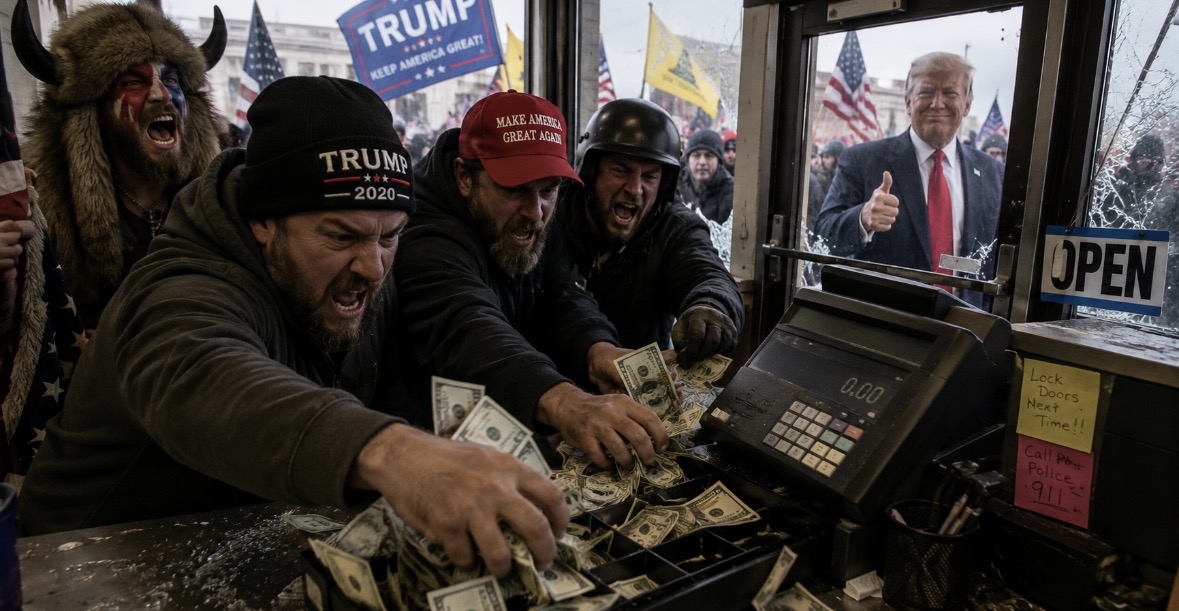
Debt Panics That Keep Wrecking the United States of America
The fear of government debt is one of the oldest “ideas” in American political life. But is that fear justified?
May 29, 2026

Note to journalists: You may quote from this text, provided you mention the name of the author and reference it as a new Strategic Intervention Paper (SIP) published by the Global Ideas Center in Berlin on The Globalist.

“Ideas of economists and political philosophers both when they are right and when they are wrong, are more powerful than is commonly understood. Indeed, The world is ruled by little else.
(John Maynard Keynes, The General Theory of Employment, Interest and Money, Concluding Notes, 1936)
Americans are again being warned that government debt is an economic danger that requires action. This warning is presented as hard-headed realism.
Is it hard-headed realism?
We are told that unless the U.S. federal government restrains spending, it invites inflation and financial collapse, burdens our children and grandchildren and crowds out private investment.
These warnings about debt and inflation, however, contradict much of American history.
For most of the country’s 250 years, the primary danger to the nation and its economy has not been inflation but the refusal to use public credit when private investment collapses, prices fall, workers and productive resources sit idle and urgent public needs go unmet.
One of the oldest political “ideas” in American life
The fear of government debt is one of the oldest political “ideas” in American life. It reaches all the way back to Alexander Hamilton and Thomas Jefferson and continued during the battles over Civil War Greenbacks (paper money) and gold.
The debate went on to the struggle between William McKinley and William Jennings Bryan, as well as shaping the conflict between Franklin Roosevelt and his opponents during the Great Depression and finally plays into the modern campaigns against deficits, social insurance and public investment.
Public debt = dangerous and private debt = virtuous?
The old idea is simple: Government debt is inherently dangerous, while private investment and spending are the virtuous engines of growth.
The historical record, however, tells us something different. The worst economic crises in American history have been driven by private-sector speculation, collapsing private debts, falling prices and the unwillingness of government to act boldly to avoid disaster.
Keynes’s lesson from the UK
John Maynard Keynes, the most important economist of the 19th and 20th centuries, understood this problem. In the 1920s, he urged Britain to spend to employ soldiers coming out of the bloody trenches of World War I.
Conventional wisdom called for the British government to return to the discipline of gold at its pre-war price. That is what the government of the United Kingdom tried to do. That response caused hundreds of thousands of survivors of the trenches to be unemployed for years.
In the 1930s, Keynes made a broader case that governments must invest and spend when private spending and investment fall short. This was a political and psychological argument as well as an economic one. Keynes was arguing against deeply held beliefs about gold, thrift, debt, economic morality and the proper role of government.
Old beliefs die hard
The old beliefs remain powerful today in the age of internet and AI. To be sure, inflation should not be ignored, but recent inflation has too often been attributed to excessive civilian spending and public debt.
In reality, the forces that have driven it actually are wars, energy shocks, supply disruptions,and the rapid recovery from the Covid shutdown.
The 1970s are a classic example. Inflation was driven in large part by oil shocks – not government overspending. Oil prices rose from roughly $2 a barrel in the early 1970s to about $12 after the first OPEC embargo and then, after the second oil shock, by 1980 to roughly $36. Energy is embedded in transportation, manufacturing, agriculture, heating, chemicals, plastics, and thousands of other prices.
Wars drive up inflation
Wars also generate inflationary pressure because they force economies to shift resources from civilian goods and services to military production.
In the case of the United States, that was true in the Revolutionary War, the War of 1812, the Civil War, World Wars I and II, and Korea. It is true today. The wars in Ukraine and the Middle East affect energy, grain, defense spending and supply chains.
Attacking public investment
Inflation matters of course, but fear of inflation and debt are repeatedly used to attack public investment and social insurance, obscuring its real causes.
Calls for “entitlement reform” similarly are often presented as fiscal realism. In political reality, they are pressure to reduce Medicare, Medicaid and Social Security payments.
Back to Hamilton vs. Jefferson
This is where the 1790s Hamilton-Jefferson argument still matters. Hamilton believed that public credit should be a tool of national development. He wanted a federal government capable of borrowing, investing, building and modernizing.
Hamilton also saw credit not as a sin but as a public instrument. It could finance lighthouses, roads, canals, armories, factories and other projects that private capital would not finance at sufficient speed or scale.
Some of Jefferson’s concerns were legitimate. He feared concentrated financial power. Debt can be abused. Financial institutions can become too powerful. Speculation can corrupt politics.
But Jefferson’s suspicion of public credit also fed a recurring American distrust of government spending, especially when that spending is used for civilian purposes.
The debate went on
The Hamilton-Jefferson debate did not end in the 1790s. It returned repeatedly. Andrew Jackson’s war on the Second Bank of the United States was carried out in the name of hostility to financial privilege.
But the destruction of the bank weakened the country’s financial structure and helped set the stage for the Panic of 1837 and years of falling prices, instability, bankruptcies and hardship.
The 19th century, despite amazing growth that was based on the country’s immense resources and dynamism, was not an age of stable markets and security.
An age of repeated panics
It was an age of repeated panics: 1819, 1837, 1857, 1873, 1893 and 1907. These crises were accompanied by falling prices and asset values. Deflation helped lenders and punished debtors. Borrowers like farmers, small businessmen, and workers were often terribly squeezed.
After the Civil War, the U.S. federal government set out to retire “Greenbacks” and restore gold convertibility. Farmers and other debtors resisted because they understood what scarce money meant. They had to repay debts in harder dollars while the prices for their crops and property were falling.
Political rebellions
The Greenback and Free Silver movements were not eruptions of ignorance. They were political rebellions against a monetary system that favored creditors over debtors.
When William Jennings Bryan warned that mankind should not be crucified on “a cross of gold,” he was giving dramatic language to economic reality. Hard and scarce money was not neutral. They redistributed power to the wealthy.
The Panic of 1907
The Panic of 1907 finally convinced powerful bankers that institutional reform was needed. J.P. Morgan and allied financiers helped stop the Panic, but a growing and modernizing nation could not rely indefinitely on private Wall Street rescue operations.
The Federal Reserve System, created by the Federal Reserve Act of 1913, was supposed to provide a more elastic currency and a lender of last resort.
That old fear of public action
Yet during the Great Depression, political leaders again held back because of the old fear of public action. Herbert Hoover and Treasury Secretary Andrew Mellon remained committed to balanced budgets and government austerity although private investment was collapsing.
Hundreds of banks failed, prices fell, asset values sank, unemployment soared and the burden of debt grew heavier because incomes and prices were falling.
The man who finally broke with the old ideas
President Franklin Roosevelt finally broke with the old ideas. His New Deal was experimental, uneven, and often hesitant. But Roosevelt abandoned the gold standard, expanded federal relief, used the Reconstruction Finance
Corporation more aggressively, supported farm prices, created local jobs and public works programs.
He also established Social Security, guaranteed bank deposits and accepted the need for large-scale federal action. Wall Street hated him.
The full power of public finance
Then World War II demonstrated the full power of public finance. The taboo against borrowing was lifted and the United States mobilized resources on a scale that previously had been politically impossible.
In that process, government debt rose dramatically. Taxes also rose. The U.S. built ships, tanks, planes, trucks, factories, ports, roads, laboratories, and training systems. With its allies it defeated fascism and Imperial Japan, supplied allies with arms and food, generated full employment, expanded industrial capacity, and created the broad middle class of the postwar decades. The wealthy prospered too.
Immense capacity to produce
Mobilization for war showed something essential: the United States had far more capacity to produce than orthodox budget thinking realized. Expansion was not limited by a fixed pot of money.
The limits had been political will, public organization and the willingness to use expanded federal credit to mobilize underutilized resources and labor.
For several decades, the New Deal and wartime experience reshaped economic thinking. Policymakers feared unemployment would return so they accepted a larger federal role in stabilizing demand, supporting growth and sustaining the middle class.
Returning from the underground…
But the old 18th century fear of government activism had only gone underground. The inflation of the 1970s gave monetarists and anti-government politicians another opportunity.
Milton Friedman and his followers persuaded many Americans that inflation, not unemployment or underinvestment, was the central economic danger. Ronald Reagan turned the argument into a political creed: government was not the solution. Government was the problem and taxes were anathema.
With debilitating consequences…
The revival of the old doctrine had debilitating consequences. It narrowed the range of acceptable public action.
It made civilian public investment suspect. It turned deficits and government spending into permanent political weapons, even when the deficits were the result of tax cuts, recessions, wars and private financial failures.
The old ideas took attention away from wages, employment, infrastructure, industrial capacity and social cohesion.
Relentless hawks
The mistake blossomed further after the financial crisis of 2008. That crisis was caused by private credit excess, mortgage speculation, financial engineering, weak supervision and reckless borrowing and lending.
Yet before recovery had fully taken hold, deficit hawks were back. The result was premature fiscal tightening, slower growth, damaged public services and political anger that still shapes American life.
Repeating the pattern
The debt panic of 2026 repeats the pattern. The United States faces major challenges: military pressure from Russia, China, and Iran; the need to invest in housing, defense, rebuild infrastructure, put more resources into science, technology, manufacturing, energy and the workforce.
There is also the need to raise incomes at middle and lower levels. After all, Americans have lived through decades in which too many of them have suffered from slow growth, insecurity and declining confidence in public institutions.
Using what the country has available
The central need is to utilize the vast resources that the United States has available. The danger is not inflation – it is what happens if government is discredited because it cannot act.
The deepest issue is the one Keynes identified in the 1930s: Ideas rule policy. Wrong ideas have survived for centuries because they feel morally satisfying.
The belief that public debt is a crucial danger has that “moral” quality, but only at first blush. This idea has led policymakers to tolerate unemployment and underemployment, deflation and unnecessary social conflict.
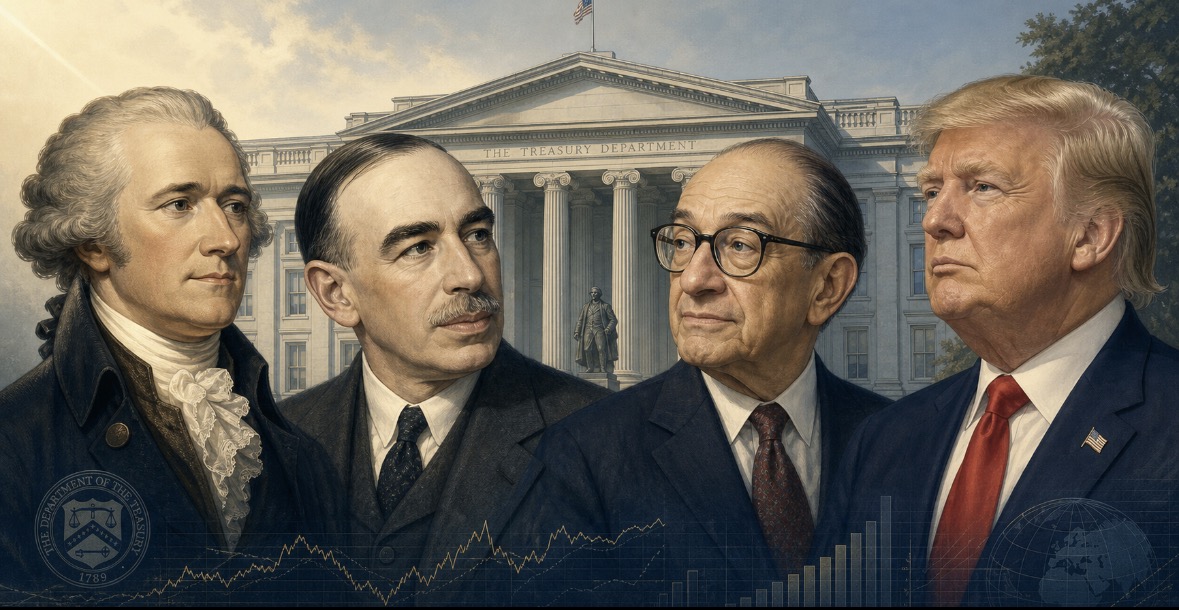
The Hamilton/Keynes axis
Hamilton’s answer was not reckless borrowing. Keynes’s answer was not unlimited spending. Their shared insight was that public credit is a governing instrument.
Used wisely, it allows a nation to do what private markets alone will not do, especially when strong action is needed.
Conclusion
The United States has a powerful military, productive capacity, scientific talent, natural resources, financial depth and human energy.
Looking forward, the very real danger for the United States is that exaggerated fears of public borrowing will prevent the country from using these resources.
An exaggerated and steadily “curated” fear of inflation is a profoundly wrong idea that has haunted U.S. economic policy for 250 years and is haunting it again.
Takeaways
We Americans are always told that unless the U.S. federal government restrains spending, it invites inflation and financial collapse, burdens our children and grandchildren and crowds out private investment.
For most of the country’s 250 years, the primary danger to the nation and its economy has the refusal to use public credit when urgent public needs go unmet.
The fear of government debt is one of the oldest political “ideas” in American life. It reaches all the way back to Alexander Hamilton and Thomas Jefferson.
Public debt = dangerous, but private debt = virtuous? The historical record tells us something different.
The debt panic of 2026 repeats the pattern. The United States faces major challenges: military pressure from Russia, China and Iran. Meanwhile, the need to invest in housing, defense, rebuild infrastructure and the workforce is clear-cut.
The central need is to utilize the vast resources that the United States has available. The danger is not inflation – it is what happens if government is discredited because it cannot act.
Hamilton’s answer was not reckless borrowing. Keynes’s answer was not unlimited spending. Their shared insight was that public credit is a governing instrument.
Note to journalists: You may quote from this text, provided you mention the name of the author and reference it as a new Strategic Intervention Paper (SIP) published by the Global Ideas Center in Berlin on The Globalist.